Tuesday, October 16, 2012

Unemployment in the UK 2012

UK Unemployment since 1979.

See updated post on UK Unemployment

Brief History of Unemployment in UK
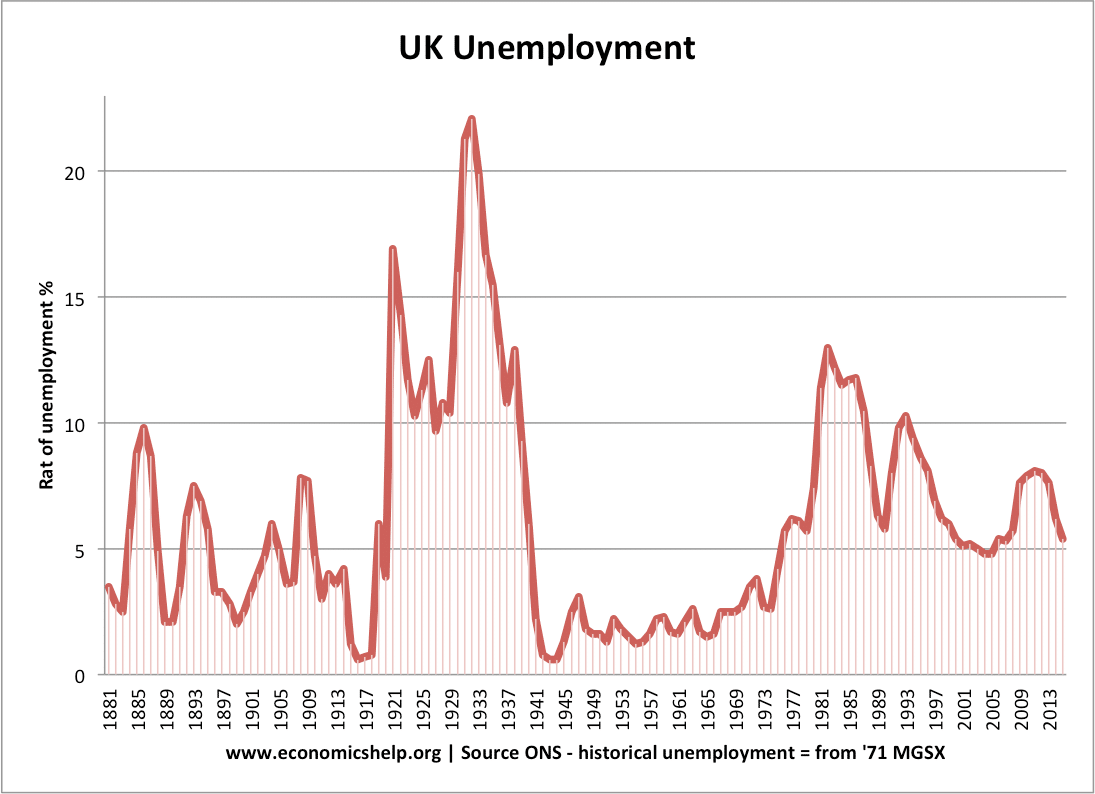
UK unemployment-1881-2015 UK unemployment 1881-2015. Source: ONS historical unemployment + ONS

After the ravages of the Great Depression era where unemployment was over 22%, unemployment in the UK remained relatively low from 1945 until the late 1970s. When Beveridge introduced the Welfare State in 1945, one thing he mentioned was the necessity of maintaining full employment. Using demand management policies and benefiting from a boom in global trade, the UK more or less achieved full employment, until the 1970s. In the 1970s, rising oil prices caused stagflation and unemployment began to rise but was still relatively low.

It was in the manufacturing recession of 1980-81 when unemployment rose to unprecedented levels. Not only did unemployment reach 3 million, but, it remained stubbornly high until 1986 well into the economic recovery. The huge rise in unemployment was due to the strong value of the Pound, high interest rates and the deflationary impact of strict monetarist policies. In particular, it was the manufacturing sector that suffered. Male full time, unskilled labour was particularly affected.

Unemployment remained high throughout the 1980s. Even at the peak of the boom in 1989, 1.6 million people were unemployed. This figure involved high rates of structural unemployment (also known as the natural rate of unemployment). This structural unemployment was because the recession of 1981 had made many unskilled workers unemployed. In the fast changing workplace, these former coal miners and ship builders struggled to get work in the new economy. Geographical unemployment was also a strong feature of the 1980s. Former areas of manufacturing and mining, struggled to cope with the large scale redundancies.

In 1991, unemployment rose again, as the economy slipped into another recession. Unemployment peaked in 1993 at just under 3 million. Unlike the 1980s, unemployment fell quicker. From the mid 1990s to 2008, UK unemployment was relatively low. Looking at official statistics, unemployment was fairly close to full employment at just over 3%.

Low unemployment was due to:

  • Long period of economic growth
  • Disguised unemployment, many unemployed were allowed to take sickness and disability benefits. Therefore, they are not counted as unemployed. See also: What is True Level of Unemployment?
  • The Labour Force survey has consistently been higher than the government record of people on Job seekers allowance. This reflects the fact it is very difficult to get benefits these days. Some unemployed are not eligible for benefits for a variety of reasons.
  • Regional Recovery. Former depressed areas like South Wales and the North East have been relatively successful in finding new industries to replace the old heavy manufacturing.
  • New Deal. Better education and training for the unemployed to get back to work.


This shows that unemployment is highly cyclical. When the economy goes into recession, unemployment typically has increased to 3 million. 

Unemployment during great recession.

Unemployment rose in the great depression, but was still lower than in previous recessions. For more on unemployment in this period see: the UK unemployment mystery.

    Other essays:

    Wednesday, October 3, 2012

    Factors that determine international competitiveness

    A look at factors affecting international competitiveness. International competitiveness is a measure of the relative cost of goods/services from a country. Countries which can produce the same quality of goods at a lower cost are said to be more competitive.

    1. Relative Inflation

    If the inflation rate is relatively lower than in other countries, then over time you become more competitive because your goods will be increasing at a slower rate. For example, in the post-war period, Japan and Germany had relatively lower inflation rates than major competitors, this helped them to become more competitive.


    This graph of relative inflation rates showed that during the period shown, inflation in Greece fell from close to 5% to below 2%. This suggests that Greece will have become slightly more competitive in this period.

    2. Productivity

    Productivity is a measure of output per input. The most common measure would be labour productivity. For example, with improved technology and education, a country can enjoy higher labour productivity and therefore produce goods at a lower cost. Higher labour productivity is the key to increasing competitiveness and living standards at the same time.

     
    German vs Italian labour productivity. During this period, Italian labour productivity growth has tended to lag behind Germany, leading to lower competitiveness of Italian exports.


    This shows labour productivity index for the UK and Germany. Between 1990 and 2005, Germany labour productivity increased 25 base points. UK labour productivity increased by 35 base points. Showing that the UK had faster improvements in labour productivity during this period.

    3. Exchange Rate

    Movements in the exchange rate will determine competitiveness. For example, a sharp depreciation will make exports cheaper and more competitive. An increase (appreciation) in the exchange rate, makes the foreign currency price more expensive.

    Often movements in the exchange rate reflect relative costs. For example, if a country has lower inflation, this will lead to an appreciation in the exchange rate, making exports relatively more expensive. Thus a floating exchange rate helps to maintain relative competitiveness levels.

    However, sometimes economies can artificially maintain a lower value of the exchange rate to maintain competitiveness. For example, China has been accused of exchange rate manipulation. China buys large quantities of US securities, this causes an increase in the value of the dollar and helps to keep the Yuan undervalued. Therefore, this helps Chinese exports to be more competitive and explains the large Chinese current account surplus

    Government has used supply-side policies to increase productivity. E.g. education and training.
    However, there is a limit to what the government can do to increase productivity. Increased productivity can be due to other factors.

    Competitiveness in the Euro

    In the Euro, countries have a permanently fixed exchange rate - they cannot devalue to restore competitiveness. Therefore divergences in labour costs and productivity will have a bigger impact on competitiveness than in a floating exchange rate.
    .
    eu - competitiveness
    Source: Krugman, How overvalued is southern Europe? link
    This shows inflation in Spain is higher than Euro area - leading to a decline in Spanish competitiveness.
    See: EU Competitiveness

    4. Tax Rates

    Tax rates on labour and corporations will be a factor in determining competitiveness. For example, higher labour taxes will increase the unit cost of labour faced by firms, leading to lower competitiveness.

    5. Cost of Doing Business

    It is argued that countries with more labour market regulations, and regulations about doing business will have higher costs and lower competitiveness. For example, the difficulty in gaining planning regulations to expand a factory.

    The World Bank produces a list of countries which are the 'easiest places to do business'. The criteria include factors such as flexibility of labour markets, degree of regulations, protection of private property.

     Top 10 ease of doing business

    1. Singapore
    2.  Hong Kong
    3.  New Zealand
    4. United States
    5.  Denmark
    6.  Norway
    7.  United Kingdom
    8.  South Korea
    9.  Iceland
    10.  Ireland

    6. Infrastructure

    A key factor in determining competitiveness is the cost of transport. For example, some argue the UK's competitiveness is undermined by bottlenecks in transport, such as limited airport capacity in London and traffic jams on major roads.

    7. Tariffs and non-tariff barriers

    A key factor is the cost of tariffs and non-tariff barriers. For example, after the UK leaves the Single market, if it has regulatory divergence, then British business may have higher costs as a result of differing standards.

    Related

    Tuesday, October 2, 2012

    Does a Current Account Deficit Matter?

    A current account deficit measures the balance of trade in:
    • Goods
    • Services
    • Net investment incomes and transfers
    A deficit on the current account means a country is importing more than we are exporting. This will have to be matched by a surplus on the financial and / or capital account.

    The financial account comprises of two main features:
    • Short Term Capital flows e.g. hot money flows and purchase of securities
    • Long Term Capital flows e.g. investment in building new factories
    A deficit on the current account will be matched by a surplus on the financial/capital account


    Some economists argue we need not worry about a current account deficit. This is because:
    1. If a current account deficit is financed from long term capital inflows then this can be beneficial for the economy. Inward investment can increase the productive capacity of the economy.
    2. In an era of globalisation it is much easier to attract sufficient capital flows to finance the deficit.
    3. If the deficit gets too large it will cause a devaluation which helps to reduce the deficit. Also when there is a slowdown in consumer spending the deficit will fall.
    4. A current account deficit provides an outlet for domestic demand and prevents inflation.

    Reasons to Worry about a Current Account Deficit

    1. There could be problems financing the deficit in the long term. A short term deficit is not a problem, but if you have a deficit of over 6% of GDP, then it is a problem if you rely on Capital flows. A significant part of the current account deficit in US is financed by Chinese investors buying US securities, at relatively low interest rates.
    2. Most countries would not be able to borrow such large amounts at low interest rates. The US currently can because the US is seen as the World’s reserve currency. However if attitudes to the US economy change and investors lose their confidence in the US economy, they will stop buying US debt. This will cause two problems.
    • US interest rates will need to rise to attract enough people to buy the debt. These higher interest rates will reduce demand in the economy. Higher interest rates will particularly hurt American consumers who have large amounts of debt at the moment.
    • If capital flows can’t be attracted, then the dollar will continue to devalue further. This could cause inflationary pressures, interest rates may need to rise to stabilise the dollar.
    Basically to correct the deficit would be a painful experience for the US economy and result in a slowdown or possibly recession

    3. In the US the current account deficit is to a large extent caused by excess spending in the economy. It is partly caused by government borrowing which increases Aggregate Demand in the economy and hence growing demand for imports. A large current account deficit is often a sign of an unbalanced economy. It could be a sign of structural weakness and an uncompetitive manufacturing sector. This is particularly a problem in the Eurozone where the exchange rates are permanently fixed.

    4. A deficit on the current account increases foreign liabilities. In the beginning, a current account deficit could be just a deficit on buying goods. However, over time, the deficit will be increased by the interest payments on the capital surplus. Foreigners invest in the US. On these investments, they receive interest payments or dividends. These dividends count as a debit on the current account. Therefore the longer the deficit goes on the higher the level of investment income debits will be accrued. This means that in the future the economy will need to attract capital flows just to pay off the investment income. As well as the deficit on goods and services.

    US current account deficit reached 6% of GDP in 2006. This reflected strong domestic demand and a decline in competitiveness. The credit crunch caused a reduction in US current account deficit.

    Example of Iceland's Current Account Deficit


    Iceland is an example of a country with a large current deficit which later imploded.
    In the years leading up to 2008, there was a sharp inflow of capital to Icelandic banks. This enabled Iceland to run a record current account deficit. Iceland was spending more than they were earning. When capital flows dried up, banks lost money and there was a rapid deterioration in the current account.

    Current Account Deficits in the Eurozone

    In the Eurozone, current account deficits are a bigger cause for concern because countries have a permanently fixed exchange rate (common currency). Therefore they can't devalue to restore competitiveness. Therefore countries may have to pursue internal devaluation (deflation) to restore competitiveness.

    Conclusion

    It depends on the size of the current account as a % of GDP. Clearly in Iceland's case, over 20% of GDP was unsustainable. But, in US case 6% of GDP later shrank to a more manageable 3% of GDP.
    A current account deficit is often a signal of another underlying problem. For example, a banking boom (in Iceland's case). A boom in domestic demand or a lack of competitiveness in Eurozone.

    See also:

    External links

    Friday, September 28, 2012

    Causes of Great Depression - Short

    The Great Depression was a period of unprecedented decline in economic activity. It is generally agreed to have occurred between 1929 and 1939. Although parts of the economy had begun to recover by 1936, high unemployment persisted until the Second World War.

    https://youtu.be/vQhk9hTwVaU 


    Causes of Great Dperession has been moved to updated version please visit! 

      Tuesday, September 11, 2012

      Austrian Economics Explained

      Austrian economics is a school of thought which places great emphasis on free markets, private property and absence of government intervention. Important Austrian economists include Carl Menger, Ludwig Van Mises, and Freidrich Hayek. Modern day supporters include congressman Ron Paul. Austrian economists oppose Keynesian economists on issues related to fiscal policy: see: Austrian debate.

      Main beliefs of Austrian School of Economics

      1. Laissez-faire economics. Proponents of Austrian school of Economics believe in free markets and avoiding government intervention in markets. They argue government intervention usually creates more problems than it solves. See: laissez-faire economics

      2. Recessions caused by credit cycles. They argue Central Banks encourage excessive growth of credit by keeping interest rates too low for too long. Some argue the credit bust of 2008 is a good example of Austrian economics theory in action. Ludwig Van Mises also predicted the depression of 1929. 

      3. Austrians criticise Keynesian fiscal policy. They argue government intervention to stimulate demand just leads to wasted resources, greater inefficiency and stores up more problems. I examined these arguments in detail here: - Hayek on Eurozone crisis and criticism 

      4. Support the Gold Standard. Austrian economists are critical of the use of fiat money which enables governments to devalue exchange rates and destroy savings through creating inflation. The gold standard means money would only be created if it can be converted into gold.

      5. Critical of Central Banks. Austrian economists are critical of Central banks and their ability to create inflation by printing money and the fractional reserve system.

      6. Rejection of statistical econometric models. Austrian economics emphasises the importance of logical deduction from people's behaviour and avoiding the use of statistics and empirical models. This sets them apart from related schools like Chicago and is one reason why they are not in the mainstream of economics.

      7. Civil Liberty Support of free markets and control of money supply essential for promoting civil liberty and social progress.

      Criticism of Austrian Economics

      1. The belief in the efficiency of markets is countered by many examples of market failure. E.g. growth of subprime mortgages / securitisation leading up to credit crisis of 2008
      2. High Tax and high spending regimes do not necessarily impinge on social freedoms. E.g. Many western European economies have high tax and high government spending. But, citizens get a comprehensive welfare state, education and health care. This compares favourably with US, where health care is expensive and piece meal.
      3. Controlling Money Supply is much more difficult in practise than theory suggests.
      4. Gold Standard can create severe economic problems such as the deflation and high unemployment suffered by UK in the 1920s.
      5. Models are too subjective and Vague.
      6. Keynesian critique that economies will recover without government intervention. Leaving it to market forces may take a very long time to move economy back to full capacity. Their policy prescriptions for the Great Depression are considered to be 'nihilistic' because they advocated no government intervention. They have also been criticised for shaping their political beliefs into economic policy.

      Books on Austrian Economics

      External Links

      Friday, August 31, 2012

      Top 10 Reasons for studying Economics

      Should I study Economics? Here are 10 absolutely foolproof reasons for studying economics.

      1. Economic Forecaster.

      As an economist, you can make a living from predicting future economic events. The key to being a good economic forecaster is to use a mixture of dice and lottery numbers. (some economists make the mistake of using just lottery numbers, but this can lead to really bad forecasting) If this method fails just use the statistics from the previous year; they are always more accurate than the actual predictions of economists.
      • Note: Economists have successfully predicted 10 out of the last 2 recessions.
      2. You can always give advice.

      When the economy enters a recession, you will be able to tell everybody why the economy is in a recession. Also, you will be able to suggest several conflicting reasons as to how we can get out of a recession. This will simultaneously, both confuse and impress everybody; but it doesn't matter because nobody ever listen to economists.

      3. Diminishing Returns.

      When you get ill from drinking 10 pints of beer in one night, you will be able to impress your parents with the knowledge that the law of diminishing returns is actually perfectly correct. As a side effect, you may also learn about opportunity cost:
      • Spending £40 on drink equals hangover.
      4. Rational Behaviour

      Economics assumes people are rational. Economics assumes that people choose the activity which optimises our utility. When people want to buy a season ticket to watch Leeds United, you can tell them this is irrational behaviour. However, the Leeds United supporter will definitely appreciate the cogency of your economic reasoning and will, more than likely, start supporting Doncaster Rovers with immediate effect.

      5. Economics is a very humorous subject

      Did you know that you can rearrange Economics to get "comic nose." If, this alone, was not sufficient proof of the hilarity endemic in the subject of Economics, try these economics jokes:
      • How many Free Market economists does it take to change a light bulb? None, in the long run, it will change of its own accord.
      • How many Marxists does it take to change a light bulb? None, smash the light bulb, a light bulb is a mere representation of the capitalist ideology that gives a feeble light, rather than the True source which is the sun.

      6. Economics gets you a high paid job

      Actually, this is the only reason people study economics. Unless, of course, you have a strange desire to be an economics teacher; in which case you will enjoy your students repeatedly asking you the question; "Why didn't you get a proper job in the city, Sir?"

      7. It's better than studying Geography

      True, but purists may argue this doesn't prove very much.

      8. Economies of Scale

      When you forget your wife's / girlfriends birthday you can say that you were merely seeking to maximise economies of scale and productive efficiency, because you are waiting to get her a really big present at Christmas. This always goes down very well.
      • (In the incredibly unlikely event it doesn't, don't forget to also check out: www.nofriendsandsingleconomist.com)
      9. However - On the Other Hand

      Economics is the only subject where contradicting yourself is seen as a highly desirable attribute. To double the mark on your economics essays, just say after each paragraph: however, on the other hand, this is probably not true at all...

      10. You will Know Why you are Unemployed

      When you are standing in the unemployment queue, you will be able to tell everyone the type of unemployment they are suffering from. This will greatly endear you to the ranks of the unemployed; who will definitely not, sarcastically, ask you;
      "If you know everything, how come you haven't got a job then?

      See also: 10 Principles of Economics Explained

      Applying economics in everyday life

      References:

      Tuesday, July 17, 2012

      UK Growth downgraded to 0.2%

      With the Olympics around the corner, there is hope that the UK may finally come out of the double dip recession this summer. However, the IMF have recently downgraded UK growth for 2012 to a miserly 0.2%, and the outlook still looks pretty grim. (By contrast the Office for Budget Responsibility, in March predicted 0.8 per cent growth for the UK over 2012, followed by 2 per cent in 2013.)


      latest-economic-growth


      A discussion of some of the different factors that have caused continued recession in the UK.
      1. Euro-crisis - uncertainty and recession in Eurozone affecting UK exports and investment levels in UK
      2. Bank Lending - Banks reluctance to lend to firms is stifling investment and economic recovery.
      3. Government spending cuts - Cuts in government spending have led to a fall in demand and also a subsequent fall in consumer spending.
      4. Global downturn. The UK is being affected by global economic slowdown. (though other parts of the world are still posting positive economic growth)
      5. Reduced real wages. Combination of real wage cuts and higher commodity inflation has squeezed disposable incomes in past few years.
      6. Weakness of housing market
      7. Low levels of UK consumer spending
      8. Government spending under Labour
      Have your say at:

      Government Spending Under Labour


      Government spending under labour rose from 36% of GDP to 46% by 2008-09  - how much is that to blame for the UK's current economic woes?

      Spanish CrisisUK growth may have been downgraded, but it is still possible to see how the UK can recover. Spain by contrast faces a real economic crisis, with seemingly no way out. Spain makes the UK look positively booming.


      What EURO Economic Crisis?

      A former chief German banker asks - is there really a crisis in the Eurozone? It's not just the UK where bankers can be out of touch. - What Euro crisis? Readers Questions

      Spanish Unemployment

      unemployment
      The remorseless rise in Spanish Unemployment

      Thursday, June 28, 2012

      Saving the Euro and Printing Money

      Does Germany actually benefit from the Euro?

      This is a question many people in Germany are asking (39% of Germans are no longer in favour of the Euro. In Germany the issue is often framed in terms of how much the bailouts will cost. But, another very important issue is the extent to which the German export sector have benefited from an undervaluation in their exports. If Germany left the Euro, the D-Mark would considerably appreciate, reducing the competitiveness of German exports - and helping to reduce the large German current account surplus.
      What Policies are needed to save the Euro?

      There are different approaches. Some frame the question as either debt pooling (fiscal union) or printing money to buy bonds and prevent rising bond yields) To save the Euro, there needs to be a combination of some or all of the following:
      1. Joint liability of European debt. Eurobonds where debt is pooled.
      2. Direct recapitalisation of European banks
      3. Printing Money to buy bonds and provide liquidity for governments facing liquidity crisis.
      4. Economic growth to give countries a chance to improve tax revenues and reduce debt / GDP ratios
      5. Restoring competitiveness amongst peripheral Eurozone countries who are struggling in the fixed exchange rate of the Euro.
      6. Structural reform / supply side policies which improves tax collection and improves productivity and competitiveness.
       To Print or Not to Print?

      The big question for Central Banks is should they be printing money, and if so how much?
      Would it help to if Italians and Greeks bought Italian and Greek Bonds?

      The Recession and Trend Rate of Growth

      trend-rate

      Will the UK ever recover the lost output of this recession? Has the recession reduced the long-run trend rate? Is the economic downturn actually a supply side phenomenon?

      Readers Questions

      Debt as % of GDP in G7

        debtcrisis

        Saturday, June 2, 2012

        Divergence in Bond Yields

         
        EU bond Yields

        The fall in UK and German bond yields almost mirrors the rise in Spanish and Italian bonds. I didn't put Greece on there because it's off the scale.

        There is a flight to safety. Does the UK deserve to be seen as safe?

        One thing is that it reduces the borrowing costs for UK and Germany very nicely. But, Spain and Italy are in a fix with  interest payments taking up a higher % of their tax revenues making it difficult to deal with underlying debt.

        One thing is certain, there is no single bond market in the Eurozone.

        Factors that influence bond yields.

        Eurobonds

        Wednesday, April 25, 2012

        1970s Revisited?

        I was watching the very good TV programme about the 1970s. 1973-74 was one of the most turbulent years in British economic history - a boom and bust, rapid inflation, strikes, a 3 day week, petrol rationing - even the first experiments with credit cards, leading to our first credit binge and later bust. There were few things the 1970s didn't have. (Economy of the 1970s)

        1970s 

        30 years later and there are some unwelcome parallels. Persistent stagflation (inflation + negative growth) Rising oil prices, a much more serious credit binge and consequent debt recovery.

        In some ways, things aren't as bad as the 1970s. Inflation of 3.5% is not comparable to the inflation of 20%. The current threat of a petrol blockade is pretty insignificant compared to the actual reality of a three day week. TV off at 10.30pm. Life was very different.

        But, at least, the 1970s didn't have such a persistent recession and mass unemployment.

        Double Dip Recession


        Figures published by ONS today, show that the UK is officially in a double dip recession. Some may wave the figures away saying it is only small fall - and it is just because of a big fall in construction. But, it is remarkable and worrying to see such a prolonged fall in GDP. (Bear in mind the UK's long run trend rate is 2.5%) But, GDP is still lower than in the 2008 peak. That's three years of falling living standards.

        More on double dip recession

        IMF Bailout

        The 1970s, was also a time when the UK needed its only IMF bailout (UK national debt was only around 75% of GDP). These days, the IMF have much bigger challenges than a relatively small debt of 75%. The big concern for the IMF is that even a firewall of £1 trillion does nothing to tackle the underlying problems of the Eurozone.
        Scottish Independence

        The discovery of oil in the north Sea during the 1970s, was a factor in contributing to the re-emergence of Scottish nationalism. Economics looks to be the decisive issue in swaying whether people will vote for independence.


        Saturday, April 21, 2012

        Recent Inflation Graph and blog posts

        I have been updating a different economics blog.

        What would a world without oil look like?

        Debt spirals explained - the situation facing many EU countries

        Why is current recession so severe?

        What is the long run trend rate of economic growth? - has it been reduced in UK since recession?

        inflation-latest
        Inflation in the UK remains relatively high given the state of the economy. Latest UK inflation

        Friday, March 2, 2012

        Europe's deflation 2012

        A predictable, but nevertheless depressing, event is to see Europe slipping into deflation.

        Monthly inflation in the EU area was -0.8% in January 2012. (EU Stat) The 12 month inflation figure was 2.6%, which includes some cost-push inflation. Inflation will continue to fall over the coming months However, there are few signs of economic recovery. Countries in the periphery of the EU are at greater risk of deflation because of the continued austerity, high exchange rate and fall in economic confidence. The ECB has been debating whether to pursue quantitative easing, but there is a deep-seated reluctance to pursue this unorthodox monetary policy.

        The problem is that even quantitative easing can take a long time to have an effect on economic activity. The experience of the UK and US is hard to judge, but it has had an effect in preventing a deeper and longer lasting recession. Any fears of inflation resulting from quantitative easing seem hard to justify as the economies struggle along.

        A short reminder of the timeline of the current economic crisis

        See: Causes of Europe's deflation

        How Will Deflation Affect the Eurozone?

        • Increase Debt to GDP ratios. Falling nominal GDP will increase the debt to GDP ratio. Even if countries like Greece and Portugal manage a primary budget surplus (which is very hard to imagine), they would still see rising debt to GDP ratios, and probably a continuation of higher bond yields
        • Decline in consumer Spending. Deflation plays a key role in delaying spending decisions. Faced with falling prices, people tend to delay spending, waiting for goods to become cheaper.
        • Higher real Interest Rates. With deflation, real interest rates are effectively higher. 
        • Higher unemployment. With continued deflation and lower growth, EU unemployment will remain high.
        • More on economic costs of deflation.

        Monday, February 27, 2012

        Boom and Bust Economic Cycles

        Definition of Boom and Bust: A period of rapid economic expansion which is unsustainable leading to subsequent period of economic contraction and recession.

        inflation


        The Great Moderation

        Was the great moderation a period of boom and bust?

         
        Inflation stayed low between 1992 and 2009. It wasn't a classic boom. Economic growth was positive, but it wasn't significantly higher than the long run trend rate. Inflation stayed low.

        However, although growth and inflation were stable in the 1990s and 2000s, there were still components of a boom and bust.

        Housing Boom and Bust

        In the late 1990s and early 2000s, there was a housing boom and bust. UK House prices rose much faster than inflation until Summer 2007, when the credit crunch completely changed the nature of the mortgage market. As mortgages were withdrawn, house prices started to fall. But, because mortgage affordability was stretched, people were not able to save the new size of deposits. Because prices had risen so much they had a long way to fall. The fall in house prices has played a crucial role in knocking consumer spending and consumer confidence. It has directly led to job losses in construction and estate agents.

        The boom and bust in housing is quite clear and has played a key role in the current bust.

        Unbalanced Economy A boom and bust suggests an unbalanced economy. In the growth years of 2000-08, there was a strong growth in consumer spending and consumer borrowing. This is reflected in the:
        In other words, the main cause of UK economic growth was consumer spending. The economic growth was not balanced throughout different sectors. Because saving rates are so low, it means that the UK is particularly sensitive to the rising living costs and tighter credit conditions.

        Lawson boom and bust of the 1980s.

        In the late 1980s economic growth increased to 5% a year in 1988 and 1989. This was far above the long run trend rate and this excessive growth caused inflation to rise to double figures. In response to the inflationary spiral, the government joined the ERM and increased interest rates. This reduced inflation, but, at the expense of switching the boom into a painful bust. House prices collapsed (not because of a financial crisis, but because interest rates were so high). Unemployment rose and the government dithered in stimulating the economy because it was pursuing an outdated target for sterling against the D-Mark. See Lawson boom
        Implications of Boom and Bust.

        The UK did have its longest period of economic expansion on record - 1992-2008. In part this was due to avoiding a boom and bust cycles which have been frequent in the post-war period. However, you could say there was a boom and bust cycle in financial markets. Lending rose rapidly, but this later proved unsustainable.

        This recent crisis, raises the importance of looking beyond headline inflation and economic growth statistics. Low inflation is not the only factor we need to look at. It is a mistake to ignore house prices bank lending and other indicators of economic / financial volatility.
        There is also a danger of relying on consumer spending to fuel growth.
        There is also a danger of attracting hot money flows to finance a current account deficit. And there is a danger of allowing lending criteria to become so relaxed that any tightening creates economic problems. 

        Wednesday, February 15, 2012

        European Recession

        After the first European recession in 2009, the EU is heading back into another recession only three years later. But, this recession is much more worrying. There is less room for maneouvre, attempts to solve the debt crisis have failed, and have left countries with both low growth, but continuing debt problems.


        The cause of the second recession is depressingly simple.
        • Austerity policies really do cause a fall in aggregate demand, higher unemployment and lower economic growth
        • If you cut government spending, you need something else to boost demand in the economy. This could be devaluation, loose monetary policy, higher exports or stronger private sector demand and investment. 
        • However, Europe has only deflationary policies. There is no devaluation for southern economies, no loosening of monetary policy and with very low confidence, the private sector has not compensated for even minor spending cuts. 
        • The German economy is doing relatively well (though GDP still fell 0.2% in the last quarter). But, the German economy is helped by very strong export demand. Germany has a current account surplus of 6% of GDP. The problem is that some feel everyone should follow German's model of exports and high current account surplus. But, not everyone can have a current account surplus! 
        • The flipside of strong German exports is a current account deficit in Greece and Portugal of 10% of GDP. To help economic growth in Greece and Portugal, there needs to be a revaluation of trade within the EU - but that is very slow to occur with a single currency.
        • In a liquidity trap and period of very low private confidence, the private sector haven't taken the place of spending cuts. It is why Italy has gone into recession with GDP falling 0.7% in last three months of 2011, following 0.4% contraction in three months before.

        Austerity and Lower Tax Receipts

        Since Greece increased taxes, and cut spending, VAT receipts have fallen 18% in 201. Simply because 60,000 firms went out of business. This is an example of how austerity policies can be self-defeating in a recession. (Tragedy of Greece)

        Yet, Daniel Mitchell, of the libertarian-minded Cato Institute, argues that Europe has not been austere enough and that much more is needed. "European countries talk about austerity but they don't mean cuts," he says. (Guardian Link). At least the IMF are aware that there can be too much of a necessary thing. (IMF blog)

        Youth unemployment of 50% - just cut government spending a bit more. This is the logical policy of free market economics.

        Yet, despite all the austerity of Greece, Italy and Ireland, they have failed to solve the 'debt crisis'

        Depressed with the European economy, I had a look at the Indian economy in 2012 - at quite a different stage of the economic cycle. What India needs is to reduce its budget deficit and liberalise its complex bureaucracy. If India can lears anything from Europe - don't wait for an economic downturn to try and solve persistent budget deficits.

        Keynesian economics may support fiscal expansion during a recession, but in India's case, a very different approach is needed.

        Related

        Wednesday, February 8, 2012

        Outlook for Euro

        A look at some of the challenges facing the Eurozone and why the Euro is likely to remain weak over coming months.

        euro

        The Euro has been weak ever since the debt crisis began at the start of 2010.

        Challenges for the Euro

        1. Current Account Imbalances


        The single currency has created economic imbalances in the Eurozone.
        • Germany has a large current account surplus (almost 6%) - suggesting German exports are undervalued.
        • By contrast, Greece has a current account deficit of 11%.
        • Portugal has a current account deficit of over 7%.
        • In Q3, the UK had a deterioration in current account deficit to 4% of GDP (despite devaluation since 2009.
        • To restore competitiveness in Greece and Portugal without devaluation would require a prolonged period of deflation. This deflation would lead to lower growth and higher unemployment.

        2. Government Debt

        deficits

        Greece and Ireland have a high budget deficit. But, it also shows that the problems of the Euro are more than debt. Portugal and Spain have high bond yields - despite a relatively low budget deficit. Portugal and Spain have a budget deficit 50% less than similar deficits in the UK and US. Yet, US and UK don't have rising bond yields.

        3. Unemployment

        unemployment

        Unemployment rates in the Eurozone present a real threat to social stability - especially since unemployment is more concentrated amongst young workers.

        4. Low Economic Growth

        Growth forecasts for the Eurozone have been downgraded. For southern Europe, there will be a double dip recession, making it harder to reduce debt to GDP ratios and increasing unemployment. Unfortunately, it is hard to see a strategy for growth. There will be no loosening of monetary policy. The exchange rate will remain overvalued for the uncompetitive south. And at the same time, they have to reduce spending to tackle budget deficits. Combined with a European wide slowdown, it will be a slow and limited recovery.

        Related