Between 2006 and 2012, the US housing market saw significant falls in house prices, combined with record levels of mortgage defaults. Many economists and housing experts have suggested it is a bust that was inevitable to occur. This short article looks at why the US Housing Market went from boom to bust.
Why US Housing Market Declined 2006-12
1. House Prices Rose at Unprecedented Levels.
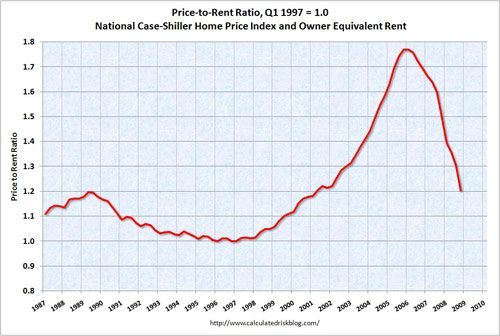
Historically US House prices have increased at a similar rate to rents, however, in the last period of the housing boom the ratio of House prices to rents had grew at a rate of 78%. (1)
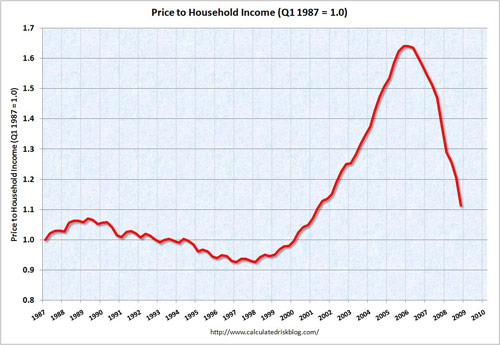
The ratio of House Prices to Income has also increased significantly from the long term average. In 1952 house prices relative to income was 100% in 2002 the ratio was 190%. (2) This increased to over 200% by the end of the housing boom.
The effect of rising house prices was that it was increasingly difficult for first time buyers and those on low incomes to buy a house. It also means that those with mortgages pay a higher % of their income in mortgage payments. This means they are more vulnerable to any changes in the housing market.
Ratio of House prices to Incomes in US source of graphs: Calculated Risk
Ratio of House Prices to Rent
2. Aggressive sale of Sub Prime Mortgages
Usually when house prices rise, demand moderates. However, in the case of the US housing market, mortgage lenders were desperate to maintain sales. Therefore they just found new ways to sell the more expensive houses.
In particular mortgage lenders did several things to maintain sales amongst those with poor credit, low income and higher risk see example of inappropriate selling of mortgages (3)
3. Increased Promotion of Discounted mortgages.
Basically, this means for the first year or two the homeowner gets an introductory interest rate, making mortgage payments cheaper and more affordable. However, after 2 years the interest rates jumped to the standard variable rate. Unfortunately because of the way mortgages were sold, these facts were not always made clear; meaning many households on low incomes took out mortgages they would later struggle to pay. This will become an increasing problem throughout 2007 as more mortgages end their introductory period.
4. Increased use of Variable Adjustable Mortgages.
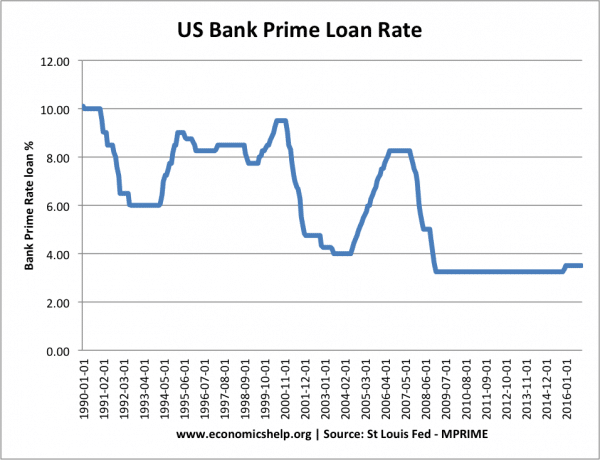
In 2002 interest rates were very low (1%) This made adjustable mortgages very attractive. Therefore more people could afford to get a mortgage. However, interest rates have since risen considerably since their historical low, significantly increasing the cost of mortgage payments. The rise in Adjustable mortgages is most prominent amongst low-income families. Fixed rate mortgages would have been safer, but mortgage companies have not been pushing these since they tend to look for best short-term chance of selling a mortgage. (The growth in ARMs between 200 0and 2004 accounted for about two-thirds of the relative increase in variable interest debt.) (4)
5. Rising Interest Rates
In 2002 because of weakness in other areas of the economy monetary policy was loosened. This was perhaps a good strategy regarding economic growth and inflation, however, it ignored the micro implications for the housing market. Low-interest rates were a real stimulus for those on low income and bad credit records to buy a house for the first time. However, between 2003 and 2006, interest rates were increased - significantly raising the cost of mortgage payments for homeowners. Just a 2% rise in interest rates can increase the cost of mortgage interest payments by 40% (5)
A combination of factors - rising interest rates, higher unemployment and subprime mortgage deals caused record levels of mortgage delinquency.
6. Speculation
Rising house prices did encourage an element of speculation in the US Housing Market. Estimates suggest 25% of house purchases in 2005 were influenced by speculation (5) The Housing market was providing greater returns than the stock market, therefore this encourages buy to let investors. As house prices start to fall this section of the market changes completely.
7. Excess Supply
The boom years encouraged an excess of new houses being built. The supply of housing now exceeds the demand, therefore the price of housing is likely to continue to fall (6)
The end of the 1950s was a period of rising living standards, summed up by Harold MacMillan's 'you've never had it so good'
Yet, this period of undoubted prosperity and rising living standards helped to mask a decline in the relative competitiveness of the UK economy.
Rising living standards of the 1960s
UK economic growth in the 1960s. There were brief dips in output, but these were not sustained.
In the 1960s, economic growth translated into rising living standards, with households able to purchase a greater range of 'white goods' and cars. There were new markets emerging, for example, teenagers had greater disposable income to spend on pop music, like the Beatles.
There was also a revolution in transport. At the start of the 1960s a majority of households did not have a private car, but relied on public transport. By the end of the 1960s, car ownership rates had risen from approx. 40% to 60% (RAC - car ownership rates) The first motorway was built in 1958, and throughout the 1960s there was a major road building programme - just as the railway network was severely cut back.
Compared to current prices, housing was also still cheap. Helped by a boom in post-war house building, owning a home was an affordable aspiration for both the middle class and working class. (Average house prices in 1969, £4,328). During the 1960s, home ownership rates increased.
Declining competitiveness
However, despite higher economic growth, the UK performed relatively poorly compared to our major competitors, such as Germany, Japan and US roared ahead UK productivity growth was relatively lower due to several factors. such as:
Lack of willingness / ability to innovate
Poor industrial relations with a growing number of days lost to strike action. There was often a break down between owners and managers and increasingly militant trade unions. Some argue this was exacerbated by Britain's class system. Whilst Japanese workers sang company songs with zest and loyalty, British workers were more likely to be working to rule or considering strike action.
Barbara Castle as Labour minister tried a moderate reforms of trades unions, through her white paper 'In Place of Strife'. However, the unions effectively lobbied Labour ministers and the reform bill was blocked.
Complacency. Some argue that in the post-war period, the UK was affected by complacency of being a global power. This complacency was in stark contrast to the defeated countries of Germany and Japan, who put greater energy into business. The UK was also hampered by coming to terms with letting go its Empire and trying to join Europe. In the 1960s, two applications to join the EEC were vetoed by the French.
Lack of public sector infrastructure. Burdened by high post-war debt, the UK struggled to invest in new transport and technologies. For example, the UK was still relying on steam trains until the mid 1960s - later than many other countries who made switch to cheaper and more efficient electricity and diesel.
Balance of Payments
In the 1960s, the trade deficit was seen as a vitally important economic statistic, with important politically considerations. Unfortunately, for the Harold Wilson government of the 1960s, the UK trade deficit was embarrassingly large - a result of the decline in competitiveness and a wish to retain a strong pound. Campaigns like 'Buy British' were surprisingly prominent, but, ultimately failed to make any real dent in the trade deficit. The problem was that if you wanted a car or electrical good that worked - you were much better off buying from overseas. If we made jokes about Skodas and Ladas in the 1980s, British Leyland was the butt of many jokes during 60s and 70s.
Despite the economic weaknesses of the 1960s, it was still an era of full employment and rising real wages. Compared to the rest of the Twentieth Century, the 1950s and 60s were a rare period of full employment. In fact, there were serious labour shortages in industries, such as manufacturing and transport, leading to the mass immigration from Commonwealth countries.
Inflation
Inflation in the UK in the 1960s
UK inflation in the 1960s was relatively benign. This was helped by low global inflation. However, towards the end of the 1960s, we start to see a rise in inflation. This rise in inflation was partly caused by devaluation, which tends to push up prices because imports are more expensive.
Devaluation of 1967
Throughout the 1960s, the government were committed to keeping the value of the Pound high. This led to relative high interest rates and intervention in foreign currency reserves. However, efforts to keep the Pound strong, ultimately failed, and in 19 Nov, 1967, the government were forced to devalue the Pound. The Pound was reduced from $2.80, to $2.40, a cut of 14%. It was considered a political embarrassment, though it was necessary given the declining competitiveness.Harold Wilson made a major announcement telling people:
"It does not mean that the pound here in Britain, in your pocket or purse or in your bank, has been devalued." (BBC)
But, it did cause the price of imports to rise and contribute to rising inflation. It was also hoped the devaluation would tackle
"Our decision to devalue attacks our problem at the root and that is why the international monetary community have rallied round."
However, although it proved a temporary boost in competitiveness. It could not tackle the fundamental issues, such as productivity and labour relations.
The experience did seem to sum up the 1960s. - not bad - but, could have done better - and we certainly weren't as good as everyone else.
National debt in 1960 106.7% of GDP - By 1970 this had fallen to 64.2% of GDP
After the Second World War, the UK was left with huge debts. National debt as a % of GDP exceeded 200% of GDP in the early 1950s. Britain was reliant on loans from the United States. Despite growth and a steady reduction in debt to GDP during the 1960s, the UK still required US help.
Undoubtedly, had it not been for the necessity of borrowing from the US, Harold Wilson would have been freer to be more critical of the Vietnam War - as he told his cabinet on why he would not criticise the war - 'You can't afford to kick your main creditor in the balls' - or words to that effect.
The 1970s
But, if the late 1960s were difficult, the 1970s proved to be one of the most difficult economic decades since the 1930s. It was an era of industrial confrontation, rampant inflation, an unexpected oil shock and an unwelcome return of mass unemployment. The economic power of the UK was exposed for what it had become.... ( - UK economy in 1970s )
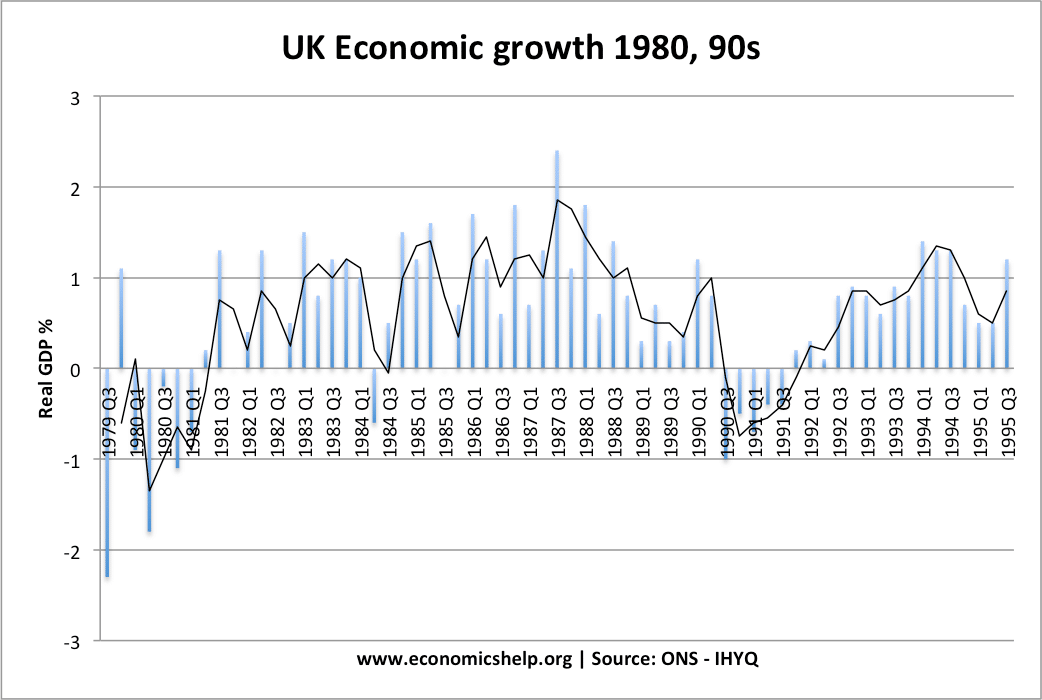
Between 1985 - 1988, UK economic growth was well above the long run trend rate of 2.5%. By 1990, inflation had increased to 9.5%.
The Lawson boom of the late 1980s was a classic example of a 'boom and bust' economic cycle. The late 1980s were a period of rapid economic expansion. This was caused by rising house prices, tax cuts, lower interest rates and high confidence.
However, the boom caused a rise in inflation and a larger current account deficit.
Policies to tackle this inflation caused the recession of 1991-92.
The Lawson boom followed from the recession of 1981. This recession particularly affected the manufacturing sector and caused unemployment to rise to 3 million. By 1985, unemployment was still over 2.5 million people. However, from 1986 the government made various decisions which helped to inflate the economy causing an inflationary boom. Economic growth in the 1980s
Causes of the Lawson Boom
Tax Cuts
In 1988, the chancellor Nigel Lawson reduced the basic rate of income tax from 29% to 25%. The higher rate of income tax was cut to 40%. The 1988 budget is often referred to as the 'giveaway budget'. The chancellor was helped by good revenues from North Sea oil.
The effect of these tax cuts was a fiscal stimulus which helped to increase disposable income and consumer confidence. This led to a rise in consumer spending and economic growth.
Over optimism
During the 1980s, the government felt that they had presided over an 'economic miracle'. They felt that the last recession had removed a lot of inefficient firms. They also felt that supply-side policies, such as privatisation, had been effective in increasing the productivity of the economy and therefore had increased the long run trend rate of growth. This belief encouraged the chancellor to believe the economy could grow at a much faster rate than previously. Therefore, when growth increased above 4%, they did little to slow down an overheating economy. They believed (or hoped) that the long run trend rate of economic growth had increased from 2.5% to 4%. As Nigel Lawson said in his budget speech 1988.
"In 1987 as a whole, output grew by getting on for 4½ per cent., rather more than the rate of inflation which averaged 4.2 per cent. At the same time, unemployment fell faster than in any other year since the war, in every region of the country, and more than in any other major nation.
The plain fact is that the British economy has been transformed. Prudent financial policies have given business and industry the confidence to expand, while supply side reforms have progressively removed the barriers to enterprise." (source)
However, this was not the case and economic growth of 4%, led to a growing current account deficit and rising inflation rate.
2. A reluctance to increase interest rates
In the 1980s, interest rates were set by the Chancellor (not the independent Bank of England, like now) In October 1987, there was a stock market crash. In one week 25% of the stock market value was wiped out. There was no obvious economic cause of this, but the government was worried about its macroeconomic implications. As a result interest rates were reduced, to avoid any downturn. As it happened the stock market crash had only a marginal macro-economic effect and the economy continued to grow at a rapid rate. But, the impact of that cut in interest rates in 1987 was to encourage the boom - and in particular the housing boom.
3. Exchange Rate Mechanism ERM
The ERM was another factor keeping interest rates lower than they should. Mrs Thatcher didn't want to join the ERM. However, the Chancellor Nigel Lawson wanted to follow an unofficial exchange rate of 3 DM to £1. This often proved to be a factor in preventing interest rates from rising. The Chancellor didn't want to increase interest rates because it would break the 'unofficial exchange rate.low interest' 4. The housing boom
The low-interest rates and the high consumer confidence sparked a housing boom. During the boom years, house prices rose by 300% (and more in places like London). Q4 1988 was the peak of the boom period with house prices rising over 30% at an annual rate. This boom in house prices caused a rise in household wealth and increased confidence. Equity withdrawal rose to record levels, which helped increase consumer spending.
Rising interest rates meant mortgage payments in the late 1980s took over 50% of disposable income.
By 1988 and 1989, the economy was growing at 5% a year (almost double the long run trend rate) Despite signs of overheating, the government were reluctant to react. Interest rates were increased, but not as quickly as they could have. Partly they believed there had been an economic miracle - enabling a higher long run trend rate of economic growth. But, also Nigel Lawson, didn't want higher interest rates to boost the value of the Pound above the 'unofficial exchange rate' he was following. This was a policy known as shadowing the D-Mark. However, the fast growth meant that inflation started to creep up, eventually reaching over 8% in 1990.
With inflation at 8%, interest rates were increased further, but this caused mortgage payments to increase and the confidence evaporated as many people found they couldn't afford the mortgage repayments.
Current account deficit
A widening current account deficit in the late 1980s was evidence of the economic boom. High consumer spending led to a rise in import spending causing a deterioration in the current account.
Higher growth led to a bigger current account deficit. In 1989, the current account was 4.9% of GDP - reflecting the fact the economy was overheating and consumers were buying from abroad; domestic suppliers could not meet the rising demand.
Unemployment in the 1980s
UK unemployment fell during the Lawson Boom(1985-89) But rose as interest rates were increased in 1990.
Conclusion
The 1980s was a missed opportunity and the recession of 1991 unnecessary. By the mid 1980s, the government had reduced inflation - through a deep recession. There had also been some supply side reforms which helped aspects of the economy. Privatisation and reform of trades unions did help increase productivity and efficiency. However, these improvements were nothing like enough to enable a 'supply side miracle'. The main lesson of the Lawson boom was that the government made a big mistake in allowing the economy grow too fast, leading to inflation and an unsustainable boom. The consequence of this boom, was a painful recession as belatedly the government tried to bring inflation down again.
Other notes on this period.
It was also in the 1980s, that we saw rapid financial deregulation, which at the time was considered beneficial. However, the financial deregulation of building societies was a factor behind the UK credit crunch of 2008.
The Lawson Boom also saw a period of widening inequality - helped by cuts to tax rates for high earners.
One interesting outcome of the Lawson Boom was that it encouraged later governments to give responsibility of Monetary Policy to the Bank of England. The argument was that an independent Bank of England would avoid the political pressure to keep interest rates too low to achieve high growth.
Several countries have recently implemented 'austerity packages' - attempts to reduce government spending and increase taxes, in an effort to reduce their budget deficit. It was hoped these austerity packages would 'restore confidence', improve countries fiscal position and enable long-term recovery.
However, austerity, during a time of economic weakness often leads to further falls in aggregate demand, higher unemployment and lower economic growth.
In some cases, austerity to reduce a budget deficit can be self-defeating, with sharp falls in real GDP, causing debt to GDP ratios to continue to rise.
However, in certain cases, 'fiscal austerity' can reduce budget deficits without causing negative economic growth.
Austerity in the 1930s
Main impact of austerity
Lower demand. A cut in government spending and higher taxes will lead to lower aggregate demand and lower economic growth. If there is a fall in output, firms will employ less workers leading to higher unemployment. Also, government spending cuts may involve making public sector workers redundant. In addition, media coverage of 'austerity measures' tend to reduce consumer and business confidence. Fears over job losses and expectations of lower growth will encourage consumers to save rather than spend . This will be a further drag on consumer spending and economic growth (See also: paradox of thrift). As a result of austerity measures in 2011, the OECD now forecast negative growth of -0.8% for the Eurozone in 2012.
Eurozone growth - hit by austerity post 2008.
Lower inflation. Spending cuts will tend to lead to lower inflation. Firstly, the fall in aggregate demand (AD) will lead to lower inflationary pressures in the economy. Also, if the government limits public sector wages, this will put downward pressure on wages. Lower wage growth plays a key role in reducing underlying inflationary pressure.
Competitiveness. It is hoped that austerity measures will help create greater pressure to reduce costs. These lower costs can help improve competitiveness. This is important for countries in the Euro, such as Ireland, Greece and Spain. In the boom years, they became uncompetitive leading to lower export demand and a current account deficit. Measures to deflate the economy should make exports more competitive. Ireland has been relatively successful in improving competitiveness, this is reflected in their move from a trade deficit to trade surplus. However, this attempt to improve competitiveness through lower inflation may take several years, and involve a high cost of lower growth and unemployment.
Ireland has been one of more 'successful' countries which has embarked on austerity, but this shows GNP is still significantly below pre-crisis levels (when real GNP was growing at an average rate of close to 5% a year)
Budget deficit. Higher taxes and lower spending will lead to an improvement in the government's budget deficit. This will help improve public finances in the long term.
However, if austerity measures cause lower economic growth, the government will also see a fall in cyclical tax revenues. e.g. increasing tax rates, should increase revenue. But, if higher taxes cause a recession, there will be less people working and so income tax revenue may actually fall. Also, if austerity measures cause unemployment, it will require higher government spending on benefits.
UK National debt as % of GDP, continued to rise despite austerity measures of 2010-12/
The UK's budget deficit fell slower than expected. This was partly because growth forecasts proved overly-optimistic. The austerity measures led to a slowdown in growth.
Distributional impacts
Austerity may not affect everyone in society equally. The biggest losers will be those who are made unemployed. Fiscal austerity will tend to hit the lowest paid the most because they will be most affected by stagnant wage growth. People in jobs with good long-term contracts may be insulated from downward wage pressures and growth in zero hour contracts.
What determines the impact of austerity?
Labour market flexibility. If labour markets are flexible, it may be easier to cut wages, and labour costs. This may make it easier to restore competitiveness and restore economic growth. However, if there is great resistance to lower labour costs, it will be much harder to restore competitiveness. But, labour market flexibility may lead to lower wages and worse working conditions. What spending is cut? If a government cuts spending by raising the retirement age to 70, then this will not lead to lower growth. In fact it could help increase labour supply and increase productivity. However, if the government cut spending on current infrastructure investment, this will have a much greater impact on reducing domestic demand and lead to lower economic growth.
Monetary policy. Austerity involves lower domestic demand. However, if monetary policy can be loosened (e.g. lower interest rates or increased money supply) then the deflationary effects of spending cuts can be offset. For example, in the Euro, countries like Greece have fiscal austerity, but there is no corresponding loosening of monetary policy (e.g. the ECB increased interest rates in early 2011 and didn't pursue any quantitative easing). By contrast, the UK has more flexibility because the Bank of England pursued quantitative easing.
There have been successful cases of fiscal austerity - where it has been accompanied by a corresponding fall in interest rates and/or devaluation in the exchange rate.
Exchange rate. Austerity is not as damaging if a country can devalue the exchange rate. This devaluation helps to restore competitiveness much quicker than relying on internal devaluation. The depreciation helps boost export demand. Countries in the Euro, can't devalue and so have to rely solely on internal devaluation to restore competitiveness. Global growth. Austerity is not as damaging if the rest of the world economy is doing well. If global growth is strong, export demand will be strong. However, if all countries are experiencing a recession, then deflationary fiscal policy will have a greater impact in reducing domestic demand. Central Bank intervention. Countries in the Euro, without a lender of last resort, are having to cut spending much quicker than countries outside the Euro. This is because bond yields on Euro debt has risen very quickly because markets fear liquidity shortages.
Rising Eurozone bond yields forced faster austerity. Though since 2012 the ECB has intervened more in bond markets giving countries a little more room for maneouvre
Governments have been borrowing for centuries. The figures for national debt are staggering. In the US, National debt is over $11 trillion. In the UK, debt is over £1.1 trillion. From a personal perspective, we are brought up to believe debt is a bad thing, and therefore it often feels worrying that national debt can be so large. But, how much should we worry about these levels of national debt?
One argument says that an increase in the national debt doesn't cause any problems. What happens is that by borrowing we merely enable the present taxpayer to enjoy a higher disposable income now rather than in the future. A cut in the national debt, would mean higher taxes now, rather than later. Therefore, national debt is just a way to spread national output amongst different generations. To understand national debt, it is important to remember how it is financed. Government debt is essentially a transfer from one part of the population to another. (Who owns national debt?)
Source:
Reinhart, Camen M. and Kenneth S. Rogoff, “From Financial Crash to Debt
Crisis,” NBER Working Paper 15795, March 2010. and OBR from 2010.Historical national debt
Furthermore, national debt has been much higher in the past. During the Second World War, the national debt of the UK and US, reached very high figures of over 150% of GDP. In the UK debt in the late 1940s reached over 200% of GDP. This is an example, of how a country can borrow during times of a national crisis and pay back the debt over a period of time. National debt can be an effective way to deal with economic shocks such as recessions, financial crisis and world wars.
It is worth bearing in mind that in the 1940s, as well as paying for post war reconstruction, the UK set up the NHS and welfare state. There was no austerity panic in the 1940s! The high government debt levels of the 1940s and 1950s were not a barrier to the post war boom years of the 1950s and 1960s which saw record levels of economic growth.
Therefore government debt is not necessarily a barrier to economic growth and prosperity. But, it is also important to point out that there is no guarantee that borrowing 150% of GDP will always lead to two decades of economic prosperity. The UK nearly went bankrupt in the late 1940s, and was saved by a loan from the US. see: Why could UK borrow so much in the 1940s, and could we do the same again?
Debt and budget surplus
It should also be remembered UK debt as a % of GDP fell from 200% of GDP to 40% of GDP (over a period of 40 years) - despite rarely having a budget surplus.
Growth and debt
Another factor is that economic growth usually makes it easier to pay back national debt. If GDP increases faster than national debt, then we need a smaller % of incomes to pay the debt interest payments. If GDP growth averages 2.5% a year, then increasing national debt by 2.5% means we will spend the same percentage of income on debt payments (assuming constant interest rates)
An analogy. When I took out a mortgage loan of £140,000, I was left with mortgage payments of £800 a month. In 2004, this was nearly 40% of my income. However, if my income increases by 3% a year. In 20 years time, it will be much easier to pay that mortgage payment of £800, it will hopefully be 15% of my income. To buy a house, it makes sense to borrow a mortgage and pay back over 30-40 years.
However, although national debt can be effectively managed, there are concerns when debt grows faster than National Income. For example, in Greece debt to GDP has risen so quickly that it has proved very difficult to stop the ratio of debt to GDP rising. (partly because spending cuts to reduce the deficit, caused lower GDP)
The fear for Eurozone economies, such as Italy, Portugal and Greece is not the levels of government borrowing, but the very poor prospects for economic growth. If the economy is stagnant, debt to GDP will continue to rise. If the economies were growing strongly, it would be much easier to reduce the debt to GDP ratio. (See also: Eurozone crisis)
Does higher borrowing cause higher bond yields?
As UK debt rose from 35% of GDP to 80% of GDP. Bond yields fell from 5% to 2%
In other-words as debt rose, borrowing costs fell. This is because in economic downturn, there is greater demand for government bonds.
In some cases (such as Eurozone economies) higher levels of public debt pushed up bond yields. Higher bond yields are damaging to the economy. It increases the cost of debt interest payments and is a reflection investors are nervous about the liquidity of government debt. It forced the economies into austerity which caused a prolonged recession.
However these countries with rising bond yields were in the Euro and did not have a Central Bank to buy bonds and ensure liquidity. In fact in 2012, the ECB took effective action to bring down bond yields (through unlimited purchases)
Countries with their own currency and Central Bank (e.g. UK and US) have the ability to purchase bonds and ensure liquidity. In the UK, the sharp rise in government debt between 2007 and 2012, led to a fall in bond yields. This shows that higher borrowing doesn't have to translate into higher bond yields.
UK Bond yields and UK borrowing
Why is there greater demand for government debt in a recession?
The UK has seen a fall in bond yields during the recession of 2008-12. This is because, in a recession, private sector saving rises. Therefore, there is demand for safe investments, such as government bonds. In a recession, people don't want to take risks, therefore demand for shares and private investment tends to fall. In a recession, government borrowing doesn't tend to cause crowding out. Government borrowing is merely mopping up private sector saving.
From a Keynesian perspective, government borrowing can help to boost aggregate demand and offset the fall in Aggregate Demand. In a recession, borrowing can provide a boost to economic growth and therefore, help improve tax revenues.
Possible reasons to be concerned about government borrowing
1. Structural deficit. If government borrowing reflects a fundamental dis-equilibirum between spending and tax revenue then this may lead to unsustainable debt levels in the future.
2. If borrowing is to finance welfare payments with an increased level of dependency. Paying pensions and health care to an ageing population, will do nothing to facilitate economic growth and improve tax revenues, and it will become more difficult to finance the national debt. Some are concerned that countries like Japan have a high debt (over 220% of GDP), but also a rapidly ageing population which will put even more pressure on Japanese debt levels.
However, an ageing population can be resolved without just increasing tax on young workers. The retirement age can be increase to keep the same% of population in workforce.
3. Inflationary Pressure. There is a concern that higher levels of national debt can cause inflation. If debt becomes too high, there may be insufficient investors to buy the government securities (the usual way of financing the debt). Therefore, the government may be tempted (or forced) to fill the shortfall in revenue by printing money. Printing money and increasing the money supply, will lead to inflation. The problem with inflation, is that it devalues the value of bonds, people will sell bonds, leading to higher interest rates on bonds and higher debt interest payments. If investors see inflation is getting out of control, people will not want to hold bonds. Foreign investors will sell their securities and this will cause a devaluation in the currency. This is particularly a problem for the US, where foreign countries hold a high % of the national debt.The hyperinflation of Germany in 1922-23 was caused by the government printing money to finance reparation payments to the allies.
However, it should be pointed out, this hyperinflation is quite rare and only occurs if the government prints money recklessly without regard to the fundamental economic situation. Quantitative easing in 2009-12 didn't cause inflation in the UK and US. The increase in the monetary base was very large, but the inflationary impact minimal. - Inflation and quantitative easing.
4. Crowding Out. It is argued that if government borrowing increases, it will cause crowding out of the private sector. If the private sector buy bonds it means the private sector has less funds for private sector investment. Also, if borrowing increases, interest rates may rise. Higher interest rates also reduce private sector spending and investment.
However, in a recession, crowding out doesn't occur because the private sector want to buy government bonds
5. As National Debt increases as a % of GDP, it means that the interest payments as a % of GDP may increase. Therefore, higher levels of taxes have to be spent on just financing the national debt.
However, this doesn't necessarily occur. The UK has seen fairly stable interest payments as a % of GDP, despite rising debt levels. In a recession, bond yields tend to fall, therefore it becomes cheaper to borrow. See debt interest payments
Conclusion - should we worry about government debt?
It depends when and why the government are borrowing. In a recession, with a fall in private sector demand, a rise in government borrowing is beneficial for maintaining aggregate demand in the economy. If private sector spending fell and we also tried to reduce government borrowing, we could see a precipitous fall in aggregate demand, and a deep recession. See: Austerity can be self-defeating.
If the government is borrowing to finance public sector investment, then this can lead to improved economic growth and better tax revenues in the future.
When should we worry about government debt?
If the government increases debt during a period of economic growth - the higher borrowing is likely to crowd out the private sector and lead to a decline in private sector investment.
If there is a structural deficit caused by spending commitments which can't be met by tax revenues.
If the government responds to higher debt by printing money; this can cause inflation. e.g. case of Zimbabwe, Germany 1920s. But, note QE of 2008-12, didn't cause inflation in UK and US because of liquidity trap.
An ageing population means the government needs to spend more (on pensions and health care) it will also receive lower income tax.
If the government does nothing it will experience a rise in the structural budget deficit. This has many problems
1) Resource crowding out. Government borrow from the private sector so private sector have less to spend and invest. Furthermore, the private sector is usually more efficient than government 2) Financial crowding out. To Borrow more money the government may need to increase interest rates, to make sure people buy enough debt. The problem is that this will put upward pressure on general interest rates and causes lower spending and growth in the economy.
3) Increase the national debt and annual interest payments. Italy already borrows over 100% of GDP. The effect is that a high % of GDP goes on servicing the debt, which will only increase over time.
4) It will require higher taxes or lower spending for future generations.
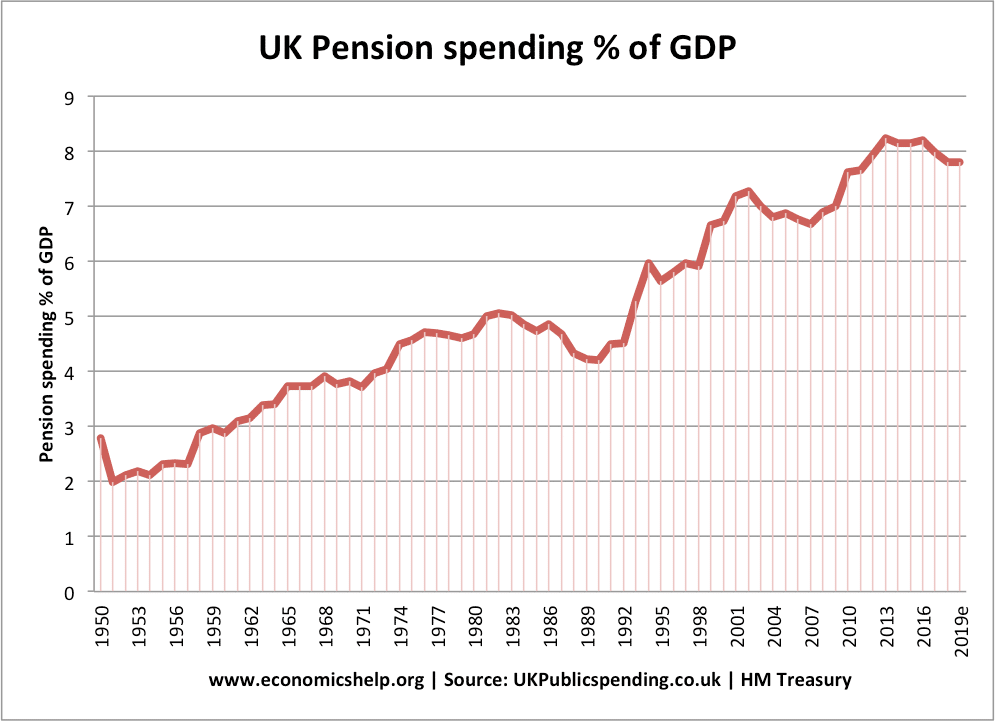
How UK Pension spending as a % of GDP has increased in recent decades.
Policies to deal with an Ageing Population
Option ONE Make people work longer.
This could involve increasing the retirement age from 65 to 70. From an economic point of view this is beneficial because it leads to more tax revenue (people will pay income tax for longer) and more consumer spending. Also, the government can delay paying pensions saving substantial funds. Also, increasing the retirement age increases the supply of labour; this could be a benefit in labour markets where there is a shortage of skilled (experienced) workers.
The main problem with this policy is that it will be highly unpopular, especially with people who are nearing retirement age. People may say the government is going back on its word to provide pensions at a certain age. In the UK, the government has pledged to increase the retirement age to 67, but this will not come in for a long time and therefore does not tackle the short-term debt.
Another problem with increasing the retirement age is that it will affect different types of workers differently. A manual labourer will find it difficult to keep working until 70. But, for an office worker, it will be easier. Also, many well-paid workers will be able to afford to take a private pension early.
Option TWO - Increase income tax
If the government increase income tax rates, they will increase tax revenue to pay for the higher pension bill. However, higher income tax may lead to lower work incentives. It may discourage people from living in a certain country. Because income tax is relatively low in the UK, a higher rate may not reduce incentives that much; however, there is a high opportunity cost of taxing for pensions. Pension spending does not increase productivity in the economy.
Option THREE - Means-tested pensions.
This means pensions are targeted just to those on low incomes, and those who do not have a private pension. This helps to reduce inequality and reduce the total cost of pensions.
However, it creates a very big incentive for people not to save and avoid getting a private pension. This is because if you did save, you would receive little from the government. Therefore, in the long run, it may make the situation worse
Option FOUR - Encourage private pensions
Governments could make it obligatory for firms to provide a private pension. Alternatively, they could give more generous tax breaks for private pensions. This is good for reducing the government's pension burden. The concern is that some people may not have sufficient private pension provision when they retire. Therefore, there is still a need for government provided means-tested pensions.
Option FIVE - Encourage immigration
Immigration of young workers helps to reduce the dependency ratio and leads to higher tax revenues as young immigrant workers pay income tax and VAT without being eligible for state pensions. However, net migration can be politically unpopular as it places stress on stock of housing and other social issues.
Evaluation - depends on economic growth
It is worth pointing out the impact of an ageing population also depends on the rate of economic growth. High economic growth enables more tax revenues, without increasing tax rates. In the post-war boom, we could afford a rising share of pension spending
After faltering for several years, the UK economy shows signs of real
recovery, with rising spending, investment, exports and even
manufacturing growth. At the start of 2014, there seems to be a virtuous
circle of falling unemployment, falling inflation, and rising GDP.
After
one of the longest and deepest recessions on record, these signs of
economic growth are definitely welcome, yet it is far from a return to
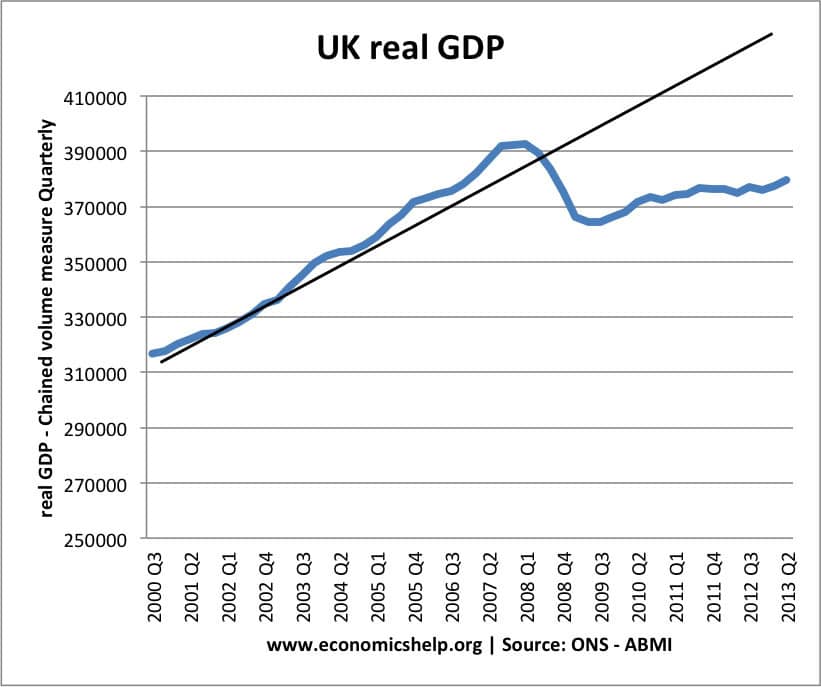
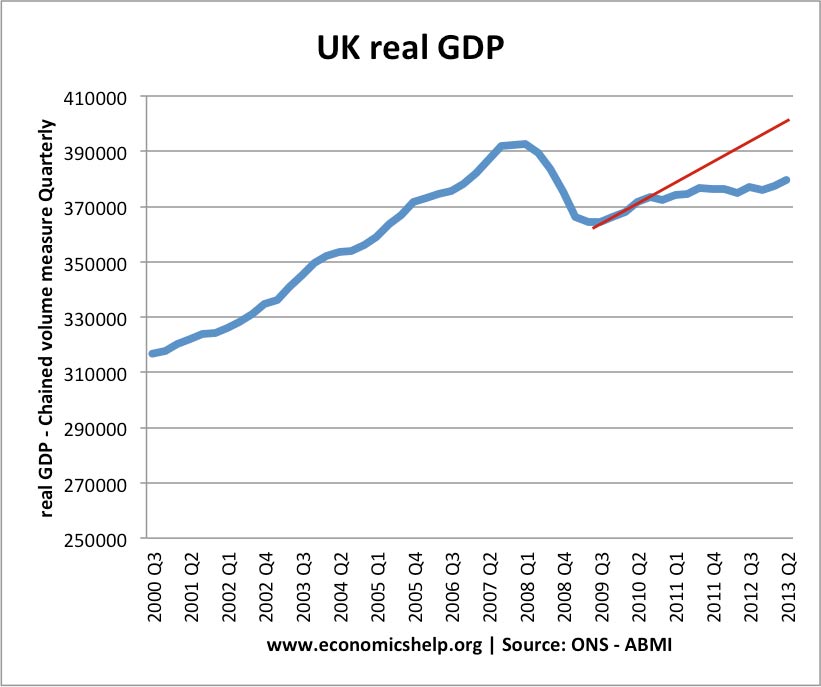
normality. Real GDP is still 2% below its 2008 peak, and the economy is
being propped up by zero interest rates, quantitative easing and a
strong housing market. Stagnant wages and poor productivity growth have
led to one of the most prolonged periods of declining living standards
in memory. Although there is economic recovery, there is still a fear
that the recovery is unbalanced, and that the UK economy could be
derailed by problems in the Eurozone and future government austerity
measures.
There are strong signs
of economic growth, with the possibility of growth rates returning to
the UK's long run trend rate of 2.5%. This will cause a virtuous circle
of higher investment and spending.
Signs of recovery in manufacturing and exports, give the hope of a more balanced economy
The UK economy has signs of flexibility to prevent rising unemployment we are seeing on the continent.
Reasons to be pessimistic in 2014
The economy is still weak and requires propping up with ultra loose monetary policy
The EU economy is still very fragile and could cause damage to the UK economy in 2014.
Elements of the recovery suggest it may not be sustainable, especially the mini housing boom, and the widening trade deficit
Prospects of more austerity in 2014 could derail the recovery before it is strong enough.
A reader asked for my take on this BBC radio programme (30mins) on Q.E. I really don't know what will happen when Q.E. ends, but this is my summary of programme and thoughts on Q.E. so far.
Risks / Criticisms of Q.E.
The new inflow of money into commercial banks from quantitative
easing has encouraged banks to use this extra money through greater risk
taking.
Bond traders have benefited from making large profits out of the Bank of England by manipulating the bond market.
Because government debt is being financed by quantitative easing,
the government has less market discipline to think about reducing fiscal
deficits
Quantitative easing has been a stealth method of reducing the value
of the Pound and Dollar – and therefore making UK exports cheaper. Some
commentators call this currency manipulation (or currency wars).
The increase in money supply has led to an unexpected rise in
commodity prices, such as oil, leading to cost-push
inflation.
By depressing interest rates, quantitative easing has wiped out
people’s return on savings
Quantitative easing is causing inflation in the UK, and when the
velocity of circulation rises, these extra bank balances will be lent –
causing a possible inflationary surge.
The scale of quantitative easing could make it impossible to sell
bonds back to market and this will damage the UK’s ability to borrow in
the future.
Evidence in US, suggests even raising the possibility of tapering could cause damage to the bond market, and higher interest rates rates.
Defence of Q.E.
There is no real evidence that
there has been a surge in risky bank lending. – A more potent criticism
of Q.E. is perhaps that it did so little to increase commercial bank
lending.
We need fiscal expansion not austerity. It is a
very good thing if Quantitative easing has reduced the need for
austerity and immediate measures to cut budget deficits.
No currency manipulation. It is hard to accuse the UK of currency manipulation when we have a current account deficit of nearly 3% of GDP.
Inflation has not been a macro-economic problem since 2008.
The main macro-problem has been significant fall in GDP and
unemployment. The Bank of England are correct to concentrate on these
real problems.
Europe inflation still too low. Inflation in the
ECB is 0.8% – that is still low and creates the risk of deflationary
pressures. This suggests the ECB have done too little money creation and
have pursued too tight monetary policy.
Unemployment in the Eurozone is
12%, significantly higher than the UK. UK unemployment may well be
higher, if we hadn’t pursued quantitative easing.
Future inflationary surge? It is true that if the
velocity of circulation rises, there could be inflationary pressure.
But, given the level of unemployment and spare capacity in the economy,
the inflationary surge is hard to see.
There are different ways of looking at the UK recovery. Firstly, we
can look at the damage done to the economy since the peak in 2008.
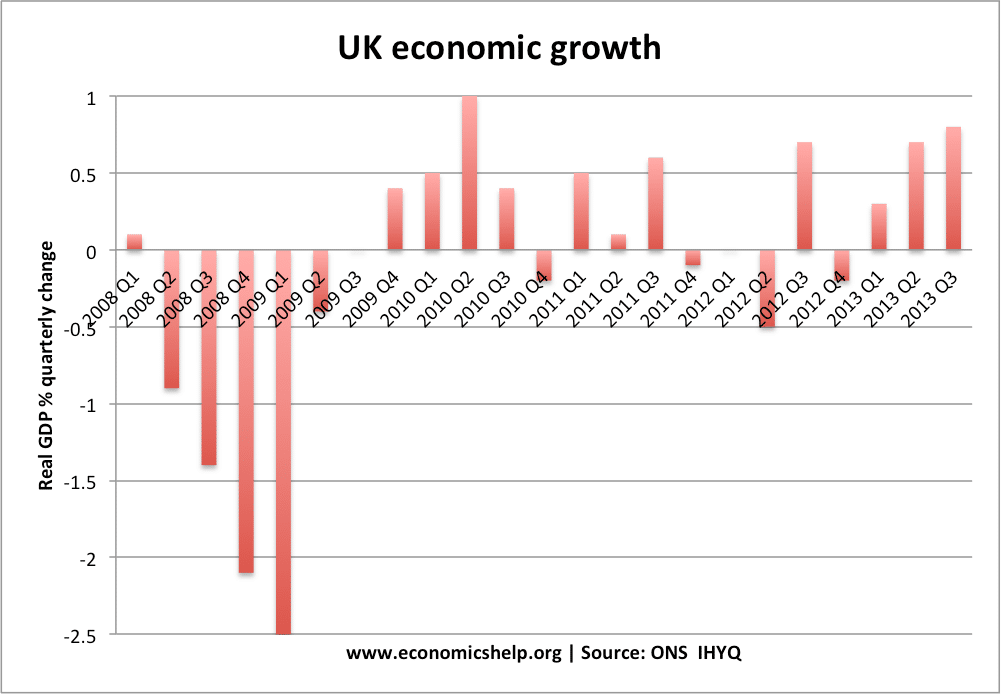
In Q3 2013 GDP was estimated to be still
2.5% below the peak in Q1 2008. From peak to trough in 2009, the economy
shrank by 7.2%. This is an unprecedented length of economic stagnation –
compare this recession to great depression of 1930s.
Could recovery have come earlier?
There is a strong case that the signs of recovery in 2009/10 could have
been maintained with more careful policy.
A strong bounce-back
Another way of looking at the recovery is
to concentrate on 2013. This looks much more promising, with the economy
expanding 1.8% in the first three quarters. After five years of
declining GDP, this is a great relief. The government might use this
‘strong recovery’ as vindication for their policies of austerity.
Criticism of German economic policy
Recently, the US Treasury criticised German economic policy. They
argue that German’s export led growth model and anaemic pace of domestic
demand is damaging to European and global growth.
“Germany’s anaemic pace of domestic
demand growth and dependence on exports have hampered rebalancing at a
time when many other euro-area countries have been under severe pressure
to curb demand and compress imports in order to promote adjustment,”
“The net result has been a deflationary bias for the euro area as well as for the world economy.” (BBC link)
It might seem a bit of a paradox for the US to criticise other
countries economic policies, when their own arguments about the debt
ceiling threatened to push the US and global economy back into
recession. But, why is the US criticising German economic policy and is it justified?
To what extent can the government help boost domestic industry and manufacturing?
"In recent weeks, several politicians have talked about their desire
to help UK manufacturing and boost industrial production. It may be a
noble endeavour to try and boost UK industry and rebalance the economy
away from financial services to manufacturing. But, how practical is it
for the government to actually boost manufacturing output?"
If you're stuck for something to write about, you can always have a look at the crazy world of the UK housing market. Why UK house prices are set to rise, despite being over-priced already. - UK house prices
Should we worry about national debt?
One of the big questions of the past few years - Governments have been borrowing for centuries. The figures for national
debt are staggering. In the US, National debt is over $11 trillion. In
the UK, debt
is over £1.1 trillion. From a personal perspective, we are brought up
to believe debt is a bad thing, and therefore people frequently worry
that national debt is too high. But, how much should we worry about
these levels of national debt? ... - Should we be concerned about national debt?
UK unemployment edged down to 7.7% - a 'relatively' 'good' figure, given the extent of the economic downturn in the past 5 years. What is going on with UK unemployment?
Facebook and productivity - How the internet can boost and hamper productivity - it's a very different kind of technological breakthrough to the assembly line or electricity.
In the past few weeks, I've been working on a new version of the website and new shop facilities. These technical changes usually end up taking three times longer than you want. But, hopefully, I've now finished - leaving more time to write economics and less time chasing up web developers.
Visit new homepage and new shop - If you see any minor problems, I'd be grateful if you let me. know.
UK recovery
The UK economy has experienced the most prolonged decline in real GDP on
record. GDP is still lower than before the start of the great recession
in 2008. This unprecedented recession has been prolonged – despite a
sharp depreciation in the Pound, and a raft of unconventional monetary
policies. However, recent statistics suggest there are some reasons to
be more hopeful and the UK economy is starting to recover with better stats in GDP, and manufacturing output. Yet, despite
the recovery, many analysts still worry that the economy is unbalanced
and could be vulnerable to a further economic downturn in Europe and the
rest of the world. More on the UK recovery
I'm sure the government will be giving itself a lot of credit for the recovery over the next few months. But, it is worth bearing in mind GDP is still below its peak. Be suspicious of anyone who uses monthly growth figures to prove or disprove the success of particular economic policies. If you have a severely depressed economy, eventually there will be some kind of recovery. But, that doesn't mean vindication of policies which prolonged the recession.
Unexpected wealth can be bad for an economy
I’m currently reading A History of the World
by Andrew Marr (it’s a good read so far). There’s an interesting
chapter about the consequence of Spain gaining a large quantity of gold
and silver from the Incas during the Sixteenth Century. Almost
overnight, Spain became very rich taking home unprecedented quantities
of gold and silver. Yet, there's a pretty good thesis that this 'easy money' held back the Spanish economy over the next few centuries. A salutary reminder that easy wealth can create it's own problems. Perhaps karmic justice for stealing other people's gold too.
In the past five years, we have had a devastating global credit crunch,
the longest and deepest recession since the 1930s (if not worse). Across
Europe, we have seen mass unemployment and in countries like Spain,
Ireland and Portugal, the housing market has seen up to 50% falls in
house prices. Yet, despite this financial and economic upheaval, UK
house prices have bucked the trend and avoided a major collapse that
many were predicting as the credit crunch hit.
There is a welcome sign of optimism in the UK. We've waited 77 years, but last Sunday we finally had a nice hot sunny day at Wimbledon. Politicians were also in the seventh heaven of delight falling over themselves to get a mug shot of themselves with Andy Murray. With the British lions triumphant in Australia, and a British rider leading the Tour de France, it seems like the glory days of London 2012 are being relieved. (there was an Olympic bounce in GDP in 2012, perhaps this bounce could return?)
Even the economy seems to be sending positive news. The IMF recently revised upwards their forecast for UK economic growth in 2013. Old favourites like UK house prices and consumer spending have risen, giving renewed hope of economic recovery. But, as John Cleese once remarked 'It's not the despair I can't stand, it's the hope' (hopes for UK economy)
With all this buoyancy and optimism, it's tempting to brush aside some more unwelcome economic news
Not least - falling manufacturing output, falling investment, a widening trade deficit, spending financed by a rapid drop in the saving ratio, future UK austerity to come). The UK picture has all has the hallmarks of a very unbalanced recovery. But, I suppose, an unbalanced recovery is at least better than no recovery at all.
There are many challenges ahead, not least the precarious nature of many people's disposable income. A small rise in rates, could see a precipitous drop in discretionary income. Real wage growth has disappointed for several years. Falling investment for several years leaves low productive capacity.
It's no comfort, but Europe is doing much worse. Unfortunately, the UK recovery is really threatened by events across the channel. The Eurozone crisis may have moved off the front pages, but the threat of debt default, and the continued reality of mass unemployment stalk the continent. It is not something that will be able to be brushed off with a touch of bond buying. Unfortunately, the longer the crisis drags on, the more difficult a resolution becomes.
The announcement of the Fed Reserve about potential ending of Q.E. has caused a rise in US bond yields. However, UK savers have seen a significant fall in deposit rates.
The fall in saving rates means that bank rates are now closer to base rates. One factor in pushing bank rates lower is the Funding for Lending scheme - though unfortunately, we haven't seen an increase in credit and lending to business.
Also, savers may well be asking - when will interest rates rise? and when they do rise, how much will they increase by? - For savers, it's not particularly good news. But, mortgage holders will be happy with short-term outlook. - when will interest rates rise?
It does explain why mortgage repossession rates in the UK are low. But, should rates rise, many homeowners may find themselves in difficulties.
Rather worryingly, the UK economic recovery is relying on the old favourites of - higher consumer spending and rising house prices. The fall in mortgage rates has caused an increase in house prices. The government is helping people to buy by making credit more easily available, but this doesn't address the more fundamental problems in the economy.
The fall in the saving rate in the past couple of quarters is quite stark. (Though ONS stats do have a habit of being revised at a later date. e.g. GDP stats and double dip recession, that wasn't really)
Another surprise was to see how much the saving rate has fallen in the past six months. A sign that real income growth is still very weak, and rising consumer spending is financed partly by lower savings.
For the past 20 years, I've heard politicians and policy makers of all shades talk about the need for a stronger UK manufacturing sector - an attempt to end the long-term decline.
Firstly, the decline in the UK manufacturing needs to be put into context. It is definitely a smaller share of the market. But, in absolute terms is still growing. Manufacturing employment has fallen, but this is partly due to a rapid rise in productivity.
Also, an attempt to boost manufacturing could be self-defeating. There is no reason why the UK has to fight a losing battle against lower cost Asian competitors. But, given the UK's tendency to rely on consumer spending, the tendency to boom and bust and the persistent current account - a stronger exporting and manufacturing sector would definitely help the economy to be more balanced.
Apart from de-industrialisation and the decline in manual labour, another big change in the UK labour market involves the increase in flexibility - and the increased uncertainty of work
Economic defeatism - 'Liquidate the banks, liquidate the rottenness out of the economy!' - In economics, there is often a mindset that we have to sit back and endure economic hardship, it harks back to the strange political appeal of austerity. However, there is always a choice - when a policymaker talks of the necessary economic pain, it is usually based on misguided macro-policy. 'It need not be like this.'
ZLB - Zero lower bound rate explained - effectively when interest rates fall to zero and can't be cut anymore. What the ZLB means for economies, and what can be done to overcome the ZLB
Flexible fiscal and monetary policy - a look at how we might shape future fiscal and monetary policy learning from mistakes of past five years.
Latvia to join the Euro - is there really any case to risk joining the Euro club and risk prolonged depression and unemployment like several existing Euro members?
Shock therapy - Want to move to a free market economy? Shock therapy says it's best to do all in one go. Radical reforms make the change, whatever the cost - a mixture of results from chaos of Russia to relative 'success' of Poland.
Will China challenge the West? - Is China set to become the economy to follow, or is the Chinese model at risk of imploding in a sea of growing credit and corruption?