Wednesday, June 9, 2021

Why Deflation is Bad

Deflation is a situation where prices fall (negative inflation rate)
     
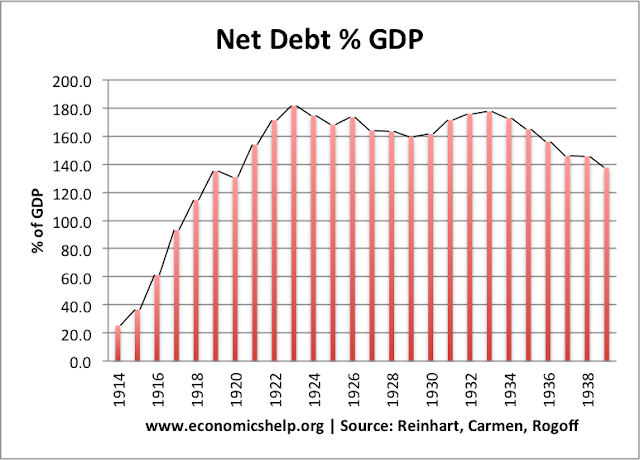
    Deflation in the UK in the 1920s.

There are several reasons why deflation is considered to be harmful to the economy.

  1. Discourage buying. When general prices are falling, consumers tend to delay purchasing. For example, rather than buy a flatscreen today, they wait a year when they will be cheaper. The effect of falling prices is to depress consumer spending leading to lower economic growth.
  2. Increasing real value of debt. When people take on debt like mortgages, they expect the value of the debt to be steadily eroded by inflation. (A mortgage becomes easier to repay as your wage increases). When there is deflation, the real value of debts increases. You owe the same, but, your wage is falling. Therefore, you have to spend a higher % of your income on servicing the deb.


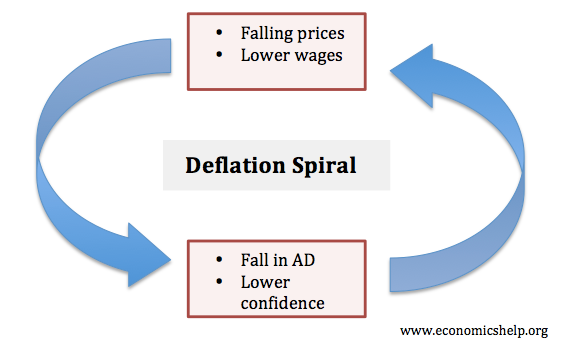
    The increasing real value of debt can cause a deflationary spiral. As prices fall and debt increases, it leads to lower confidence, lower spending (lower AD) and this leads to a further fall in prices and wages.

  3. Increasing Government Debt to GDP ratio. Deflation also increases the real value of government debt. It makes it much more difficult to reduce the debt to GDP ratio. Thus countries can start spending a higher % of income on debt repayment. Furthermore, as deflation tend to reduce economic growth, the cyclical deficit increases. The lack of growth of nominal GDP was a key factor behind the increase in debt to GDP in Greece, during the debt crisis of 2010s. In the UK in the 1920, deflation kept debt to GDP above 100% of GDP for two decades.


  4. Real Wage Unemployment. In deflation, wages may need to fall so firms can afford to keep employing workers. However, wages are often sticky downwards. (Unions resist nominal wage cuts). Therefore, falling prices are often not met by falling wages this leads to a rise in real wages. This creates real wage unemployment. It also makes a countries exports less competitive (particularly a problem in the Eurozone where countries can't devalue the exchange rate)


    Demand for labour falls to D2 causing equilibrium wage to fall to W2. But, if wages are sticky downwards they remain at W1 causing unemployment of Q3-Q1.

  5. Monetary Policy Becomes ineffective. With deflation, zero interest rates may be too high. Even quantitative easing may be insufficient to get people spending. (deflation and monetary policy)  The problem is that it is difficult to cut interest rates below zero and so the monetary authorities cannot adequately deal with the slow growth and deflation.
Further Reading

Friday, March 20, 2020

Link

This post has moved please visit updated post

How much can a government borrow? 

Wednesday, March 11, 2020

Paradox of Thrift

  • The paradox of thrift is a concept that if many individuals decide to increase their private saving rates, it can lead to a fall in general consumption and lower output.
  • Therefore, although it might make sense for an individual to save more, a rapid rise in national private savings can harm economic activity and be damaging to the overall economy.
  • In a recession, we often see this 'paradox of thrift'. Faced with the prospect of recession and unemployment, people take the reasonable step to increase their personal saving and cut back on spending. However, this fall in consumer spending leads to a decrease in aggregate demand and therefore lower economic growth.

Paradox of thrift during 2020 corona recession

  • In 2020, the economic shutdown will lead to an unprecedented rise in savings. Partly because people are very nervous about the future economy but also because opportunities to spend are severely limited.
  • On the other hand, people who see a large fall in income will have to dip into their savings and borrow to stay afloat.

Paradox of thrift during 2009 Recession

In the recession of 2008, we see a sharp rise in the UK saving ratio as consumers respond to bad economic news by increasing saving and cutting back on spending.
This fall in spending and a rise in saving contributed to the recession.


 A deep recession in 2008/09 partly magnified by a rise in private sector saving.

Paradox of Thrift in 1930s

In the great depression of the 1930s, GDP fell, unemployment rose and the UK experienced a long period of deflation. In response to this disastrous economic situation, mainstream economists were at a loss as how to respond. Such a lengthy period of disequilibrium didn’t sit well with Classical theory which expected markets to operate smoothly and efficiently.

One policy the National government did approve was the cutting of unemployment benefits. The rationale was that in times of depression the govt should set an example by reducing its debt. This example actually inspired members of the public to send in their savings in the hope that it would help the economy.

By reducing benefits they further reduced consumer spending and AD. This made areas of high unemployment even more impoverished. When people saved rather than spent their money it just made the recession worse.

Keynes and paradox of thrift

In the 1930s, J.M. Keynes argued that this 'paradox of thrift' was pushing the economy into a prolonged recession. He argued that in response to higher private saving, the government should borrow from the private sector and inject money into the economy.

This government borrowing wouldn't cause crowding out because the private sector were not investing, but just saving.

In the UK and US Keynes was largely ignored until after the war and as a consequence the UK economy experienced high levels of unemployment for the remainder of the decade.


Who coined the term paradox of thrift?

Keynes first popularised the term as it fitted in neatly with his concept that recessions were caused by falls in aggregate demand. It also justified higher government borrowing to offset the private sector savings. He mentioned it in his General Theory.
"For although the amount of his own saving is unlikely to have any significant influence on his own income, the reactions of the amount of his consumption on the incomes of others makes it impossible for all individuals simultaneously to save any given sums. Every such attempt to save more by reducing consumption will so affect incomes that the attempt necessarily defeats itself. It is, of course, just as impossible for the community as a whole to save less than the amount of current investment, since the attempt to do so will necessarily raise incomes to a level at which the sums which individuals choose to save add up to a figure exactly equal to the amount of investment.
— John Maynard Keynes, The General Theory of Employment, Interest and Money, Chapter 7, p. 84
This rather long-winded statement was shortened by Paul Samuelson, who used the term 'paradox of thrift' in his influential post-war macroeconomics text book.

The idea was also in use before Keynes. In 1893, in the The Fallacy of Saving, John M. Robertson writes on the potential problem of many individuals saving at once.
"Had the whole population been alike bent on saving, the total saved would positively have been much less, inasmuch as (other tendencies remaining the same) industrial paralysis would have been reached sooner or oftener, profits would be less, interest much lower, and earnings smaller and more precarious. This ... is no idle paradox, but the strictest economic truth."
— John M. Robertson, The Fallacy of Saving, pp. 131–132

Paradox of thrift and government borrowing

The paradox of thrift suggests that if there is a recession, there will be a rise in private sector saving and hence greater demand to buy government bonds. Therefore, even if the government borrow more, bond yields may fall.


Criticisms of paradox of thrift

  1. Higher saving increases bank balances and can lead to an increase in bank lending - and hence investment.
  2. A fall in demand from higher saving, will cause lower prices, which encourage demand to increase. This is related to Say's Law which states supply creates its own demand.
  3. Higher domestic savings can lead to lower domestic inflation and therefore increase exports. Higher exports can boost demand.

Responding to criticisms

  1. In a recession, banks may not want to lend, and even if banks do want to lend, firms do not want to borrow and invest. In fact, in a recession, firms may do the same as consumers and try to save more and pay back dent. 
  2. Prices may be sticky downwards and not fall, even if there is lower demand. Also, if prices fall, deflation can discourage spending because real value of debt rises.
  3. Not every country can 'export' its way out of a recession.

Related

Friday, June 14, 2019

Understanding UK Housing Market

The housing market is said to be one of the most popular topics of conversation at dinner parties. In the UK, this is for good reason. Houses are by far the biggest form of household wealth and have a big impact on consumers and the economy.


This graph shows two main features of the UK housing market.
  • House prices are volatile with frequent booms and busts.
  • Despite volatility, and even adjusted for inflation - UK house prices have been on a strong upward trend since the 1930s.

Main factors affecting house prices

  • Supply. UK house prices have stayed relatively high (despite recession and credit crunch) because of a shortage of supply. Ireland and Spain have seen much bigger house price falls because they have large excess supply.
  • Interest rates. The UK housing market is sensitive to changes in interest rates. Higher interest rates in the early 1990s made mortgages unaffordable and caused a big drop in house prices.
  • Economy / unemployment. A recession and rising unemployment usually causes lower demand for buying houses and a fall in price. (falling house prices also tend to deepen the recession)
  • Mortgage availability. In the boom years of 2000-07, banks were keen to lend and they relaxed their lending criteria, enabling more people to get a mortgage. But, the credit crunch meant banks had to tighten their lending criteria making mortgages difficult to get (even though interest rates were low)
  • see more at: factors affecting housing market

Why are UK house prices so volatile?


UK house prices have been highly volatile in the past few decades. On the one hand this is unexpected. People don't buy and sell houses like a commodity. But, in practise, house prices are volatile for a number of reasons.
  • Inelastic supply. It takes time to build houses - with rising demand, supply often can't keep up. This pushes prices up.
  • Change in credit conditions. Mortgage availability can vary depending on the state of the banks and financial markets.
  • Changing interest rates. Interest rates are used to control inflation, but a rise in interest rates has a big effect on demand and affordability.
  • Changes in confidence. In the boom years, we see landlords buying to let and demand rises. When prices fall, people don't want to buy for fear of negative equity.

Why are UK house prices so expensive?


 (graph showing nominal house prices)

UK house prices are very expensive. Despite the credit crunch, UK houses are still less affordable in 2013 than at the end of the Lawson boom in the 1980s.


If we look at the affordability of mortgage payments, buying a house looks more affordable because interest rates are much lower in the 2010s, than in the 1990s. But, with house prices nearly 7 times average earnings in London, buying a house is out of the question for many first time buyers.  Generally, mortgage companies only lend 3-4 incomes. It is too difficult to raise a deposit. Why are house prices so expensive?


1. Demand rising faster than supply. The UK fails to build enough houses to meet growing demand. This is related to strict planning legislation and the frequent local opposition to building new houses. Home building was also hard hit by the credit crunch. See more at Supply of houses

 2. Squeezing onto the property market. As well as a shortage of supply, people try very hard to buy a house despite its expense. For example, some young people may benefit from generous loan or help from their parents to help get them on the property ladder. London has seen strong demand from overseas buyers; parts of the countryside has seen the purchase of second homes, pushing house prices higher.

Housing market crashes

If the UK had a boom in housing builds, we may have had a similar experience to Ireland. In the boom years, Irish house prices rose 300%, but between 2006 and 2012, house prices collapsed, falling more than 50%. The main difference is that Ireland were building record numbers of houses, leaving a glut in the property market. Irish boom and bust. See also boom and bust in US housing market

How does the Housing market affect the rest of the economy?

Housing is the biggest form of personal wealth in the UK. Changes in house prices have a significant effect on UK household wealth and confidence. If house prices are rising, homeowners can gain extra cash through re-mortgaging their house and spending the extra equity (this was a feature of the 1980s and 2000s boom). Therefore, rising house prices tend to increase consumer spending. However, if people see falling house prices, they lose capacity to re-mortgage and also consumer confidence tends to fall, leading to lower spending. Falling house prices in 2009 and 1990 were key factors in contributing to the recessions of those periods.

see more at:  Housing market and economy

Government intervention in the housing market

Ideally, the government would overcome market failure in the housing market. This would involve:
  1. Increasing supply to overcome fundamental shortage.
  2. Protecting green belt land
  3. Ensuring minimum standards of house building and ensuring tenants get a fair deal
  4. Seeking to avoid house price volatility.
However, 1 and 2 conflict. The government often say they want to build new houses, but this is often politically unpopular with local protests against the building of new houses. Governments often focus on helping first time buyers, through government backed mortgages - but this has been criticised for not solving the fundamental problem house prices are too expensive, and just encourages greater debt levels.

Related posts on the housing market

Monday, May 13, 2019

Trades Unions Link


This is a look at the main pros and cons of trade unions in the modern economy. 

The post has been updated and moved to  https://www.economicshelp.org/blog/219825/labour-markets/trades-unions/

Friday, March 8, 2019

Fallacies (moved)

Some common economic fallacies, such as 'immigrants take our jobs' the broken window fallacy and the Luddite fallacy on the role of new technology.
 

Monday, May 7, 2018

Problems with the Euro

The Euro is a bold experiment to create the largest currency area in the World. However, the current Euro crisis have revealed deep flaws in the structure of the single currency

The Euro involves:
  1. A single currency within the Eurozone area.
  2. A common monetary policy. Interest Rates are set by the ECB for the whole Eurozone area.
  3. Growth and Stability Pact. In theory there are limits on government borrowing, national debt and fiscal policy. However, in practice member countries have often violated the strict limits on government borrowing.

Problems and costs of the Euro

  • Interest rates not suitable for whole Eurozone. A common monetary policy involves a common interest rate for the whole eurozone area. However, the interest rate set by the ECB may be inappropriate for regions which are growing much faster or much slower than the Eurozone average. For example, in 2011, the ECB increased interest rates because of fears of inflation in Germany. However, in 2011, southern Eurozone members were heading for recession due to austerity packages. The higher interest rates set by the ECB were unsuitable for countries such as Portugal, Greece and Italy.

  • The Euro is not an optimal currency area. If a state in the US, such as New York ,was in recession, workers in New York could move to New England and get a job. However, in the Eurozone this is much more difficult; it involves moving country and possibly learning a new language. There are more barriers to the movement of labour and capital within a diverse region like Europe. Therefore, an unemployed Greek can't easily relocate to Germany. see: Two Speed Europe

  • Limits Fiscal Policy. With a common monetary policy it is important to have similar levels of national debt, otherwise countries may struggle to attract enough buyers of national debt. This is a growing problem for many Mediterranean countries like Italy, Greece and Spain who have large national debts and rising bond yields.

  • Lack of Incentives. It is argued that being a member of the Euro protects a country from a currency crisis. Therefore, there is less incentive for countries to implement structural reform and fiscal responsibility. For example, in good years Greece was able to benefit from very low bond yields on its debt because people felt Greek debt would be secured by rest of Europe. But, this wasn't the case, and Greece were lulled into a fall sense of security.

  • No scope for devaluation. Since the start of the Euro, several countries have experienced rising labour costs. This has made their exports uncompetitive. Usually, their currency would devalue to restore competitiveness. However, in the Euro, you can't devalue and you are stuck with uncompetitive exports. This has led to record current account deficits, a fall in exports and low growth. This has particularly been a problem for countries like Portugal, Italy and Greece.

eu-currentaccount

This shows the effects of Eurozone members becoming uncompetitive. Very high current account deficits.
  • No Lender of Last Resort. The ECB is unwilling to buy government bonds if there is a temporary liquidity shortage. This makes markets more nervous about holding debt from eurozone economies and precipitates fiscal crisis. See: Problems of Italy - why Italian bonds increased despite having a much lower budget deficit than UK.
  • However it is worth noting that since Mario Draghi took over and promised to 'do whatever it takes, the ECB has effectively acted as lender of last resort.

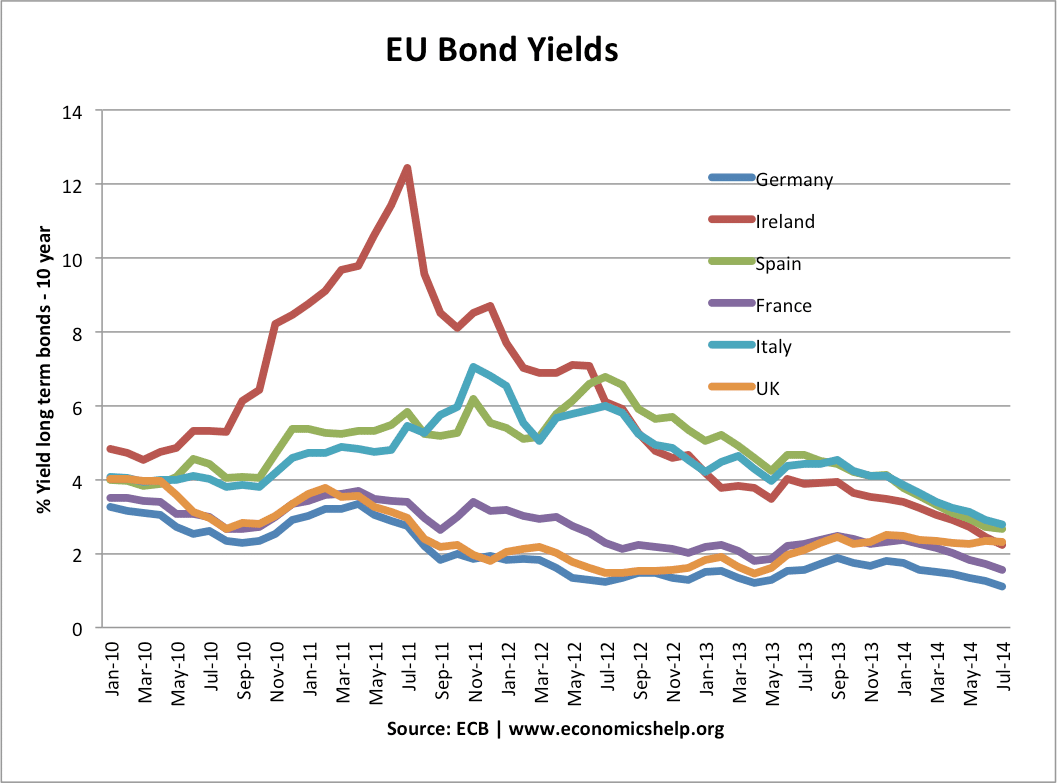
eu-bond-yields
Italy bond yields rose despite a primary budget surplus

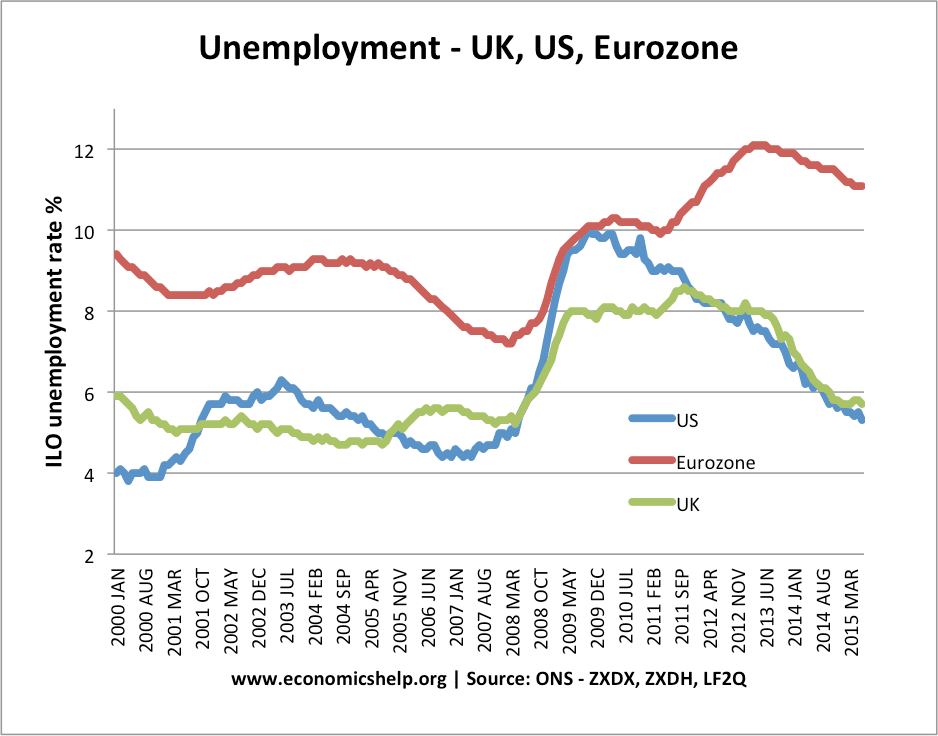
UK, EU, US unemployment

Eurozone members have seen a rise in unemployment - higher than US and UK

  • Divergence in bank rates. In theory, the Eurzone creates a common interest rate. However, in the credit crisis of 2010-13, we see rising bank rates for peripheral Eurozone countries, like Italy and Spain. Small and medium sized firms faced higher borrowing costs than in 2005, even though the ECB cut the main base rate. This suggests that the ECB was unable to loosen monetary policy when needed. See more on credit policy 
  • Asymmetric Shocks. If one country experienced an external shock it might need a different response. But this is not possible with a common currency. E.g. German reunification required higher interest rates in order to help reduce inflation but this was not good for many other countries.
  • An oil shock would affect net importers like France more than Norway and the UK who export a lot. Monetary Policy will have different effects in different countries. For example, the UK is sensitive to changes in the interest rate because many people have mortgages.

Experience of EU Fiscal Crisis


The great recession of 2008-11 showed the vulnerability of Euro member countries to a common monetary policy. Because they can't devalue and also ask the Central Bank to buy government securities they are at much greater risk of a liquidity crisis.

Because of fears over liquidity crisis, bond yields rose from Ireland, Spain, Portugal and Greece. As a result these eurozone countries were forced into pursuing spending cuts, and accepting higher interest rates. But, this led to a vicious cycle of lower growth and lower tax revenues.

See: Why UK bond yields stayed low compared to Euro members

Problems for UK Economy

UK economy has additional problems which make joining the Euro a bad idea.
  • Housing market. Many in the UK have a mortgage which is a big % of their disposable income. This is related to the high cost of buying houses in the UK.
  • Variable Mortgages In the UK more homeowners have variable mortgages. These two factors means UK consumers are very sensitive to changes in the base rate. If the ECB kept interest rates higher than the UK needed it would create serious problems in the UK. Arguably to join the UK would need to reform its housing market and reliance on variable mortgages.
Related Posts on the Euro

Tuesday, April 3, 2018

Predictions for the Dollar as the Reserve Currency

Governments hold foreign currency reserves to help deal with issues such as depreciation in their currency. At the moment, the world’s biggest foreign currency reserve is the US dollar; about 64% of the World’s foreign currency reserves are currently denominated in dollars. This is because, historically, the US economy has been the most secure and powerful economy. However, with the continual decline in the dollar, many countries are fearing that the dollar is no longer the best currency to use and increasingly countries are switching to other currencies such as the Euro.

Pricing of Commodities in Dollars


A separate, but related issue, is that most commodities, e.g. oil prices, are also priced in dollars. Oil prices are denominated in dollars because currently, the dollar is the most common currency. If the dollar was to be replaced by the Euro as the world’s currency reserve; it is more than likely that we would see commodities priced in Euro’s. In fact, some countries are already starting to use the Euro rather than the dollar

Will the Euro Replace the Dollar as the World’s Reserve Currency?

  • Since 1999, the Dollar’s share of the world’s currency reserves have fallen from 70.9% to 64%
  • In the same period, the Euro has increased from 17.9% to 25.8%
  • (the 3rd biggest reserve currency is the Pound sterling 4%
  • (the 4th biggest reserve currency is the Japanese Yen 2.8%)

Why the Euro May soon Replace the Dollar

  • The Dollar has been very weak in the past 8 years. Against the Euro, the Dollar has fallen by over 30% since 2001. The Dollar has also fallen against the Yen and other currencies. This means that countries holding reserves in dollars are seeing a decline in their value. For example, China has over $1,400 billion of dollar reserves. A 20% devaluation represents a significant loss for them. Therefore, the rational step is to diversify out of the dollar.
  • Countries dropping the Dollar Peg. Many middle eastern Countries such as Saudi Arabia, Kuwait and Syria used to maintain a dollar peg. However, there are signs that they no longer want to keep a peg against a devaluing dollar. Kuwait and Syria have dropped their peg and Saudi Arabia recently decided not to follow the US in cutting interest rates.
  • Dollar’s weakness may continue. The US economy is continuing to slow down as it remains hard hit by the housing slump. US interest rates have fallen and may continue to fall by more than the Eurozone. As interest rates in the US are low it becomes less attractive to buy US dollars so the devaluation will continue.
  • US Trade Deficit (current account deficit of 5%). In recent years, the US has built up a large current account deficit. This has caused an outflow of currency and is a factor in maintaining the weakness of the dollar. (although the recent devaluation though has helped reduce the deficit from over 6% to 4.7%)
  • The Euro is a real alternative. The Euro economy is now as large as the US. The Euro may also be seen as more politically desirable. European countries were less willing to get involved in Iraq and many accuse the US of an ‘imperial overreach’ with too many foreign bases and interference around the world. The European Union, by contrast, provides greater diversity and is politically more attractive, especially to middle eastern countries.
  • Better inflation performance of the Eurozone to the US. There was a marked contrast in response to the recent credit crisis. The US slashed rates to 2.25%, the ECB barely cut rates at all. The lower rates and devaluation of the dollar makes future inflation in the US more likely, this will only make the US less attractive.
Changing the world’s reserve currency is something that doesn’t happen very often. The US has enjoyed a hegemony really since the end of the First World War. However, that is no reason to suggest that the dollar’s influence will continue. Sooner or later, economic fundamentals are likely to cause people to shift out of the dollar and into alternatives. I will look at the consequences of this potential change in future essays.

Related

Wednesday, November 1, 2017

Importance of Growth - Quick summary -


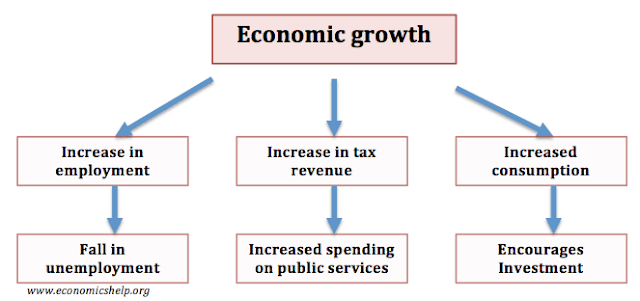
  1. Economic growth raises real incomes and living standards, enabling households to consume more goods and services.
  2.  It increases tax revenues without raising tax rates, giving governments more scope to fund healthcare, education, pensions and infrastructure. 
  3. Growth reduces unemployment by creating new jobs and encouraging firms to invest. 
  4. It helps lower relative debt burdens because GDP rises faster than liabilities. 
  5. Higher growth supports business confidence and innovation, improving productivity over time. 
  6. It can reduce poverty by expanding opportunities and wages. Internationally, fast-growing economies attract inward investment and strengthen competitiveness. 

Full post - Importance of economic growth


Related

Saturday, October 21, 2017

Wednesday, October 11, 2017

Interest Rates explained

Interest rates reflect the cost of borrowing. They also indicate the return on savings/bonds.


Commerical banks charge a higher interest rate on loans and pay a lower rate on savings. This difference between the cost of borrowing and rate of return on savings is part of the reason banks are profitable. Lending customers deposits at a higher rate than they pay customers interest on their savings.

Types of interest rates


Interest rates are controlled by the Central Bank (sometimes governments set interest rates directly). The Central Bank change a base rate. This base rate is the rate they charge to commercial banks. If the base rate rises, commercial banks will tend to put up their standard variable rates.

Effect of an Increase in Interest Rates

If interest rates go up, we will see:
  1. Cost of borrowing is more expensive. If borrowing is more expensive consumers will take out fewer loans. Firms will borrow less. Therefore consumer spending and investment will fall (or increase at slower rates)
  2. Mortgage and loan repayments increase. This reduces consumer disposable income and consumer spending further.
  3. Return on savings increase. More attractive to save and this will reduce consumer spending
  4. Higher interest rates cause an appreciation in the exchange rate due to hot money flows. (It is more attractive to save in the UK, if UK interest rates are higher than other countries)
  5. An appreciation in the exchange rate makes more expensive, leading to less export demand
  6. Fall in asset prices. Higher interest rates can make it less attractive to buy a house with a mortgage leading to lower house prices.
------------------------


Macro effects

  • If consumer spending and investment falls, this will lead to lower AD. Therefore this causes a fall in Real GDP or at least a fall in the rate of economic growth.
  • Lower growth will tend to increase unemployment. With less output, firms demand less workers.
  • Lower growth will also help to reduce inflation.
---------

Evaluation of Interest rate increases

1. Depends on the situation of the economy


If the economy is at full capacity a rise in interest rates may reduce inflation, but not growth. However, if there is already spare capacity then rising interest rates could cause a recession.

2. Depends on other components of AD

For example, if exports are rising, or if consumers confidence is high; rising interest rates may not reduce AD. For example, in the late 1980s, there were modest rises in interest rates, but the other aspects of the economy were growing so quickly, it failed to halt the above trend rate of growth (until 1991/92 when interest rates reached a record 15%)

3. Income effect of higher interest rates

Higher return on saving may give some consumers a high income. This will be consumers like pensioners. However, in the UK, the savings ratio is quite high, therefore the income effect of a rise in interest rates is likely to be quite low. The substitution effect will be higher.

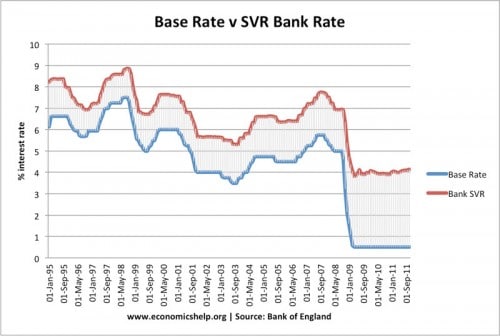
4. It depends whether commercial banks pass interest rate cut onto consumers. In the credit crunch, banks didn't reduce their Standard Variable Rate as much as the Bank of England cut its base rate.

uk-base-rate-v-bank-svr-500x336

In Credit Crunch of 2008, lower interest rates failed to boost economic growth.

How does Bank of England decide whether to increase interest rates?

The Bank will look at a wide variety of statistics to consider the state of the economy. The most important factors are
  • Inflation target of 2%. But Bank has to consider other objectives such as
  • economic growth and inflation.
  • It also has to consider the type of inflation. Is it temporary cost-push inflation or underlying inflationary pressures.
  • Is the economy reaching full capacity?

Example of interest rate dilemma Nov 2017


Should interest rates go up?

Real interest rates


Real interest rate = nominal interest rate - inflation rate.

If interest rates are 5%, and inflation is 3%, the real interest rate is 2% - savers will see a positive return on savings.

However, if interest rates stay at 5% and inflation rises to 6%, then real interest rates become negative. Real interest rates will be -1.0%

See also:

Thursday, October 5, 2017

The Economy of the 1970s


The 1970s was not just an era of dayglow trousers, lava lamps and the emergence of punk rock. It was a traumatic economic decade of stagflation, a three day week and the return of unemployment. Yet, despite some headline-grabbing crisis - it was also a decade of rising living standards, the growth of credit and rising property prices.

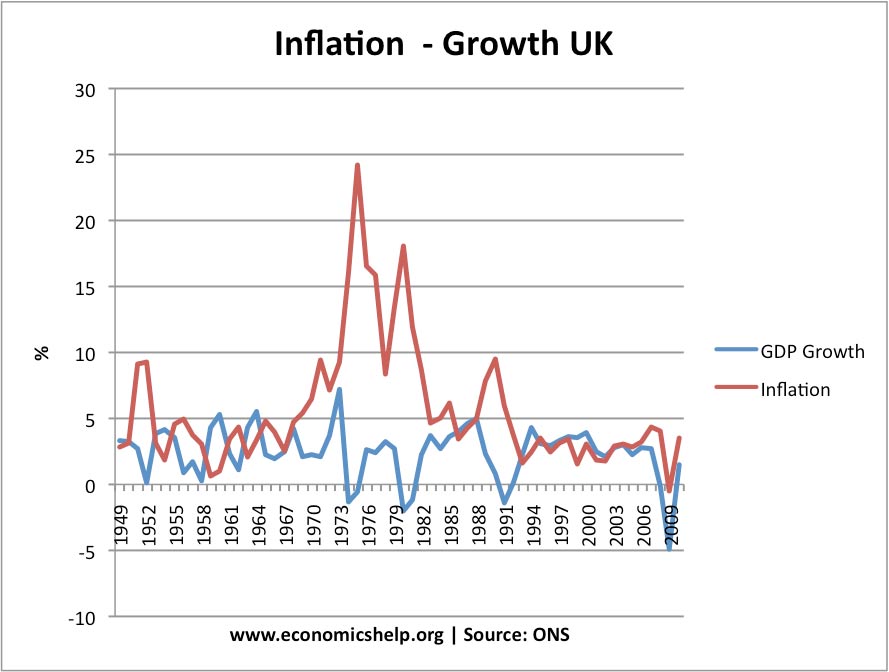
stagflation

Graph showing combination of high inflation and volatile output.

Barber Boom 1970-73

 The early years of the 1970s were a period of rapid economic growth.
  1. The Bank of England deregulated the mortgage market - meaning High Street Banks could now lend mortgages (not just local building societies). This helped fuel a rise in house prices and consumer wealth.
  2. Barber Boom of 1972. In the 1972 budget, the chancellor Anthony Barber made a dash for growth - with large tax cuts against a backdrop of high economic growth.
  3. Growth of Credit. It was in the 1970s, we saw the first mass use of credit cards (Access). This helped create a consumer bubble.

Inflation Crisis

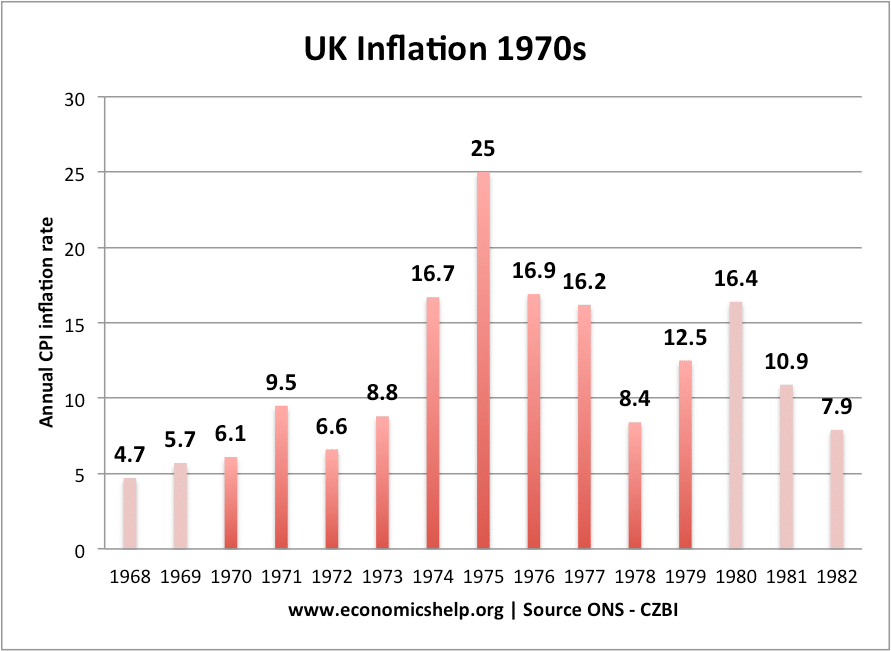
inflation-1970s

By 1973, inflation in the UK was accelerating to over 20%. This was due to:
  • Rising wages, partly due to strength of unions.
  • The inflationary budget of 1972.
  • Growth in credit and consumer spending.
  • Oil price shock of 1973, leading to 70% increase in oil prices.

Trying to deal with inflation

Belatedly, the government tried to deal with unemployment, through higher interest rates. Also, the Heath government tried capping wages. This was fuel for industrial unrest, leading to frequent and widespread strikes. In 1973, the miners went on strike and were also joined by sympathetic trades unionists - led by, amongst others, the young and infectiously strident Arthur Scargill. Growing up in Thatcher's Britain, it is hard to remember how powerful trades unions actually were at the time. During Heath's government 9 million working days were lost to strike action - plus more to practises such as 'working to rule'. Flying pickets successfully blocked coal and coke factories, which at the time produced the majority of the nation's power. Suddenly the life source of Britain's energy was being blocked. At the height of the strike, Britain was on a 3 day week, with the Prime Minister, Edward Heath making public appeals to conserve energy.

1974, also saw an unwelcome return of a real recession. This recession was caused by the end of the Barber boom and falling living standards from rising prices. In the post-war period, we had booms and busts, but, the bust were relatively mild, with only very minor declines in output. But, in 1974, output fell 3.4% causing a return of high unemployment not seen since the 1930s.


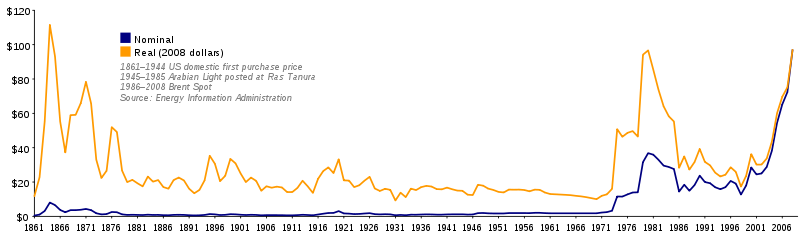
Oil Prices in the 1970s

  • blue line - nominal oil prices
  • Yellow line - Real oil prices, adjusted for inflation

Since oil had become an intrinsic part of the economy, we had taken it for granted that oil could be bought cheaply. The 1960s and early 1970s, saw a rapid rise in ownership of cars and motoring. Britain enthusiastically embraced the motor car - helped by rising incomes and cheap petrol.

But, the 1973 oil crisis, changed all that. Suddenly the price of petrol more than doubled and the UK faced an energy crisis to go along with a spike in inflation. The government seemed powerless as Britain was put on a three day week and TV was turned off at 10.30pm. Emergency speed limits were introduced to conserve petrol.

If in 1957, we had never had it so good, by 1973, it seemed we had never had it so bad. It was a return to the 1940s austerity; but with no obvious enemy, the public were less forgiving of this inconvenience.

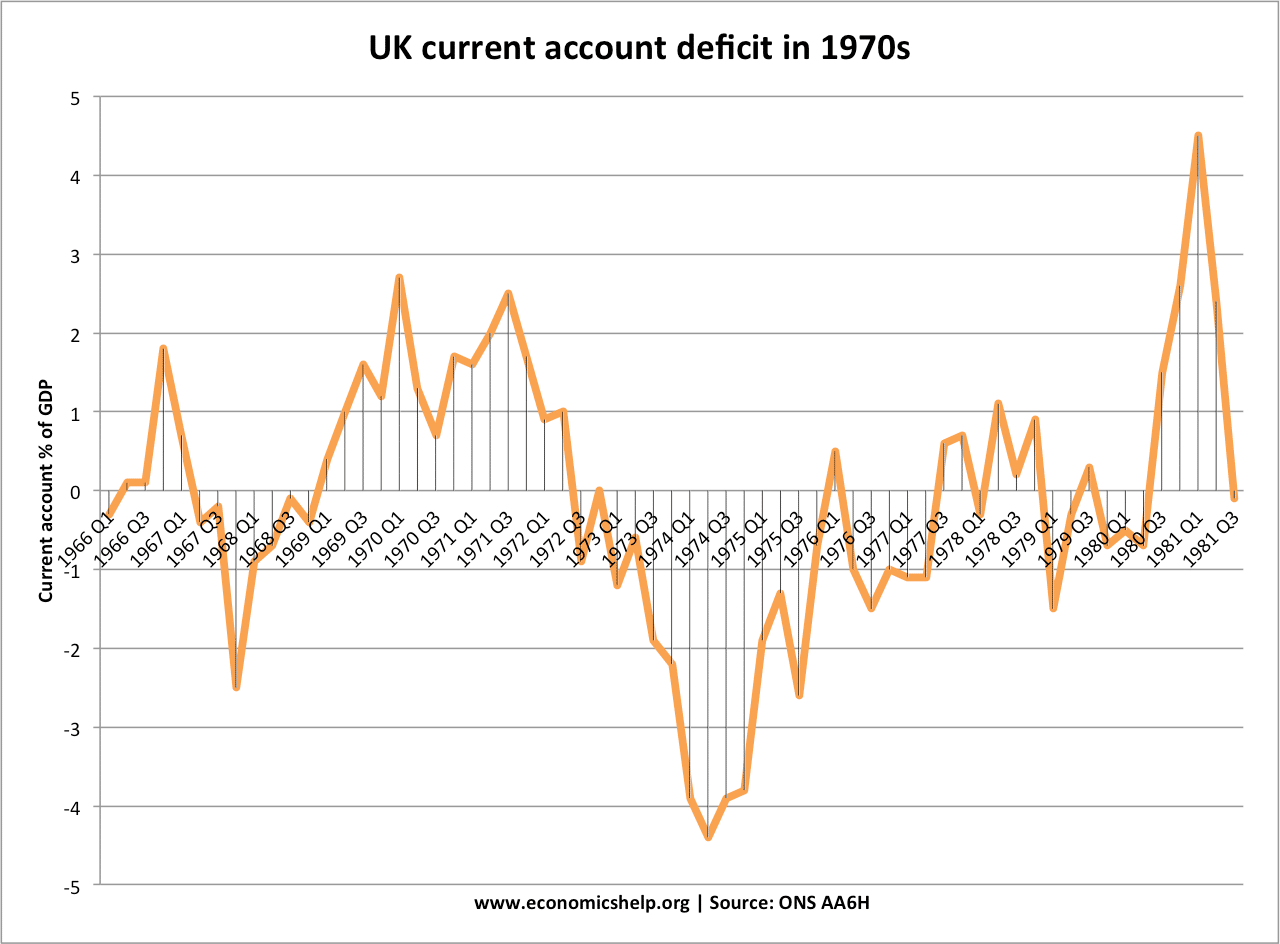
UK current account

current-account-1970s
In the mid 1970s, the UK saw a deterioration in the current account. High UK inflation was making UK goods less competitive. Also domestic consumer spending remained relatively strong - sucking in more imports. Although the current account reached a peak of only 4% of GDP in late 1974, (low compared to current account in 2000s) there were greater concerns about financing the current account deficit in the 1970s due to less investment income

1976 IMF Bailout

In 1976, the UK needed to apply to the IMF for a bailout. This was due to high budget deficit and also concerns over the value of Sterling. Markets believed Sterling was overvalued and so kept selling. This caused the Pound to depreciate.

Britain asked the IMF for a £2.3bn bail out in 1976 saying unemployment and inflation were at exceptional levels.

In return the IMF insisted on deep spending cuts to tackle the budget deficit. The government implemented spending cuts. By 1977, the economy showed signs of recovery, and helped by oil revenues the balance of payments improved. The pound also strengthened after the loan. The UK did not need to draw-out the full loan. More detail at: IMF crisis

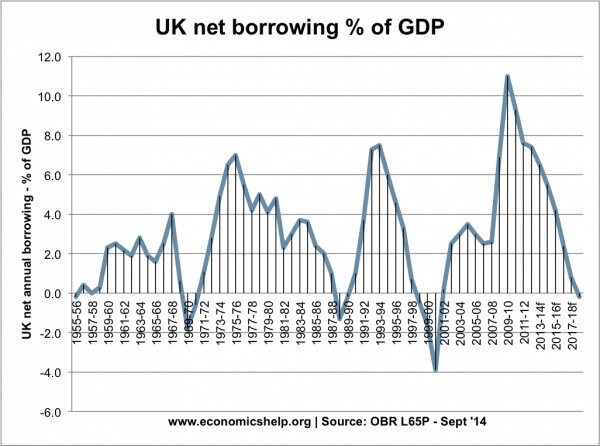
UK borrowing in the 1970s

net-borrowing-55-14

From UK Budget deficit

UK budget deficit rose rapidly from 1971/72 to 1975/76
Due to rise in GDP, total public sector debt fell from approx 60% of GDP (1970) to 50% in 1980 (see: National debt

Saturday, June 17, 2017

Economics

Readers Question: What is the Importance of Economics?

See: The Importance of Economics

Thursday, June 1, 2017

Run on the Pound

A run on the pound refers to a situation where international investors become nervous over holding sterling and sterling assets, and so sell as quickly as possible.

A run on the pound may occur when markets feel the Pound is overvalued and likely to fall quickly. If markets expect the pound to fall, they will sell quickly before making a loss.

What may cause a run on the Pound?

  • A run on the pound is more likely in a semi fixed exchange rate. e.g. when the Government is committed to trying to keep the Pound at a certain level. If markets feel this level is unsustainable they may keep selling Pounds until the government is forced to devalue.

  • For example, in 1992, the UK tried to maintain value of Sterling in ERM, but, ultimately markets forced the UK out and we had to devalue. The graph above shows the near 20% devaluation in 1992.
  • We also had a run on the pound in the late 60s, causing the Wilson government to devalue pound. (In 1967, Wilson devalued pound by 15% after selling many foreign currency reserves trying to maintain value of Pound)
  • In 1976, there was another on the Pound as markets feared the UK's fiscal position.
  • Financial crisis depreciation. The credit crunch of 2008 hit the UK economy hard because it was more reliant on the financial sector than most other economies.

Other potential causes of a run on the Pound

  • High inflation - high inflation reduces the value of Pound Sterling. Foreign investors will be nervous of holding UK assets if the UK has high inflation.
  • Threat of sovereign debt default. If markets feel government borrowing is too high and unsustainable then there is a risk of foreigners losing their government bonds. Therefore, the market will sell bonds causing an outflow of foreign currency and fall in value of sterling. This can build up a momentum effect. As the fall in the currency can alarm other investors.
  • Large current account deficit. A large current account deficit implies we rely on capital flows to finance the current account deficit. Therefore, the UK would be more vulnerable to capital flight. In this circumstance a run on the Pound would be stronger. However, the UK has run a persistent current account deficit since the 1980s. (See: Current account deficit)

Is the UK at risk from a Run on the Pound?

No. Firstly the Pound is floating i.e. governments are not trying to keep its value high. The Pound has already depreciated by about 15% since the Brexit vote in June 2016. - This wouldn't count as a run on the pound but large depreciation. With a floating exchange rate, there is less chance of markets feeling an exchange rate is fundamentally overvalued.

UK's debt is a concern (national debt at over 80% of GDP), but, we still retain good credit rating and despite rising debt, bond yields fell - reflecting the fact markets see UK debt as a safe investment. 

Would membership of Euro protect against a run on the Pound?

If we joined the Euro, by definition we couldn't have a run on the Pound, but, it doesn't solve underlying problems like lack of competitiveness, excessive government borrowing, negative growth. Being outside the Euro, would give Greece more flexibility for dealing with their crisis.

Related

Monday, May 22, 2017

Sample Question and Answers in Economics

A good revision technique is reviewing sample questions and model essays:

Micro A Level Questions and Answers:

Sample Macro Economics Questions and Answers

Economic Growth Essays

Inflation Essays

Unemployment Essays

Market failure
Trade and globalisation

Tuesday, January 10, 2017

Link between inflation and interest rates

  • Interest rates can influence the rate of inflation and the rate of economic growth.
  • The Bank of England change the 'base' interest rate to try and target the government's inflation rate of 2% +/-1
  • Generally, an increase in inflation leads to higher interest rates.
  • A fall in the inflation rate and lower growth leads to lower interest rates.
Graph Showing Inflation and Interest Rates in the UK


Real Interest Rates

  • Typically, nominal interest rates are 1 - 2 % higher than inflation. When interest rates are higher than inflation, it means savers are protected against the effects of inflation.
  • However, in 2008 and 2011, we had a period of negative real interest rates. This meant the inflation rate was higher than the base rate.
  • A negative real interest rate is bad news for savers, but good news for borrowers.
Response to Rising Inflation
  • If inflation rises, generally, the Bank of England increases interest rates to reduce inflationary pressure.
  • Higher interest rates tend to reduce consumer spending. This is because homeowners see an increase in the cost of their mortgage payments and have less disposable income. Therefore, they spend less. Also, higher interest rates increase the incentive to save and reduce the incentive to borrow.
  • Therefore, an increase in interest rates tends to reduce the rate of economic growth and prevent inflationary pressures.
  • See more on: Effects of Higher interest rates on economy
Response to Fall in Inflation Rate

If inflation falls below the target, there is likely to be a fall in the rate of economic growth, and the Central Bank may fear a recession. Therefore, in response, they may cut interest rates to try and boost economic growth.
  • Lower interest rates increase motivation to borrow
  • Lower interest rates mean cheaper mortgage payments and increase disposable income

Why A Cut in Interest Rates May Not Work

In some situations, cutting interest rates may be ineffective in boosting economic growth. For example, in 2008-11:


  • The recession was so sharp that investment and consumption have fallen dramatically and so the cuts in interest rates have only mitigated the extent of the downturn
  • House Price falls provide a powerful negative impact on spending. Lower interest rates should boost spending. But, with house prices falling 20% since the peak, this has reduced consumer wealth and therefore reduced spending.
  • Global downturn. Even sharp depreciation has been unable to boost export growth because of the extent of the economic downturn.
  • Time Lags. A cut in interest rates can take a long time to have an effect. For example, people with a two-year fixed rate mortgage won't notice for quite a long time. (until they re-mortgage. Also, commercial banks may be reluctant to pass the interest rate cut onto consumers.
Why higher inflation may not cause higher interest rates
  • In some circumstances, the Central Bank may not increase interest rates, despite an increase in inflation.
  • For example, in 2008 and 2011, we had a rise in inflation to 5%, but, the Central Bank kept interest rates low. Why?
They kept interest rates low because:
  • They felt inflation was just due to temporary cost-push factors like higher taxes and volatile food prices increasing
  • They felt economy was at risk of inflation. Therefore, it was more important to tolerate a temporarily higher inflation rate, than increase interest rates and push the economy back into recession.
Related

Wednesday, July 6, 2016

UK Exchange Rate Mechanism Crisis 1992


In October 1990, the UK made the decision to join the Exchange Rate Mechanism (ERM)
The ERM was a semi-fixed exchange rate mechanism. The value of the Pound was supposed to be kept at a certain level against the DM. £1 = DM2.95. The lower limit for the exchange rate was DM 2.773. If the Pound approached this level, the government would be obliged to intervene - through buying Pounds and raising interest rates.


The exchange rate mechanism was designed as a precursor to joining the Euro. The aim was to keep exchange rates stable; it was hoped this would:
  • Keep inflation low
  • Provide stability for exporters encouraging trade
  • Enable countries to join the single currency - the Euro.


In the late 1980s, the chancellor, Nigel Lawson was keen to join the ERM. But, Mrs Thatcher with her more euro-sceptic views wanted to stay out. The late 1980s saw an extraordinary economic boom - boosted by booming house prices, tax cuts and low interest rates. Growth reached record levels of 4-5% a year. Enthusiastic government ministers talked of an economic miracle - hoping Government policies had enabled, at long last, to catch up with other countries like Germany.

Economic growth


However, this miracle was an illusion. High growth was unsustainable and led to inflation.(see: Lawson Boom) With inflation of 10%, Nigel Lawson was able to convince Mrs Thatcher that the UK would benefit from joining the ERM to help reduce inflation.
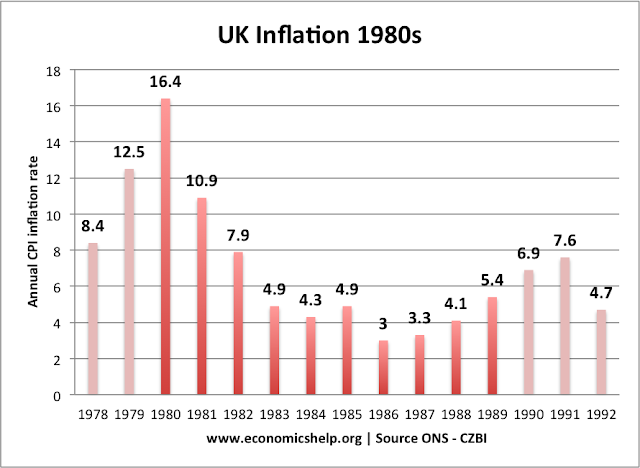
uk inflation 1980s


Therefore, the UK joined in October 1990. at a rate of DM 2.95 to the Pound.

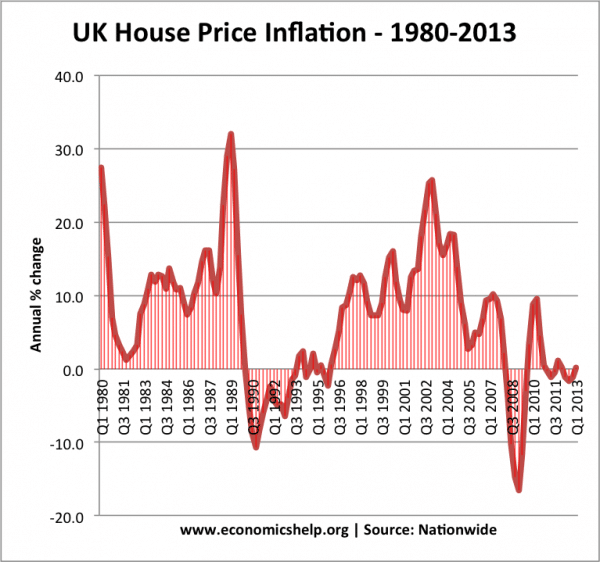
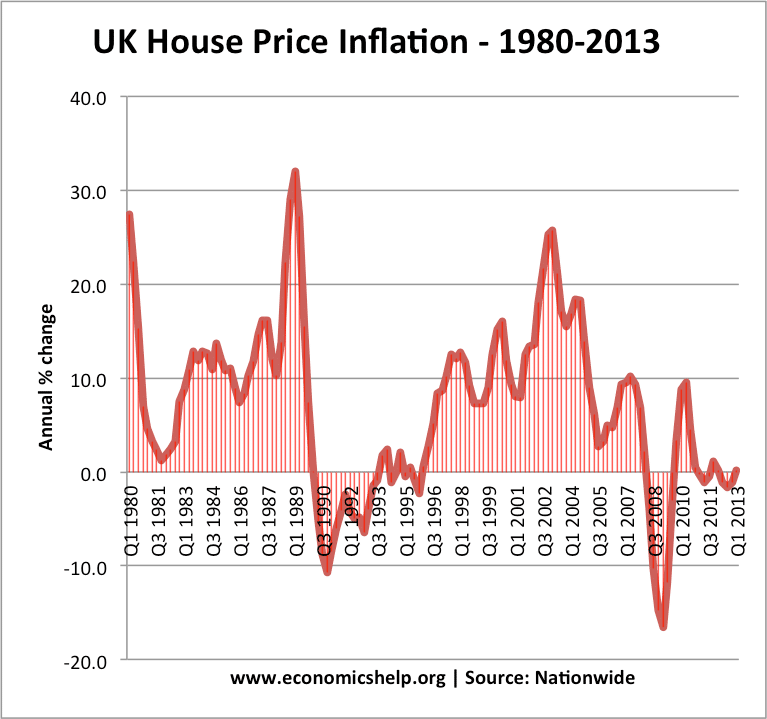
However, the problem was that the economic situation was declining quickly. The UK was sliding into recession due to falling house prices and an end to the past economic boom.
uk-house-price-inflation-1980-2013

High inflation and deteriorating economic activity was making the Pound less attractive. Therefore, the Pound kept falling to its lower limit in the ERM. Therefore, the government was bound to protect this value of the Pound by:
  • Increasing interest rates - this attracts hot money flows - it is more attractive to save in UK with high interest rates.
  • Buying pounds with foreign exchange reserves.
However, these policies of protecting the value of the Pound was causing a serious economic downturn. High interest rates particularly hit the housing market. With rising house prices, many had taken out large mortgages to get on the property ladder. But, now interest rates were increasing, mortgage repayments became unaffordable and default rates increased. Combined with rising unemployment from the recession, the housing market saw a dramatic fall in prices that was to last 4 years.

unemployment 1980s


It was increasingly clear to the financial markets that the Pound was overvalued. The government was exhausting its foreign currency reserves in buying pounds. But, more problematically, the high interest rates was causing a serious recession and misery for homeowners.

Financial speculators like George Soros predicted the Pound was doomed, so they were keen to sell their pounds to the British government. (It is said George Soros made £1 billion out of the UK government during ERM crisis)

It became a question of pride for Ministers, with Norman Lamont and John Major pledging to keep the UK in the ERM, seemingly at all costs.

interest-rates

For a long time, the British government fought a losing battle. But, the foreign currency reserves of the British government were no match for the trillions of Pound Sterling traded on the foreign currency and the pound kept sliding. It is estimated that the Treasury used £27 billion of foreign currency reserves trying to prop up the Pound. The Treasury estimated the final cost to the taxpayer was estimated at £3.4 billion.

On one desperate day - Wednesday 16th September, the UK government increased interest rates to 15%. In theory, these high interest rates should attract hot money flows. But, the market saw it for what it was - a measure of desperation. The market knew these interest rates were unsustainable and couldn't be maintained; the sell off continued and eventually, the government caved into the inevitable and left the ERM. The Pound fell 15%, interest rates were cut, and the economy was able to recover.

It is a classic example, of failed government policy. If the UK had joined the ERM at the start of the economic boom in the mid 1980s, the anti inflationary impact would have helped moderate the boom, kept inflation low and prevented a painful readjustment. But, they joined at the wrong rate at the wrong time. Trying to keep the Pound artificially high caused a recession, deeper than any of our competitors.  The ERM was dubbed 'The eternal recession mechanism'. The artificially high exchange rate just attracted financial speculators who saw the British government as a source of easy profit.

On leaving the ERM, the UK economy soon recovered. This was partly due to devaluation, but also perhaps more importantly - interest rates were able to fall significantly.

However, the episode left painful scars and played a key role in keeping the UK out of the Euro. It also shows the mistake of targeting inflation through an intermediary such as the exchange rate. As a consequence of this episode, the government gave the Bank a direct inflation target of 2.5%. The ERM crisis also paved the way to given the Bank of England independence in 1997. The hope was that an independent bank would avoid the excesses of the Lawson boom and bust of the 1980s.

Lessons from ERM

  • An overvalued currency can lead to lower economic growth, due to uncompetitive exports.
  • Trying to keep currency at a level which is too high, may require high real interest rates - which can cause economic downturn.
  • It is hard to buck the market. Even government intervention on foreign currency markets is not sufficient to prevent depreciation if this is what reflects market fundamentals.
  • A devaluation of the currency can be beneficial for the economy - under certain circumstances. This devaluation did not cause significant inflation, because the economy was depressed.
Related
     

Sunday, July 3, 2016

Benefits of the European Union

The European Union is a political and economic union of 28 countries. Originally formed in 1958 by six countries (then the EEC), the EU has expanded in terms of size and integration. The aim of the EU is to promote European harmony through creating a single market, enabling the free movement of goods, services and people.

Some of the benefits of the European Union include

Broad political and legal benefits

  1. European harmony - European Union countries are no longer at loggerheads like they were in the past. With the exception of civil war in Yugoslavia (which wasn't in the EU at the time), Europe has managed to heal the divisions which were so painfully exposed in the two World Wars in the Twentieth Century. The EU was awarded the Nobel Peace Prize in 2012 for helping to promote peace and international co-operation. Many Eastern European countries are keen to join the EU because they feel it will help promote economic and political stability.
  2. Legal and human rights. The EU has a strong commitment to human rights, preventing discrimination and the due process of law. This makes the EU attractive to countries, such as the Ukraine who wish to share in similar legal and human rights.
  3. Prospect of membership has helped modernise countries, such as Turkey. The Copenhagen Criteria for EU membership enshrine a commitment to human rights, the rule of law and a market economy. The prospect of gaining membership of the EU, encourage countries to implement human rights legislation.

Economic benefits

  1. EU is one of strongest economic areas in the world. With 500 million people, it has 7.3% of the world's population but accounts for 23% of nominal global GDP.
  2. Free trade and removal of non-tariff barriers have helped reduce costs and prices for consumers. Increased trade with the EU creates jobs and higher income. Over 52% of UK exports are to the EU. Trade within the EU has increased 30% since 1992.
  3. According to one study - over ten years (1993-2003), the Single Market has boosted the EU’s GDP by €877 billion [£588 billion]. This represents €5,700  [£3,819] of extra income per household.
  4. A paper, Campos, Coricelli, and Moretti (2014) used the synthetic counterfactuals method (SCM) pioneered by Abadie and Gardeazabal (2003). The red dotted line shows estimated GDP if the country had not been a member of the EU. This shows that even more prosperous EU countries, such as the UK have benefited from higher GDP as a result of being in the EU.

  5. Removal of customs barriers mean 60 million customs clearance documents per year no longer need to be completed, cutting bureaucracy and reducing costs and delivery times
  6. Countries in the EU, are amongst the highest positions in the Human Development Index (HDI)
  7. Poorer countries, such as Ireland, Portugal and Spain have made significant degrees of economic development since they joined the European Union. A report suggests that over the period of the 1980s and 2004 enlargement, there are substantial positive payoffs of EU membership, with a gain in per capita GDP of approximately 12% for poorer countries. (Vox - how poorer countries benefit from EU)
  8. Social cohesion fund. This has invested in poorer areas of the EU to help reduce regional disparities. For example, Ireland benefited from the EU social cohesion fund (over €6 billion of investment in education and infrastructure spending)
  9. EU structural funds to help Eastern European economies develop will benefit the UK in the long term because as they become more affluent, they will be able to buy more UK exports.
  10. The European Union has attracted greater inward investment from outside the EU. Inward investment grew from €23 billion  [£15.4 billion] in 1992 to €159 billion [ £106.5 billion] in 2005. The UK is the 5th largest source of inward investment in the world, and being a member of the single market is an important factor in encouraging Japanese firms.
    he European Social Fund (ESF)

Labour and free movement of people

  1. Free movement of labour and capital have helped create a more flexible economy. For example, UK and Ireland have benefited from the immigration of Eastern European workers to fill labour market shortages in certain areas, such as plumbing, nursing and cleaning. 
  2. Far from 'taking jobs', migration has helped increase productive capacity and makes a net contribution to tax revenues. (see impact of net migration)
  3. Free movement of labour also enables British people to live and work in Europe. Roughly 1.6 million British citizens live in the EU outside the UK (UNCTAD World Investment Report 2010)
  4. EU migrants are net contributors to UK Treasury. EU migrants tend to be young. Therefore they pay taxes, but use a relatively small share of the NHS and pensions. See: Fiscal effects of immigration. Net migration has helped deal with the UK's demographic timebomb.
  5. EU has enabled people to travel freely across national boundaries making trade and tourism easier and cheaper. According to the European Commission, more than 15 million EU citizens have moved to other EU countries to work or to enjoy their retirement.
  6. 1.5 million young people have completed part of their studies in another member state with the help of the Erasmus programme. The possibility to study abroad is considered positive by 84% of EU citizens. (benefits of EU)
  7. Easier to use qualifications in different member countries. This makes it easier to work abroad without having to retrain in different national qualifications.
  8. Mutual recognition of safety standards and rules have helped reduce costs for firms. This has encouraged the development of small and medium business who rely on the low cost of exports.
  9. Social charter enshrines protection for workers such as a maximum working week, right to collective bargaining and fair pay for employment. 
  10. European Arrest Warrant (EAW) scheme has made it easier to track criminals across the European continent.

Environmental benefits of the EU

  • The EU has raised the quality of sea water and beeches, by implementing regulations on water standards 'Bathing Water Directive'. 92% of tourist locations now meet minimum water quality standards. (Clean water at Europa.eu)
  • Tackling global warming. In 2006, the (EU) committed to reducing its global warming emissions by at least 20 percent of 1990 levels by 2020. The EU has also committed to spending $375 billion a year to cut greenhouse gas emissions by at least 80 percent by 2050 compared to 1990 levels. (global warming pdf)
  • Tackling acid rain. Environmental treaties which have sought to deal with European wide environmental problems such as acid rain. The EU has set strict restrictions on emissions of pollutants, such as sulphur, and other causes of acid rain. (BBC Link)

Consumer benefits of the EU

  • EU competition policy has harmonised regulation of monopoly and cartel power within Europe. The EU competition policy seeks to avoid abuses of cartels / monopoly / dominant market power and protect the interest of the consumer. There has been successful deregulation of airlines, electricity and gas markets.
  • The EU has reduced the price of making mobile phone calls abroad. In 2007 EU legislation set maximum charges for making and receiving calls.  The EU also agreed with 14 mobile phone manufacturers to create a standard design for chargers from 2011 in order to make life easier for consumers and reduce wastage. In 2014, it is has voted to scrap roaming charges which will drastically reduce the cost of using a mobile phone abroad. (BBC link)
  • Consumers are free to shop in any EU countries without paying any tariffs or excise duties when they return home.
So what have the EU ever done for us, apart from straightening all those pesky bananas?

Benefits of EU for eastern European economies

  1. Political stability and greater integration amongst European states. Pressure to keep democratic norms.
  2. Increased Trade - This will lead to advantages such as lower prices for consumers and more exports for industries with a comparative advantage.
  3. Increased competition
  4. Increased Inward Investment This will be because of greater stability in the economy, lower trade costs and greater harmonization. The benefits of this include a positive regional multiplier and greater technical assistance
  5. Social Policy's and subsidies. New countries will benefit from Regional, Social and CAP because they tend to be poorer.
  6. Reduce income disparities. Membership of EU will help eastern economies to 'catch up with' western counterparts.
  7. Free-movement of labour enables workers in east to travel to west and gain higher incomes that can then be re-invested in business in the east.

Related