Tuesday, May 7, 2013

Problems with the Euro

The Euro is a bold experiment to create the largest currency area in the World. However, the current Euro crisis have revealed deep flaws in the structure of the single currency

The Euro involves:
  1. A single currency within the Eurozone area.
  2. A common monetary policy. Interest Rates are set by the ECB for the whole Eurozone area.
  3. Growth and Stability Pact. In theory there are limits on government borrowing, national debt and fiscal policy. However, in practice member countries have often violated the strict limits on government borrowing.

Problems of the Euro

  • Interest rates not suitable for whole Eurozone. A common monetary policy involves a common interest rate for the whole eurozone area. However, the interest rate set by the ECB may be inappropriate for regions which are growing much faster or much slower than the Eurozone average. For example, in 2011, the ECB increased interest rates because of fears of inflation in Germany. However, in 2011, southern Eurozone members were heading for recession due to austerity packages. The higher interest rates set by the ECB were unsuitable for countries such as Portugal, Greece and Italy.

  • The Euro is not an optimal currency area. If a state in the US, such as New York ,was in recession, workers in New York could move to New England and get a job. However, in the Eurozone this is much more difficult; it involves moving country and possibly learning a new language. There are more barriers to the movement of labour and capital within a diverse region like Europe. Therefore, an unemployed Greek can't easily relocate to Germany. see: Two Speed Europe

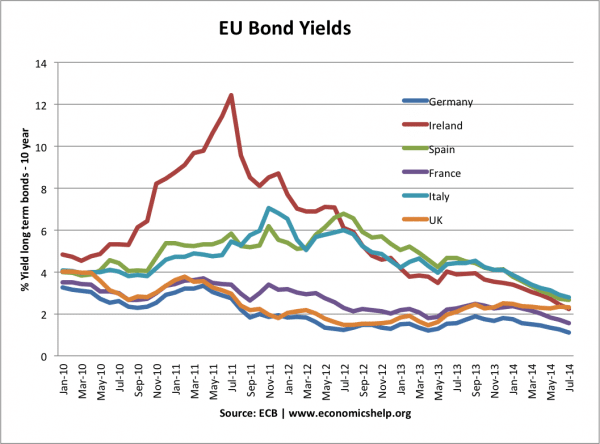
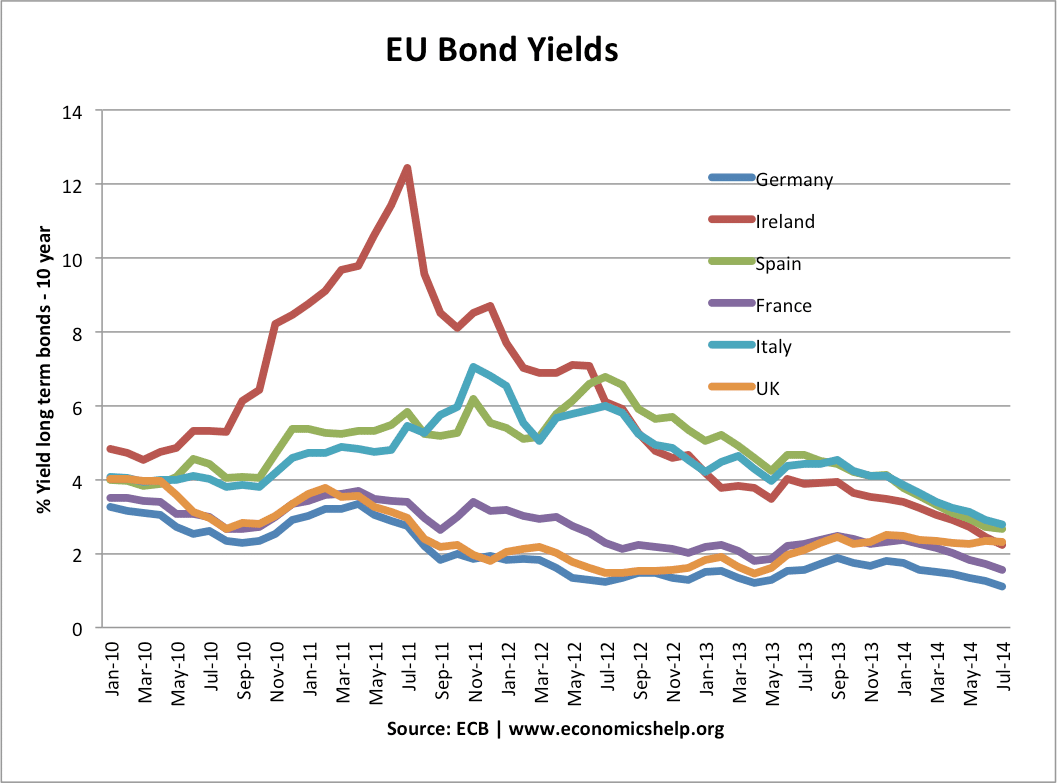
  • Limits Fiscal Policy. With a common monetary policy it is important to have similar levels of national debt, otherwise countries may struggle to attract enough buyers of national debt. This is a growing problem for many Mediterranean countries like Italy, Greece and Spain who have large national debts and rising bond yields.

  • Lack of Incentives. It is argued that being a member of the Euro protects a country from a currency crisis. Therefore, there is less incentive for countries to implement structural reform and fiscal responsibility. For example, in good years Greece was able to benefit from very low bond yields on its debt because people felt Greek debt would be secured by rest of Europe. But, this wasn't the case, and Greece were lulled into a fall sense of security.

  • No scope for Devaluation. Since the start of the Euro, several countries have experienced rising labour costs. This has made their exports uncompetitive. Usually, their currency would devalue to restore competitiveness. However, in the Euro, you can't devalue and you are stuck with uncompetitive exports. This has led to record current account deficits, a fall in exports and low growth. This has particularly been a problem for countries like Portugal, Italy and Greece.

eu-currentaccount

This shows the effects of Eurozone members becoming uncompetitive. Very high current account deficits.
  • No Lender of Last Resort. The ECB is unwilling to buy government bonds if there is a temporary liquidity shortage. This makes markets more nervous about holding debt from eurozone economies and precipitates fiscal crisis. See: Problems of Italy - why Italian bonds increased despite having a much lower budget deficit than UK.

bonds
Italy bond yields rose despite a primary budget surplus
unemployment

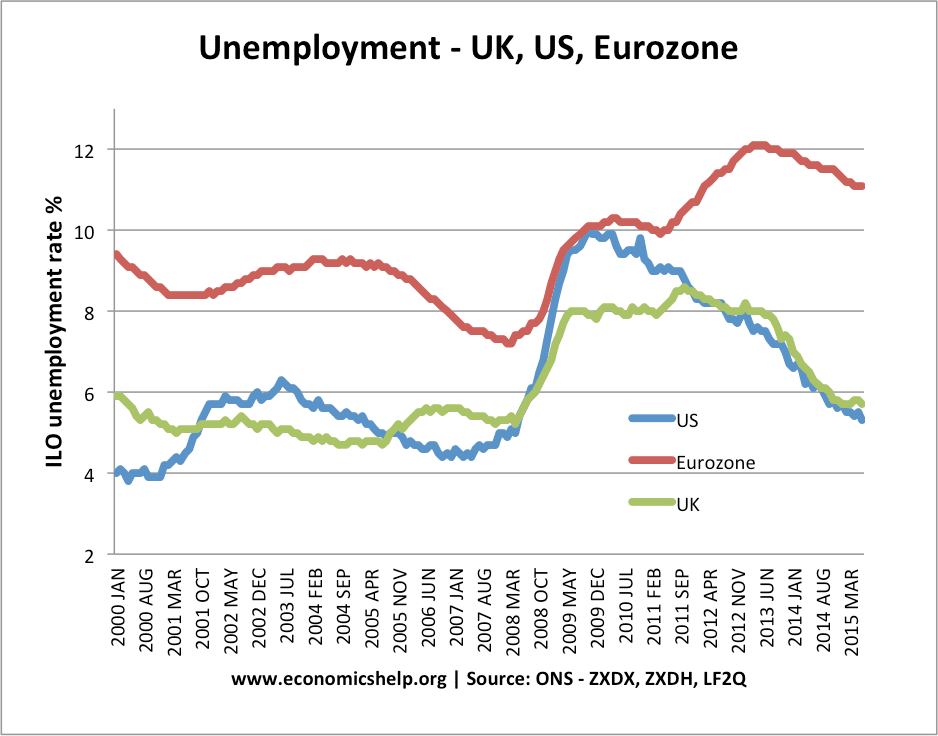
Eurozone members have seen a rise in unemployment

  • Divergence in bank rates. In theory, the Eurzone creates a common interest rate. However, in the credit crisis of 2010-13, we see rising bank rates for peripheral Eurozone countries, like Italy and Spain. Small and medium sized firms faced higher borrowing costs than in 2005, even though the ECB cut the main base rate. This suggests that the ECB was unable to loosen monetary policy when needed. See more on credit policy

Experience of EU Fiscal Crisis


The great recession of 2008-11 showed the vulnerability of Euro member countries to a common monetary policy. Because they can't devalue and also ask the Central Bank to buy government securities they are at much greater risk of a liquidity crisis.

Because of fears over liquidity crisis, bond yields rose from Ireland, Spain, Portugal and Greece. As a result these eurozone countries were forced into pursuing spending cuts, and accepting higher interest rates. But, this led to a vicious cycle of lower growth and lower tax revenues.

See: Why UK bond yields stayed low compared to Euro members

Problems for UK Economy

UK economy has additional problems which make joining the Euro a bad idea.
  • Housing market. Many in the UK have a mortgage which is a big % of their disposable income. This is related to the high cost of buying houses in the UK.
  • Variable Mortgages In the UK more homeowners have variable mortgages. These two factors means UK consumers are very sensitive to changes in the base rate. If the ECB kept interest rates higher than the UK needed it would create serious problems in the UK. Arguably to join the UK would need to reform its housing market and reliance on variable mortgages.
Related Posts on the Euro

Tuesday, April 23, 2013

Economic update April 23rd

Mrs Thatcher's recent passing has created an unsurprising interest in re-evaluating her period in office. From an economic perspective, it is possible to look at the changing British economy from many different angles. There were definitely winners and losers in the 1980s.
The biggest losers were undoubtedly the 3 million unemployed. The winners were stereotypically living in the south east, homeowners, working in the finance sector, buying shares in privatised industries. Whether the British economy was left in a better place is still debated today. But, one thing is certain, for good or ill - the economy is very different, and there is no going back to pre 1979.

Essay here on economic impact of Mrs Thatcher 

Unemployment since Mrs Thatcher

UK Unemployment 

Inflation and interest rates

inflation-interest-rates-1945-2011


more on Mrs Thatcher perspectives

Arguing over the past is one thing, but a more pressing concern is the economic policy of Europe.
How much is government borrowing influenced by economic growth?

This is very important in the current debate, as Europe seeks to reduce borrowing, without really considering impact and importance of economic growth


growth+borrowing

Also the effect of borrowing on bond yields and debt interest payments

Economic shorts
  • Zero-hour contracts - Mrs Thatcher would probably have approved, but how does it affect workers who increasingly find themselves with zero guaranteed hours?
gdp-constant-market-prices

Irish economy summary - From boom to bust. Is Ireland really a model austerity nation?
The Irish housing market saw one of the greatest boom and busts in the world.

Thursday, March 28, 2013

Ireland - success or failure?

Ireland is often put forward as a model of austerity.

March 2010: “Greece has a role model, and that model is Ireland” — Jean-Claude Trichet

December 2011: “As European leaders scramble to overcome the Continent’s debt crisis, many are pointing to Ireland as a model for how to get out of the troubles.”

March 2012: “Confidence is returning to Ireland and to Europe. The Irish economy is turning the corner. ” — Jose Manuel Barroso.

(Ireland recovers and recovers, P.Krugmanhttp://krugman.blogs.nytimes.com/2013/03/22/ireland-recovers-and-recovers-and-recovers/)

Yet, the evidence is mixed with unemployment at 14% and a very uneven economic recovery.


gdp-constant-market-prices

You can make your own mind up here: Irish economy summary.

You can always look for evidence that supports your opinions. But, it's a tough time for the unemployed in Ireland.

irish-unemployment-rate
 

Sunday, March 24, 2013

Budget special - how much austerity do we really have?

The past week has been dominated by the budget. Government borrowing is forecast to fall this year, though it is helped by a few 'useful' accountancy tricks. In 2012/13 borrowing is forecast to be £ 80 billion (5.1% of GDP - down from £121bn or 7.9% of GDP) - borrowing  is reduced in 12/13 by £28bn transfer because of a transfer of Royal Mail pensions in April 2012 and reduced by £6.4 bn because of transfer of funds from Q.E.). It's hard work keeping on top of these debt statistics.


budget-deficit-uk-percent-gdp 


Do we really have austerity? - A big debate is the extent to which the UK actually has austerity. It is true UK spending cuts are quite minor compared to some of our European neighbours. But, it should be remembered, in a recession, automatic fiscal stabilisers automatically increase spending (e.g. on welfare benefits), so to cut spending overall requires bigger cuts elsewhere.

To what extent is Europe to blame for the UK double dip recession? - The European recession is definitely a factor in holding back UK recovery, but with exports to Europe rising between 2009 and 2012, there's only so much blame we can put on Europe.

How bad is the recession?

In terms of GDP, this recession is worse than the great depression, though paradoxically, unemployment is lower than in many other recessions.


recessions-different-recoveries


Other blogs

Escape velocity - the speed and effort you need for an economy to recover from a liquidity trap and return to normal trend rate of growth .

Patching up the economy with plastic bands - It's hard to have strong recovery when you don't really expect it, but spend most of your time saying how bad the economy is.

UK Government spending - There is a lot of debate about the level of government spending; these are some statistics from HM Treasury about how much, and where government spending goes.

govt-spending-94-12


Housing is less in the news, but the UK still faces a curious situation - despite the credit crunch, house prices are still very expensive. The budget offered some help with getting a loan, but will this measure deal with the fundamental lack of supply?


housing-supply

The number of households is forecast to grow by 232,000 a year until 2033, and yet the current rate of home construction is struggling to increase above 100,000 a year. You don't have to be an economist to work out the mismatch of supply and demand is likely to push up prices.

Quick links

Readers questions

Tuesday, March 12, 2013

It's all a question of timing

One feature of economics is that policies which are very desirable at one period of time, may be completely undesirable in another situation. In particular, the current recession and liquidity trap, allow many economic paradoxes to come to the fore, and you find many rules turned on their head.

For example, is the rise in the UK savings ratio a good thing?  yes in the long-term, but not in a recession. As the saying goes - make me virtuous - just not yet.

savings-ratio-nat-income-accounts.jpg 

In the long-term, a good level of saving helps promote investment. But a rapid rise in savings during a recession contributes to lower consumer spending and a fall in real GDP. (the rise in savings in 2008-09 mirrored the fall in real GDP)

The good news is that with an improved level of savings, there is the potential for the UK consumer come to the rescue of the UK economy - just a slight fall in the savings ratio could see a significant boost to economic growth. The interesting thing is savings is increasing - despite the squeeze on real incomes.
At least stock markets are doing well...

The mystery of global stock markets. Why are stock markets doing well, when the outlook for the global economy remain depressed? - The stock market often defies economic reality. But, it is worth remembering the stock market is no higher than in 2000 - still a long way to go. But, Q.E. did put money in the pockets of quite a few in the city.

Is UK monetary policy too lax?

Some commentators have started to criticise the Bank of England for ignoring inflation targets and allowing the Pound to slide. I offer a defence of monetary accommodation - at the moment, there are still more pressing things to worry about that inflationary pressures. Criticisms of Bank of England

The problem with deficits

deficit
OECD – Budget deficits 2012

Spot the countries with the biggest borrowing problem. Hint, it isn't UK, US and Japan who have the three largest deficits.

Austerity and timing

Economic news is dominated by the effect of fiscal consolidation (austerity). Research by IMF shows that for highly indebted countries, fiscal consolidation can increase the debt to GDP ratio in the short-term. The impact of fiscal consolidation depends very much when you implement it. There's a big difference to cutting spending in a recession and cutting spending when there is growth - as Europe is finding out.

Unfortunately, it all made it rather hard to support our PM's hope that fiscal consolidation helped increase economic growth. The PM's bizarre logic of fiscal consolidation

An alternative - 8 policies to increase economic growth.

Unfortunately, the EU rules on fiscal stability give little room for manoeuvre and display a lack of flexibility. Greater flexibility on the timing of fiscal consolidation would make life less painful for everyone.

Economic Concepts in action

Economic shorts
  • Universal credit - the new all encompassing benefit coming out in Oct 2013
  • RPIJ - a new inflation measure, like RPI but calculated using a geometric mean - who said economics isn't interesting?
  • Energy prices - they've gone up in past few years, but you probably don't need an economist to tell you that.
  • Fuel consumption. Prices go up, demand goes down. Who said economics was difficult?

Monday, March 4, 2013

The impact of the falling Pound on the UK and other links

The UK export mystery - We've seen  30% devaluation in Pound Sterling, but the UK current account still worsened at the end of 2012.

pound-euro

 - Does a devaluation actually help the economy or does it just make us poorer? Is a strong currency a good thing?

UK exports rise to non-EU countries.  Away from the depressed EU economy, exports to China and India rose sharply. Export growth to BRIC countries was 35% between 2009 and 2012.

UK wage growth.

wages-inflation-2007-2012

Real wages at the end of 2012 fell to levels not seen since 2003. That's the impact of the great recession. Unfortunately, there is no end in sight for stagnant real wages. A look at the impact of falling real wages for inflation, monetary policy and unemployment.

Do we have an inflationary time bomb? Many still worry the Bank of England has lost its anti-inflationary credentials as it happily watched the Pound slide, but when you look at figures for M4 money supply, it looks more like we are stuck in a severe recession.

m4-money-supply 
 

- M4 Money supply

Negative Interest rates?

Could the Bank of England really implement negative interest rates? It has been done in Denmark, and it could be implemented for commercial banks borrowing from Bank of England. But, it is still unlikely to be implemented unless the Bank get even more desperate.
  • Osborne, debt and credit ratings - Report card for G.Osborne and the governments economic reforms. No grade A for Osborne. more likely a grade E for scraping a pass, just because they turned up to exam. 


eu-recession

Quick links for A-Level economics help

Economics in everyday life

Economic Theory

  • New Trade Theory - why economies of scale can outweigh the theory of comparative advantage. A look at the work which gained Paul Krugman a Nobel prize in economics.
  • Neo-classical synthesis - Keynesianism adopted for US, without the 'leftwing' bits.

Wednesday, February 27, 2013

Definition of Recession

In the UK, the standard text book definition of a recession is:
"Negative economic growth for two consecutive quarters". This means there must be a fall in real output for a period of 6 months.
A recession means there is a fall in real national output and real national income. 

UK Recessions in 2008, 2012


economic-growth-uk-ons-quarter

  • This graph shows the UK was in a recession in from 2008 until Q3 2009.
  • There was a 'double dip recession'  from Q4 2011 to Q2 2012.

Features of a recession include:
  • higher unemployment, 
  • lower living standards.
  • increase in government borrowing
  • often falling asset prices (e.g. falling house prices) 
There are different  Types of Recession such as:

Balance sheet recession - a recession caused by high levels of debt in private sector causing firms and consumers to 'deleverage'

Difficulties of defining recessions
  1. Population Growth: If the population was increasing by 1% a year. Real GDP growth of 0.5% would mean Real GDP per Capita was falling. This is an important factor for countries like the US which have growing populations.
  2. Statistics can be inaccurate. Often GDP statistics are inaccurate and need to be revised down. Therefore, growth of 0.3% could actually mean growth is falling 0.2%. However, figures can be rounded up as well as down.
  3. Growth below trend rate. If capacity grows by an average of 2% a year, then economic growth of 0.8% a year, would mean a rise in spare capacity and therefore, unemployment is likely to rise. Therefore, some economists feel we should call a recession, if spare capacity is rising. However, the problem with this is that it means economic growth of 1.0% could be classed as a recession, which creates confusion. Some economists refer to a 'growth recession'. Low growth compatible with features of recession.
  4. Unemployment. Arguably, a distinguishing feature of a recession is rising unemployment. If unemployment rises significantly, then this signifies the economy is in recession. It would seem churlish to say the economy was not in recession, if unemployment has risen by 0.5 million but, growth is just about positive. However, how much unemployment would have to increase by? Also, unemployment could be caused by supply side factors, rather than demand side factors.
  5. Survey. You could ask a survey of economists / people, whether they think the economy is in recession. But, this is very subjective. At the moment, 53% of economists think the US in in recession, but, 47% don't - how helpful is this? (see: Why is the US not in recession?)
'Growth Recession'

Some define recession as a period of rising spare capacity and rising unemployment. It is possible to have a 'growth recession' i.e. very low growth of 0.5% and people feel they are in a recession.

US Definition of Recession.

In US, a recession is said to occurs, whenever the National Bureau of Economic Research NBER says so. There definition is:
..... a significant decline in economic activity spread across the economy, lasting more than a few months, normally visible in real GDP, real income, employment, industrial production, and wholesale-retail sales.
NBER further tells us that:
"There is no fixed rule about what weights are assigned to the various indicators, or about what other measures contribute information to the process."
This clearly is injecting a lot of subjectivity into the definition. I appreciate the reasoning behind the statement, but, it creates uncertainty as to what will cause a recession.


Definition of Depression.

There is no universally agreed definition of a depression, but common ideas include real GDP falling by 10% or real GDP falling for two years.


For example,  in the Great Depression of 1929-33, output fell by 18%
External Links
Further Reading on Recessions


Saturday, February 23, 2013

From the Great Moderation to the Great Financial Panic

On the day, Britain loses its AAA credit rating, research shows a link between austerity and rising debt to GDP ratio in the Eurozone.

022213krugman5-blog480


Source: Vox

The Eurozone 'Panic driven austerity' was a tragic waste. Austerity has done a lot of damage, but it was unnecessary and only really occurred because of rising bond yields due to having no Central Bank willing to shore up confidence. With an independent Central Bank, the UK didn't have same problem with bond yields have fallen to record levels, so it is a shame, we pursued austerity over economic growth.

Other popular blog posts

  • Keynesian Economics - How much does the current crisis vindicate basic Keynesian economics?
  • What happens when quantitative easing ends? We will see the Central Bank start to sell it's mountain of government securities. This will push up interest rates and possibly reduce money supply. But hopefully, Q.E. will only be reversed when the economy is growing strongly.
  • The Great Moderation - Those were the days! the longest period of economic expansion on record, low inflation, low interest rates,  rising house prices (just don't mention the sub-prime mortgages on private debt)
  • Iceland's recovery - some proof that devaluation and defaulting on bank debts can actually be quite good.
  • Financial instability hypothesis - why the great moderation helped create the great credit crisis and financial panic of 2008.

A Level Economics Help

Light Hearted Reading

Quick Links

Monday, February 11, 2013

Reasons for Falling Bond Yields

The UK has one of the largest budget deficits in the OECD. Often the argument is that if government borrowing rises, this pushes up interest rates. (see: problems of Government borrowing) This has occurred for some countries in the Eurozone, e.g. Ireland, Spain, Portugal, Greece and recently Italy. (see: bond yields on EU debt) Markets fear the fiscal situation and liquidity of these countries and so have become more reluctant to buy Eurozebonds. This causes a fall in price of bonds and rise in interest rates. (see: inverse relationship between bond price and yields).

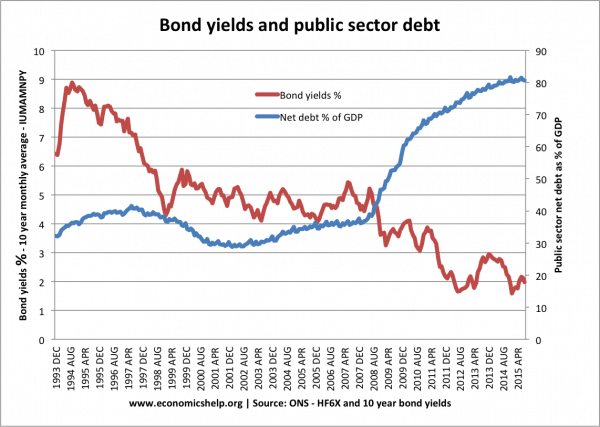
Yet, the UK, with one of highest budget deficits in Europe, and a rapidly increasing public sector debt, has still seen a significant fall in bond yields.

Recent UK Bond Yields
uk-bond-yields-10-year-monthly-average
Source: Bank of England - 10 year bond yields
David Cameron claims that the fall in bond yields is vindication of the governments resolve in pushing through spending cuts to bring down the deficit.

This may have played a small role. But, the main reason bond yields are so low is that we are in a liquidity trap, with strong demand for government bonds due to private investors preferring the security of government bonds to spending, investment or undertaking risky investment. When the UK economy recovers, we will see a rise in bond yields as investors become less attracted to government bonds with a low return.

Reasons for Falling Bond Yields

1. Prospects for Low Growth / Low inflation
  • When markets expect low growth and low inflation, they tend to move out of stocks and into bonds.The prolonged recession and poor outlook for 2013 means there is limited demand for buying private sector corporate bonds. Investors prefer the relative security of government bonds.
  • In a period of deflation and low return on private sector investment, bond yields of even 1% can offer a better return than cash under the bed.
2. Higher Saving Ratio 

  • Since Q1 2008, we have seen a strong rise in the saving ratio as people prefer to pay off debt, increase savings and reduce consumption.  Similarly firms are preferring to hold onto cash reserves rather than undertake risky investment. This is why in a liquidity trap, in a recession, governments can usually borrow more without causing higher interest rates. Demand for bonds is stronger in a recession.
If there was the prospect of higher economic growth, bond yields would tend to rise, as markets anticipated higher interest rates and better returns from the private sector.

3. Quantitative Easing

Quantitative easing has involved the creation of £375bn of new money, which has been  used to  purchase government bonds. The Central Bank buy bonds, pushing up prices and pushing down bond yields. If the Central Bank reversed quantitative easing, we would see a fall in bond prices and increase in bond yields.


Related

Comparison of Government Deficits

deficit

Highest budget deficits - Ireland, Japan, UK and US. Data 2010.

10 Year Bond Yields


bond-yields 
data for 2010

  • The link between size of budget deficit and bond yields is very weak.
  • Portugal and Spain have very high bond yields despite low borrowing.
  • US, Japan and UK have very low bond yields - despite highest levels of government borrowing

Monday, February 4, 2013

From the Luddites to the UK Unemployment Mystery

Some recent blog posts at economicshelp.


debt 

uk debt 

Total UK debt has risen to over 500% of GDP. One of biggest in world's second only to Japan. Don't panic!
  •  How bad is government debt? A popular question, but not so straightforward to answer. Why debt can be good or bad depending on when, for what, and how you borrow
  •  The Treasury View - What the Treasury view is in economics. It is actually a belief of economics that pre-dates the creation of macro-economics. In essence, it means balance the budget at all costs. To a large extent the UK treasury has been following this old fashioned 'Treasury view' 
  •  High Street shopping and buying online. Is window shopping on the high street becoming a free rider problem? 
 Quick links

Tuesday, January 15, 2013

New posts of 2013

Some new posts of 2013

Should the UK stay in the European Union? In the past few years, there have been a noticeable increase in the calls for the UK to consider leaving the European Union. Would it really be in our economic interests to go it alone? or does the EU still provide benefits which outweigh the costs?

One unexpected consequence of the UK's double dip recession has been a widening of the trade deficit (and Current account deficit). Should we worry? Does it mean a depreciation is imminent? or are trade deficits not important in a globalised economy?

ca

Economics and Positive Thinking. Could we really 'think' ourselves into recovery? Well probably not. But, a very optimistic a clear vision of economic growth would be much better than settling for a dismal decade of austerity and low growth. Europe could do with some vision for better economic times and low unemployment.

UK Economy 2013 A summary of the UK economy as it starts 2013. Also a look at prospects for growth and inflation in 2013. Will growth forecasts, once again prove over-optimistic?

EU's Policies for Economic Growth in 2013 Unfortunately, European supporters will not get much encouragement from looking through the EU's rather anaemic policies for economic growth in 2013 (which by the way, were the same policies as for 2012). An evaluation of policies, such as 'differentiated growth-friendly fiscal consolidation'. and 'kind of hoping for growth'


top10
Top 10 Economies   - How to measure the top 10 economies. Real GDP, Real GDP at PPP and Human development index (HDI)

Graph of the Week

graph 

Cinema's buck the post war trend. Cinema attendance in the UK

Economic Shorts
~

Tejvan

Economics Help at Twitter

Monday, January 14, 2013

Economic Problems of European Union

Since 2007, the EU has experienced a deteriorating economic situation. This has been most concerning for southern members of the Eurozone, such as Greece, Italy, Portugal and Spain. Economists fear that with the current EU economic problems, we could see a lost decade of high unemployment, low economic growth and deteriorating social conditions.


Main Problems Facing European Union
 
eu unemployment
  1. Unemployment. Unemployment in the EU has reached a critical point. In Spain, unemployment has increased to over 25%, and youth unemployment rates have reached 50%. The recent rise in EU unemployment is primarily due to the prolonged recession. Long term structural unemployment is also a problem.
  2. Prolonged Fall in GDP

  3. uk-us-port-spain-economic growthuk-us-port-spain-economic growthuk-us-port-spain-economic growth

    After the deepest recession since the 1930s, Europe has still not been able to recover. Weighed down by austerity measures and a weak global economy, the EU economy has fallen back into recession. The concern is that structural problems and the current monetary and fiscal policies will create several years of below trend economic growth. (Evaluation of EU Policies for economic growth)  
     
  1. Competitiveness Problem. The Euro has caused a divergence in competitiveness. Countries who face higher labour costs cannot regain competitiveness in the usual way through depreciation. Prices become uncompetitive, leading to lower domestic demand, and high current account deficits. Since 2011, current account deficits have fallen in countries like Ireland and Spain, but it has been at the high cost of reducing domestic demand and rising unemployment. Countries are seeking to regain competitiveness through internal devaluation (lower demand, pushing down prices) But, this is much more damaging to the economy than the traditional approach of depreciating exchange rates. more on EU competitiveness.
  2. The ECB is too concerned with low inflation The ECB has been accused of giving too much priority to the goal of low inflation. It is argued they have sought to maintain low inflation at the expense of lower growth. The ECB have rigidly stuck to an inflation target of 2%, despite the rise in unemployment and poor performance of nominal GDP.
  3. bond-yields


  4. Bond Yields. Membership of the Euro, has created a tendency for bond yields to rise much more quickly. After concerns were expressed over Greece, market fears soon spread to other Eurozone countries, like Ireland, Spain and Portugal. This increased borrowing costs and also put countries under pressure to pursue austerity measures to reduce budget deficits. However, these austerity measures have been implemented when the economy is already weak, causing a big negative multiplier effect and causing the economic downturn. Countries with their own currency and ability to print money have been able to maintain low bond yields, which reduces borrowing costs and gives them more time to reduce budget deficits. See more at Euro Debt crisis  - Note - although bond yields fell in last half of 2012, they are still higher than they should be, and there is concern without strict austerity, the ECB may be unable to prevent rising bond yields in the future.
  5. Stability and Growth Pact. This is a constraint on expansionary fiscal policy because in theory it limits governments borrowing to 3% of GDP. In a recession a European government is unable to use monetary policy (ECB set rates for whole Euro zone) but also they are unable to reflate the economy through higher spending and borrowing. 
  6. Inflexible Labour Markets. This is frequently held up as a constraint on economic growth and a cause of structural unemployment. In particular rigidities in the labour market discourage investment from abroad. For example in France there are laws which makes it difficult to fire workers once they are hired. This discourages firms from expanding and investing. Both the IMF and OECD have argued that further labour market liberalisation is needed to regain competitiveness. Even many of the European leaders acknowledge it is a necessity. However such reforms often face stiff opposition from powerful interest groups who wish to protect the interests of their members. Thus reform has proved very difficult and exceedingly slow. As Luxembourg’s Mr Juncker once said.
    We all know what to do, we just don’t know how to get re-elected after we’ve done it.”
  7. Demographic Changes. Countries like Germany and Italy have a declining birth rate. This means that the population structure is becoming weighted towards those who are over 50. The traditional population pyramid is being inverted. The increased demands placed on benefits and decline in tax revenue is a serious burden for government spending. It is reflected in burgeoning public debt. As of 2006 Italy’s public debt stood at 105%. German and France just below 70% of GDP. Such high levels of debt are argued to cause crowding out of private sector spending. Unfortunately this problem is likely to be exacerbated as the 1960s baby boomers retire. Again there is much opposition to the reform of generous state pensions.

See also:


References


Sunday, January 13, 2013

Benefits of European Union

The European Union is a political and economic union of 27 countries. Originally formed in 1958 by six countries (then the EEC), the EU has expanded in terms of size and integration.

Note: The Euro is a distinct concept to the European Union. The Euro is a Single Currency adopted by 16 of the EU members.

Some of the Benefits of the European Union include:
  1. Peace amongst nations - European Union countries are no longer at loggerheads like they were in the past. With the exception of Yugoslavia (who wasn't in the EU at the time), Europe has managed to heal the divisions which were so painfully exposed in the two World Wars in the Twentieth Century. The EU was awarded the Nobel Peace Prize in 2012.
  2. Economic development of countries like Portugal, Ireland and Spain. These countries made great strides in catching up with their other European neighbours. After the fall of Berlin Wall, Eastern European economies, such as Poland, Czech Republic and Hungary have also seen strong growth in real GDP..
  3. Free trade and removal of non-tariff barriers have helped reduce costs and prices for consumers. Over 60% of UK exports is to the EU. Trade within the EU has increased 30% since 1992.
  4. Environmental treaties which have sought to deal with European wide environmental problems such as acid rain, global warming, e.g. Commitment to use 20% renewable energy.
  5. Free movement of labour and capital have helped create a more flexible economy. For example, UK and Ireland have benefited from immigration of Eastern European workers. In the boom years, many eastern European workers moved to Ireland, but in the recession of 2009, returned home.
  6. Prospect of membership has helped modernise Turkey. Copenhagen Criteria enshrine commitment to human rights, rule of law and market economy. The prospect of gaining membership of the EU, encourage countries to implement human rights legislation.
  7. EU is one of strongest economic areas. It accounts for 20% of world GDP, from 6% of world's population.
  8. EU has enabled people to travel freely across national boundaries making trade and tourism easier and cheaper. According to the European Commission, more than 15 million EU citizens have moved to other EU countries to work or to enjoy their retirement.
  9. 1.5 million young people have completed part of their studies in another Member State with the help of the Erasmus programme. The possibility to study abroad is considered positive by 84% of EU citizens. (benefits of EU)
  10. Easier to use qualifications in different member countries. This makes it easier to work abroad without having to retrain in national qualifications.
  11. Mutual recognition of safety standards and rules have helped reduce costs for firms. This has encouraged the development of small and medium business who rely on low cost of exports.
  12. Social Charter enshrines protection for workers such as maximum working week, right to collective bargaining and fair pay for employment. (UK opted out).
  13. Countries in the EU, are amongst the highest positions in the Human Development Index (HDI)

Related

Monday, December 31, 2012

A quick look at economy 2013

A quick look at UK economy 2013. UK economy in 2013


economic-growth
How long will it take GDP to regain lost ground since 2008?

Unfortunately, Bank of England (and other forecasts) have often proved to be overly optimistic in the past few years and forecasts have later been downgraded. Will this happen in 2013?

Reasons to be Optimistic

  • Housing markets showing signs of recovery
  • Some growth in consumer spending and service sector
  • Unemployment stayed lower than might have been expected
  • Possibility GDP statistics underestimating output.
  • Bank lending costs falling.
  • The recession has to end sometime.
  • There's potential for growth in labour productivity in coming years
  • Hopes Eurocrisis is past its worse.

Reasons to be Pessimistic

  • Eurocrisis not really over. Falling bond  yields doesn't alter the fact Europe in painful deflationary recession. 
  • Eurocrisis and global slowdown will hit UK economy
  • Forecast of cost-push inflation in 2013 will keep squeeze on living standards.
  • No let up in government austerity as they miss budget deficit targets
  • Quantitative easing hasn't really worked.
  • Consumer confidence at all time low
  • Labour productivity growth has been negative in past few years.

Well, however, economy fares in 2013, I hope your own year proves to be better!

More at UK economy in 2013

Wednesday, December 12, 2012

Economics Update 11th December 2012


tax-avoidance 

Portugal in Crisis

Readers Question: Can you tell what Portugal has done to reduce the Current Account as % GDP deficit so steeply?


The reduction in the Portuguese deficit is quite striking. From what I can gather, essentially, the rapid reduction in the current account is due to a sharp fall in consumer spending on imports, combined with some growth in exports – helped by improvements in unit labour costs. But, the Portuguese economy remains deeply depressed.
portugal-real-gdp-growth-q32010-q3-2012

 see also: Portugal Economic crisis

EU Competitiveness

competitiveness 

 In the lead up to the Euro debt crisis, there was a marked divergence in competitiveness within the Eurozone. In fact, some economists suggested that the currency imbalances were the root cause of the Eurozone fiscal crisis.  However, recent evidence suggests some restoration of competitiveness within the Eurozone. See: the extent of EU competitiveness improvements

How Important are Credit Ratings?

Do you remember all those sub-prime mortgage bundles which caused the credit crisis? These mortgage bundles which later proved to be almost worthless were, for a considerable period, given a AAA credit rating by rating agencies. Even Greece, now on the verge of insolvency, maintained an A credit rating until May 2009. ( What did a credit rating of A mean for Greece? It meant the credit rating agencies didn’t really know what was coming quite soon. (nor the rest of the market either)

Because credit ratings are a highly visible signal, they can perhaps gain more political importance than they perhaps deserve. A triple AAA credit rating sounds good. (Plus, it’s much easier to explain to the public than the ‘merits of expansionary fiscal policy in a liquidity trap’.)

- more on should we worry about losing our AAA credit rating?

The Decline of the Coal Industry

coalmine 

An essay looking at the long decline of the UK coal industry.


Graph of the Week

industrial-production  

Triple dip recession in UK likely. OBR budget deficit forecasts make grim reading too.

Reasons for US Budget Deficit

deficit 

 A look at why the US deficit is so large. Spot the recession.

Quick Links