See part 1: Economics of the Naughties
Financial Markets need regulating.
Financial deregulation has been a disaster. Unchecked, the credit crisis shows that financial institutions can make basic mistakes in the pursuit of risky profit. Supporters of the free market have vainly tried to show the irresponsible loans of the naughties was actually due to government pressure. But, this is misleading, it was unregulated financial companies who made the vast majority of loans that had no chance of being repaid. There was a complete failure to adequately measure the level of risk involved in the buying of subprime loans. Somehow many of the NINJA mortgages (no income, no job) were rebundled, repacked and bundled as triple AAA credit rating. Western banks took these mortgages on, and it was the taxpayer who had to bailout their mistakes. Many banks pursued risky strategies of reducing liquidity ratios. There was a temptation to achieve short term profits by borrowing short to lend long. Northern Rock was once proud of it 125% mortgages. But, when the credit crisis hit, they were left unable to finance its positions. It was only when credit markets froze that they realised their business structure was flawed.
The Problem of Moral Hazard
A real problem we have is that banks acted on a premise of invulnerability. As we mentioned in this post, bankers often have an incentive to pursue risk. (problem of bank bonuses) Heads they win - tail the taxpayers lose. This is still a pressing issue - how to balance the need to ensure banking stability and prevent bank runs, without giving bankers a green light to pursue the most irresponsible strategy - knowing if they mess up someone else will clean it up.
One Tool Does Not fit
In the middle of the 2000s, it seemed that interest rates were the magic wand of the central bank to achieve any economic goal they wanted. Alas, this is not the case. Managing the economy is much more difficult that just changing interest rates. An interest rate cannot maintain strong growth, target inflation, and target asset bubbles all at the same time.
Keynesian economics
At the start of the recession, interest rates were slashed from 5% to 0%, without effect. We were in a liquidity trap where rate cuts may have no effect. In a liquidity trap, there is need for more - expansionary fiscal policy, quantitative easing. Faced with the failure of markets and the prospect of another Great Depression. The analysis of Keynes from the 1930s became very important.
Government Borrowing is necessary in a recession
One of the difficult things has been to explain, though government borrowing is bad, it would be even worse to try and reduce borrowing in the middle of a recession.
A boom is a time to reduce deficits.
Hindsight is a wonderful thing. But, at the height of the boom the decision to increase government borrowing was a painful mistake. America cut taxes and increased military spending. The UK increased spending on social security and health care. This meant both had large deficits before the recession started. This reduced room for maneouvre when the recession came.
Inflation Target can be Misleading
The central policy target of both UK and US was low inflation. With low inflation, neither governments could believe they were in the middle of an unsustainable boom. The low inflation rate, masked a boom in asset prices caused by unsustainable lending. A stable economy doesn't just need low inflation it needs stable asset prices, and sustainable bank lending.
Related

Tuesday, December 22, 2009

Monday, December 21, 2009
Economics of the Naughties
At the turn of the millennium, the landscape of economics was quite different. It was a period when major economies like the US and UK briefly had budget surpluses. It was a period of great optimism with people talking about the end of business cycle. For many analysts the world economy was living proof of the triumph of market forces, the efficient market hypothesis, and belief in the strength of unchecked capitalism. Yet, at the end of the decade, the global economy is still reeling from the biggest crisis since the Great Depression of the 1930s.
Here's a brief overview of some of the major economic events in the past decade.
The 2001 Recession
The terrorist attacks of 2001, contributed to a sharp downturn in the US economy leading to a mild recession. Faced with plummeting markets and falling output, the Federal Reserve acted quickly to cut interest rates and restore economic growth. The ease with which the Federal Reserve averted a prolonged downturn led to a round of self-congratulation amongst leading policy makers. As Paul Krugman noted 1997, it really did seem that:
It was also a period of financial deregulation, and financial innovation. Rising house prices encouraged a rash of new mortgage types. Never had it been so easy to get a mortgage. The combination of low interest rates and financial deregulation encouraged a new generation of homeowners to take out mortgages that previously would have been unthinkable. Based on a great sense of optimism of (seemingly) permanently rising house prices, banks seemed willing to lend a mortgage to just about anyone who could sign on a dotted line.
In the middle of a boom, the US cut income taxes and the UK increased government spending. Both of which caused a structural budget deficit. This worried few people at a time of prosperity, but was to become much more significant later.
Boom and Bust
With low inflation, low unemployment and strong growth. It appeared policy makers had achieved the holy grail of economic stability and constant growth. Talk of the end of the business cycle was common.
But, this stability masked an asset boom and a rise in unsustainable subprime lending, that nobody seemed to be aware about. At the start of 2006, few if any could have predicted how fragile the global financial system was. Healthy profits masked a much different story.
After keeping interest rates too low for too long, in 2005-06, the Federal Reserve finally began to increase interest rates. Nothing spectacular, interest rates were increased to 5%. But, even this modest rise in interest rates sparked one of the most spectacular wave of loan defaults the world economy has ever seen. It was only after a modest rise in interest rates that people started to realise how absurd many mortgage deals had been made.
After rising inexorably and against many optimistic forecasts (see: Books they wish they hadn't written ), US House prices started to fall and nervous banks started to realise alot of their sub-prime mortgages had all the foundations of a sand castle, based on the assumption the sea would always keep retreating.
In other times, this wave of mortgage defaults may have stayed in America. But, thanks to financial deregulation and a collective amnesia in analysing risk, the financial community had very nicely spread these toxic subprime loans all around the global financial system, rebundling them into seemingly anonymous Collateral Debt Obligations CDOs. If you don't understand what a CDO is, it seems many professional bankers didn't really know what they were buying either.
The result was that suddenly the liquidity evaporated from the global banking system. Everyone was hurrying to try and improve their balance sheets and recall toxic loans. But, it was too late, no-one wanted to lend to each other anymore. The cleverest and riskiest banking strategies now appeared for what they were - a recipe for self-bankruptcy. It all seemed like a bad joke, except, it was a very expensive joke with the taxpayer paying - see humorous look at sumprime crisis)
For more details see step by step Credit Crunch explained -
In the summer and autumn of 2008, it appeared no financial institution was safe. Just when you thought it could get no worse, another huge financial company announced they were on the verge of bankruptcy. Northern Rock, Bradford & Bingley, JP Mogan, Citigroup (to list but a small number who received government bailouts). Mostly, the taxpayer rode to the rescue and bailed out the banks with mind blowing sums. But, for whatever reason, when it came to Lehman Brothers, the American authorities decided to say "sorry, but, no". It was perhaps a brave and courageous decision. But, it was a decision they were to quickly regret. Financial markets and consumers panicked - the great assumption that no bank could possibly fail was suddenly exposed as a myth. Now, no bank now was safe. The only thing to do well was gold and mattresses as people sought to hoard their wealth in gold or cash under the bed.
The crisis precipitated the biggest fall in GDP since the great depression. In fact the start of the 2008 recession was just as severe as the Great Depression. With collapsing house prices, banks on the verge of bankruptcy, and confidence hammered, there was a real possibility of another depression.
To be fair after making so many mistakes in allowing the bubble and credit crunch, the response of governments to the crisis was reasonable. At least some of the mistakes of the Great Depression had been learnt. Though it is a bitter pill to swallow, governments prevented more bank collapses with bailouts. Interest rates were slashed, expansionary fiscal policy was pursued and even the unorthodox monetary policy of quantitative easing was pursued to avoid the great threat of deflation.
The most pessimistic forecasts of another depression have been averted. But, that doesn't mean all is well. Far from it. Banks still nurse fragile balance sheets, economies are being propped up with unprecedented government intervention. Public debt has ballooned creating real threats of government default in various western economies. The recovery will be very difficult. Trying to balancing record debt against the need to maintain growth.
It was also a decade where the problems of global warming became increasingly apparent. But, a problem the global community seem unable or unwilling to tackle. If the scientific forecasts for global warming prove correct, the credit crisis could seem a minor problem compared to the devastation caused by rising sea levels and weather crisis.
Tomorrow:
Lessons from the Economics of the Naughties.
Here's a brief overview of some of the major economic events in the past decade.
The 2001 Recession
The terrorist attacks of 2001, contributed to a sharp downturn in the US economy leading to a mild recession. Faced with plummeting markets and falling output, the Federal Reserve acted quickly to cut interest rates and restore economic growth. The ease with which the Federal Reserve averted a prolonged downturn led to a round of self-congratulation amongst leading policy makers. As Paul Krugman noted 1997, it really did seem that:
“If you want a simple model for predicting the unemployment rate in the United States over the next few years, here it is: it will be what [Alan] Greenspan wants it to be, plus or minus a random error reflecting the fact that he is not quite God.” (When Greenspan was nearly God)
It was also a period of financial deregulation, and financial innovation. Rising house prices encouraged a rash of new mortgage types. Never had it been so easy to get a mortgage. The combination of low interest rates and financial deregulation encouraged a new generation of homeowners to take out mortgages that previously would have been unthinkable. Based on a great sense of optimism of (seemingly) permanently rising house prices, banks seemed willing to lend a mortgage to just about anyone who could sign on a dotted line.
In the middle of a boom, the US cut income taxes and the UK increased government spending. Both of which caused a structural budget deficit. This worried few people at a time of prosperity, but was to become much more significant later.
Boom and Bust
With low inflation, low unemployment and strong growth. It appeared policy makers had achieved the holy grail of economic stability and constant growth. Talk of the end of the business cycle was common.
But, this stability masked an asset boom and a rise in unsustainable subprime lending, that nobody seemed to be aware about. At the start of 2006, few if any could have predicted how fragile the global financial system was. Healthy profits masked a much different story.
After keeping interest rates too low for too long, in 2005-06, the Federal Reserve finally began to increase interest rates. Nothing spectacular, interest rates were increased to 5%. But, even this modest rise in interest rates sparked one of the most spectacular wave of loan defaults the world economy has ever seen. It was only after a modest rise in interest rates that people started to realise how absurd many mortgage deals had been made.
After rising inexorably and against many optimistic forecasts (see: Books they wish they hadn't written ), US House prices started to fall and nervous banks started to realise alot of their sub-prime mortgages had all the foundations of a sand castle, based on the assumption the sea would always keep retreating.
In other times, this wave of mortgage defaults may have stayed in America. But, thanks to financial deregulation and a collective amnesia in analysing risk, the financial community had very nicely spread these toxic subprime loans all around the global financial system, rebundling them into seemingly anonymous Collateral Debt Obligations CDOs. If you don't understand what a CDO is, it seems many professional bankers didn't really know what they were buying either.
The result was that suddenly the liquidity evaporated from the global banking system. Everyone was hurrying to try and improve their balance sheets and recall toxic loans. But, it was too late, no-one wanted to lend to each other anymore. The cleverest and riskiest banking strategies now appeared for what they were - a recipe for self-bankruptcy. It all seemed like a bad joke, except, it was a very expensive joke with the taxpayer paying - see humorous look at sumprime crisis)
For more details see step by step Credit Crunch explained -
In the summer and autumn of 2008, it appeared no financial institution was safe. Just when you thought it could get no worse, another huge financial company announced they were on the verge of bankruptcy. Northern Rock, Bradford & Bingley, JP Mogan, Citigroup (to list but a small number who received government bailouts). Mostly, the taxpayer rode to the rescue and bailed out the banks with mind blowing sums. But, for whatever reason, when it came to Lehman Brothers, the American authorities decided to say "sorry, but, no". It was perhaps a brave and courageous decision. But, it was a decision they were to quickly regret. Financial markets and consumers panicked - the great assumption that no bank could possibly fail was suddenly exposed as a myth. Now, no bank now was safe. The only thing to do well was gold and mattresses as people sought to hoard their wealth in gold or cash under the bed.
The crisis precipitated the biggest fall in GDP since the great depression. In fact the start of the 2008 recession was just as severe as the Great Depression. With collapsing house prices, banks on the verge of bankruptcy, and confidence hammered, there was a real possibility of another depression.
To be fair after making so many mistakes in allowing the bubble and credit crunch, the response of governments to the crisis was reasonable. At least some of the mistakes of the Great Depression had been learnt. Though it is a bitter pill to swallow, governments prevented more bank collapses with bailouts. Interest rates were slashed, expansionary fiscal policy was pursued and even the unorthodox monetary policy of quantitative easing was pursued to avoid the great threat of deflation.
The most pessimistic forecasts of another depression have been averted. But, that doesn't mean all is well. Far from it. Banks still nurse fragile balance sheets, economies are being propped up with unprecedented government intervention. Public debt has ballooned creating real threats of government default in various western economies. The recovery will be very difficult. Trying to balancing record debt against the need to maintain growth.
It was also a decade where the problems of global warming became increasingly apparent. But, a problem the global community seem unable or unwilling to tackle. If the scientific forecasts for global warming prove correct, the credit crisis could seem a minor problem compared to the devastation caused by rising sea levels and weather crisis.
Tomorrow:
Lessons from the Economics of the Naughties.
Monday, December 7, 2009
US Economy in 2010
After the deepest recession since the Great Depression, there is understandably considerable relief at the first signs of growth in the US. Recent job figures also suggest the economy has turned. However, some commentators worry that these first greenshoots could lead to a complacent feeling and that the US economy still faces many weakness in 2010.
This graphs shows the extent of the decline in economic output. The recession of 2009 easily dwarves the modest decline of 2001. The red line indicates the potential rate of economic growth. This shows how much spare capacity will exist in the US economy in 2010, this will make it difficult to tackle the unemployment problem. The sharp rise in unemployment is perhaps the biggest problem facing the US economy. Like the UK, the rise in unemployment has been muted by a fall in working hours and increase in temporary employment. The bad news is that the forecast for unemployment in 2010 and 2011 is for a continued period of high unemployment.
 Unemployment rates in 2010 and 2011 - source: P.Krugman


The Dollar in 2010
 Many people might be a little surprise at how much the dollar rallied from the summer of 2008. But, this year, the dollar has regained its downward momentum, and it is hard to see a reversal in the dollar fortunes given state of economy.

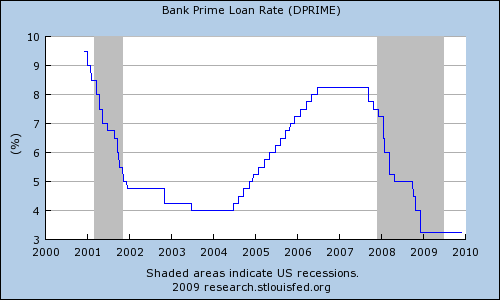
There are some who apparently worry about inflation prospects in the US. But, I still feel the US has more to fear from inflation than deflation. Inflation is likely to remain low during 2010 because of the spare capacity and lack of wage pressures. As a consequence, interest rates are likely to remain low throughout 2010.

Related
Image Sources: St Louis Fed
Economic Growth and Spare Capacity
This graphs shows the extent of the decline in economic output. The recession of 2009 easily dwarves the modest decline of 2001. The red line indicates the potential rate of economic growth. This shows how much spare capacity will exist in the US economy in 2010, this will make it difficult to tackle the unemployment problem.
Unemployment in US
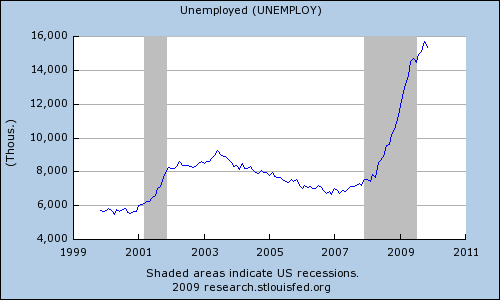 The sharp rise in unemployment is perhaps the biggest problem facing the US economy. Like the UK, the rise in unemployment has been muted by a fall in working hours and increase in temporary employment. The bad news is that the forecast for unemployment in 2010 and 2011 is for a continued period of high unemployment.
Forecast for US Unemployment
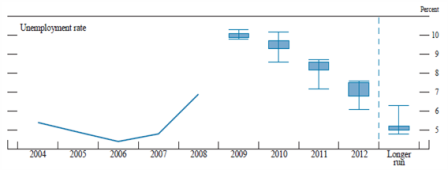 Unemployment rates in 2010 and 2011 - source: P.Krugman
The Problem with US Banking Sector
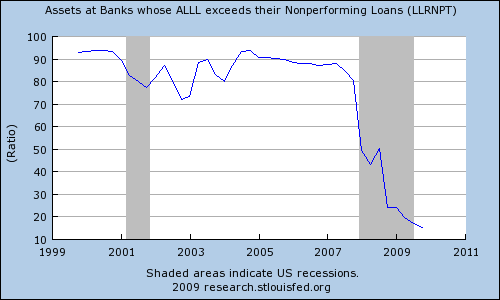
As we mentioned in a recent post - Worries over future home foreclosures - the US banking sector still faces more potential losses from home repossessions. This graph shows how much banks have been affected by the housing market crash and credit crunch. It will take a long time for banks to recover balance sheets and ability to lend like before the crash.Assets of US Banks
Budget Deficit
The US budget deficit continues its remorseless rise. Now over $12 trillion, it continues to rise as a % of GDP. It has also become an important political issue. With more voters apparantely concerned about the deficit than unemployment. The debt is a long term problem, but, efforts to reduce it in the short term could dampen the economic recovery and push the economy back into recession.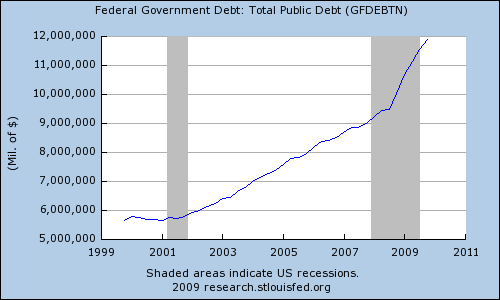
The Dollar in 2010
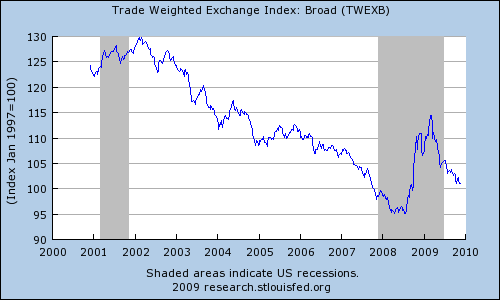 Many people might be a little surprise at how much the dollar rallied from the summer of 2008. But, this year, the dollar has regained its downward momentum, and it is hard to see a reversal in the dollar fortunes given state of economy.
Inflation and Interest Rates
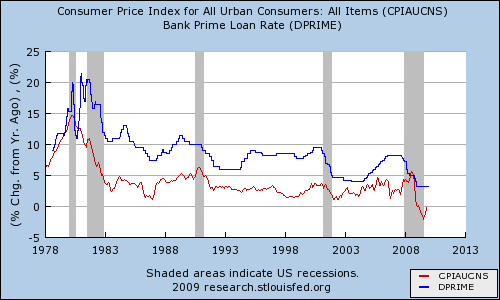
There are some who apparently worry about inflation prospects in the US. But, I still feel the US has more to fear from inflation than deflation. Inflation is likely to remain low during 2010 because of the spare capacity and lack of wage pressures. As a consequence, interest rates are likely to remain low throughout 2010.
Related
Image Sources: St Louis Fed
Thursday, November 26, 2009
Falling Dollar
For the past decade, the US Dollar has been weak, falling against a basket of currencies. A falling dollar has many implications for both the US and world economy. It is not necessarily a bad thing. A falling dollar, in many ways, is necessary to readjust the global and US economy.
Due to a decline in competitiveness and a low domestic saving ratio, the US has been running a current account deficit. Basically, they are buying more imports of goods and services than they export. A current account deficit puts downward pressure on the dollar, especially as capital flows to finance the deficit dry up. Even after a recession and a rise in domestic spending, the US current account deficit remains persistently high (at $500bn). Some economists say a current account deficit is nothing to worry about and reflects the US ability to attract capital. But, there are signs that overseas investors are becoming less willing to buy US assets.
Long Term Changes in Structure of Global Economy.
In the post war period, the US economy was the world's largest and dominant economy. This meant the US dollar was the global reserve currency and used to denominate oil and gold prices. With the rise of China and India, and the Euro, the US economy is becoming relatively smaller. Thus, it is slowly and gradually losing its status as the world's reserve currency, which is pushing down the dollar.
Worries over Debt and Inflation.
The US is certainly not alone in having a rise in public sector debt. However, the recession and financial bailout is pushing US public sector debt towards 100% of GDP. Since the Federal Reserve is also pursuing quantitative easing (creation of dollar) investors are becoming more nervous about dollar assets. They fear, a prolonged policy of increasing money supply could lead to inflation and devalue the dollar.
Low Interest Rates
Low interest rates make it less attractive to save in the US; this should lead to lower demand for dollars and weaken currency. However, because many other countries (such as Eurozone) are experiencing volatility, investors are willing to buy dollar assets, even though interest rates are quite low
Related
Reasons for Falling Dollar
Persistent US Current account deficit.Due to a decline in competitiveness and a low domestic saving ratio, the US has been running a current account deficit. Basically, they are buying more imports of goods and services than they export. A current account deficit puts downward pressure on the dollar, especially as capital flows to finance the deficit dry up. Even after a recession and a rise in domestic spending, the US current account deficit remains persistently high (at $500bn). Some economists say a current account deficit is nothing to worry about and reflects the US ability to attract capital. But, there are signs that overseas investors are becoming less willing to buy US assets.
Long Term Changes in Structure of Global Economy.
In the post war period, the US economy was the world's largest and dominant economy. This meant the US dollar was the global reserve currency and used to denominate oil and gold prices. With the rise of China and India, and the Euro, the US economy is becoming relatively smaller. Thus, it is slowly and gradually losing its status as the world's reserve currency, which is pushing down the dollar.
Worries over Debt and Inflation.
The US is certainly not alone in having a rise in public sector debt. However, the recession and financial bailout is pushing US public sector debt towards 100% of GDP. Since the Federal Reserve is also pursuing quantitative easing (creation of dollar) investors are becoming more nervous about dollar assets. They fear, a prolonged policy of increasing money supply could lead to inflation and devalue the dollar.
Low Interest Rates
Low interest rates make it less attractive to save in the US; this should lead to lower demand for dollars and weaken currency. However, because many other countries (such as Eurozone) are experiencing volatility, investors are willing to buy dollar assets, even though interest rates are quite low
Related
Monday, November 9, 2009
Tobin Tax
Definition of Tobin Tax
- A Tobin tax is the name given to a specific tax placed on currency transactions.
- It was proposed by economist, James Tobin, as a way of stabilising currency markets.
- The idea is that by increasing the marginal cost of currency transactions it reduces the incentive to speculate on currency movements. In theory, this prevents destabilising swings in currencies.
- Tobin initially proposed a tax of 1% on all currency trades. This has subsequently been reduced to lower figures such as 0.25%. One UK proposal suggested a Tobin tax as low as 0.01%
Advantages of a Tobin Tax
- By placing a tax on currency trades, it makes currency trading slightly less attractive. By marginally increasing the cost of currency trading there should be a reduction in speculative trading, leading to greater exchange rate stability in floating exchange rate systems.
- Raises Revenue. The global trade in currencies has grown at a very rapid rate. In 2007, the global currency market was worth $3,200 billion a day in 2007, or £400,000 billion per annum. Of this, trade in Pound Sterling as £34,000 bn a year.
- A tax set at 0.01% on just Sterling trades would raise £2bn a year. A tax on global currency trades could raise significant sums.
- Redistribution from Financial Sector to Developing World. The idea of a Tobin Tax is often seen as a good way to redistribute income from developed world to the developing world. The idea has been seized upon by many aid charities and anti-globalisation protesters. Though James Tobin has often stated that the main purpose of the tax is not about raising revenue and redistributing wealth, but its impact on reducing speculation.
- After damage created by speculative investments such as derivatives and futures trading. There has been greater support for intervention to reduce speculative buying in financial markets.
Arguments Against Tobin Tax
- Difficult to tax all transactions, it may encourage investors to find ways around the tax.
- Decline in currency flows may harm functioning of markets and lead to poor liquidity in currency markets.
- Tax may be insufficient to prevent speculative flows and currency movements which are driven by economic fundamentals.
- A tax may discourage 'hedging' which is a way of insuring against currency movements rather than discouraging speculation.
- If it was introduced unilaterally in one country, e.g. UK then it would lead to loss of financial business as firms trade in other currencies / countries
- There may be better ways to deal with speculation e.g. placing lump sum insurance schemes on financial firms who invest in speculative markets.
A Tobin tax is more than just a measure to tax 'undeserving financial speculators' It is not going to undermine the world economy as some of the more extravagant claims may suggest. On balance, it is a sensible policy with many benefits - both economic and social.
Monday, November 2, 2009
Problems Facing UK Economy in 2010
It's been a bad 12 months for the UK economy. 2010, should see some kind of economic recovery. But, few are expecting a rapid rebound. These are some of the problems facing the UK economy, into 2010.
Depth of the Recession.
Typically, the UK economy expands at an average underlying trend rate of about 2.5%. Even zero growth will lead to a growth in spare capacity and unemployment. After 6 consecutive quarters of falling GDP, the output gap is significant. This means output is significantly below potential, firms will be reluctant to hire. There is a danger that the recession will lead to a permanent loss of output and jobs and shrink the UK's productive capacity .
Unemployment.
The Bank has an inflation target of 2%, but it is unemployment which creates the most social / personal misery. So far, the rise in unemployment has been relatively muted, at least, given the scale of recession. However, this slow rise in unemployment means it will be slower to fall. After the 1992 recession, unemployment fell relatively quickly, but after this recession, the fall in unemployment is likely to be slower - more like the experience of the 1980s where unemployment remained close to 3 million for several years. In particular, it is young workers who have been hardest hit. The fear is that prolonged youth unemployment could lead to a return to the unemployment related social unrest, characteristic of the early 1980s.
Budget Deficit.
In the past few years, the UK's public finances have taken a real battering, leading to record peace time deficits. We relied on bubble taxes (property taxes, income tax on bonuses e.t.c) to help fuel inflation beating rises in government spending. Yet, these tax sources have dried up leading to a budget deficit approaching £200bn.
The dilemma is that, although the budget deficit continues to rise towards 100% of GDP, reducing the deficit too early could push the economy back into recession. For example, if the Conservatives were to implement their plans for spending cuts next year, the deflationary effect could well push a fragile economy back into recession.
Problems of Prolonged Borrowing
Economic necessity will make it difficult to tackle the budget deficit. But, this means the budget deficit will continue to grow and this brings future problems. If debt grows too quickly towards 100% of GDP, it may effect the UK's credit rating. This would make it more expensive to borrow and pay the debt interest payments.
In the longer term, there is a also a fear relating to the size of the debt and quantitative easing. Increasing the money supply, rises the prospect of future inflation and a weaker sterling. At the moment, there is little real fear of inflation and a weak pound is helping the economy to recover. But, there is a danger continued high levels of borrowing could weaken pound and could create future inflation.
Trade Deficit / Unbalanced Economy
The UK has been running a current account deficit, more or less since the recession of 1981. The economy has relied on services and the financial sector. We have struggled to remain competitive in the manufacturing / industrial sector leading to a trade deficit. Often the problems of trade deficits / decline in manufacturing are exaggerated, but the UK economy does still feel unbalanced and this is one reason why the UK economy was hit by the recession much more than other countries.
Propensity to Boom and Bust
I have written about the problems of UK housing market in more detail here. Yet, the continued shortage of supply means the UK will be sensitive to future booms and busts. It is hard to believe house prices have risen so much in the middle of a recession - a sign of the fundamental imbalances which exist in the housing market.
Weak Sterling
At the moment, I don't see the weak sterling as an economic problem. The depreciation has helped to limit the fall in economic growth and, over time, will help to rebalance the economy and reduce trade deficit. But, if sterling continues to be weak over the longer term, there could be inflationary risks and a decline in living standards as imports become more expensive.
Demographic Changes - An ageing population and unfunded pension deficits, will make the governments public finances more difficult in the future.
These problems, could equally be applied to the US economy. I think one important issue is to be clear on which problem is the most serious. For example, government borrowing is a definite problem. But, although it is very serious, it is more important to worry about the loss of output and unemployment first.
Related
Tuesday, October 27, 2009
The Economic Wealth Effect 2009
2008, saw a precipitous decline in UK wealth. UK wealth fell to £5.8 trillion at the end of 2008. A decline of £844bn or 13%. The decline in wealth was a combination of a £394bn fall in housing wealth and a £450bn
Although, in 2009, house prices have stabilised and stock markets have showed signs of recovery, the outlook still looks bad with wealth expected to decline a further £251bn in 2010.
Whilst these declines in wealth are dramatic, they should also be placed in context of rapidly rising wealth during the long house price boom since the mid 1990s. Rising house prices contributed to growing wealth inequality between property owners and non-property owners. Wealth is still much higher than in the mid 1990s.
See - wealth effect
Economists generally agree that wealth has at least some impact in influencing consumer spending. For example, rising house prices help to boost consumer spending for two reasons.
Changes in wealth do not always directly affect consumer spending. Most households do not tie their spending to the value of their house. For most people a rise in house prices doesn't mean much because they can't access it. Although re-mortgaging is popular, it is only taken up by a minority of households.
Yet, the sustained decline in wealth we have seen since the start of 2008, will effect the economy in 2010 and 2011, lower wealth will lead to higher savings and make a recovery slower. The UK economy may have to look for more diverse sources of economic growth than consumer spending. - And that of course may be no bad thing.
Although, in 2009, house prices have stabilised and stock markets have showed signs of recovery, the outlook still looks bad with wealth expected to decline a further £251bn in 2010.
Whilst these declines in wealth are dramatic, they should also be placed in context of rapidly rising wealth during the long house price boom since the mid 1990s. Rising house prices contributed to growing wealth inequality between property owners and non-property owners. Wealth is still much higher than in the mid 1990s.
See - wealth effect
Impact of wealth on Economy
Economists generally agree that wealth has at least some impact in influencing consumer spending. For example, rising house prices help to boost consumer spending for two reasons.
- Householders feel more confident to spend. Saving rates tend to fall because householders view housing equity as a form of saving. It is no coincidence the saving rate has started to rise as house prices have fallen.
- Equity withdrawal. Rising house prices give households the opportunity to re-mortgage their house and spend the extra money. This source of consumer spending was quite significant up to 2007
Changes in wealth do not always directly affect consumer spending. Most households do not tie their spending to the value of their house. For most people a rise in house prices doesn't mean much because they can't access it. Although re-mortgaging is popular, it is only taken up by a minority of households.
Yet, the sustained decline in wealth we have seen since the start of 2008, will effect the economy in 2010 and 2011, lower wealth will lead to higher savings and make a recovery slower. The UK economy may have to look for more diverse sources of economic growth than consumer spending. - And that of course may be no bad thing.
Monday, October 19, 2009
Solutions to Unemployment
A recent report, by Professor Steve Fothergill, suggests that the real level of unemployment is already closer to 3.4 million - much higher than the 1.6m official claimant count statistics suggest (link)

Undoubtedly, the main cause of unemployment is the current recession and output gap. With demand falling, firms have spare capacity and so are employing less workers. This is why we have:
Employment Subsidies
An employment subsidy could be given to firms who keep on workers part time during the recession. This saves the government the cost of unemployment benefits and prevents workers being idle and losing on the job training. However, the danger of employment subsidies is that they may be misused by firms who see an opportunity to gain extra income. It is also difficult for the government to decide which workers / firms to subsidise.
Cutting Minimum Wages
With stagnant nominal wage growth, the minimum wage is more at risk of causing real wage unemployment. - wages above equilibrium levels. A cut in minimum wages could create extra job opportunities. However, there is no guarantee that cutting wages actually creates jobs. Since the minimum wage was introduced in 1999, successive increases were compatible with a period of falling unemployment. Cutting wages would also reduce overall demand in the economy, creating less demand for workers.
Education and Training of Long Term Unemployed.
Whilst the majority of current unemployment is cyclical, even before the current recession there were pockets of structural unemployment related to a lack of skills. Relevant skills and training programmes would help the long term unemployed get back into work. Few economists would have any objection to the principle of retraining the unemployed. It is essential the skills and education is highly relevant to the needs of the workforce. However, it is a policy often easier to say than actually do. I don't know a time when we haven't talked about the need to improve education and training. But, I do believe that in the UK, too much emphasis is placed on getting 50% of young people a degree when insufficient money is spent on vocational training.
Reclassification of Incapacity Benefits.
The report mentioned above, suggests that many long term unemployed have been given incapacity benefits when there are still jobs they could do. Rather than conveniently putting people on incapacity benefits, more attention could be given to retraining workers for non-manual labour. The potential cost savings of reducing dependence on sickness benefits are significant. Though it will be a difficult balancing act to prevent those really incapable of work being withdrawn from necessary welfare support. Also, this policy will not reduce the official claimant count, but will increase employment rates.
Flexible Labour Markets.
Many economists have suggested high levels of structural unemployment are due to inflexible labour markets. For example, if it is difficult to hire and fire workers this can discourage firms from employing workers in the first place. Arguably this is a much bigger issue in European countries such as France and Spain.
Shorter Working Week.
The theory is that if workers are doing 40 hour weeks, then reducing the week to 30 hours will lead to an increase in the number of workers employed. However, in practise, it is rarely as simple as that. The shorter working week can also act as hindrance to firms.
Geographical Subsidies.
The geographical spread of unemployment is not as bad as in the 1980s, but the north south gap still exists. Of the top 20 areas of unemployment all are above the line from the Wash to the Severn. It is again manufacturing output in the UK's industrial heartlines that has been hardest hit. The fall in manufacturing output 13% is double the fall in GDP 6%. Subsidies / tax breaks may be need to encourage firms to open in relatively more depressed areas.
Weak Pound and Restructuring of Economy.
The weak pound does make UK exports more competitive. It may help manufacturing relative to the consumer sector. In the long term, when the global economy recovers, this boost in exports may help create manufacturing jobs in the north.
Related Posts on Reducing unemployment
The report suggests the real unemployment level is higher because there are many people unemployed but not entitled to unemployment benefits. (see also: What is true level of unemployment in UK)
In September, the employment rate fell to 72% and the official unemployment rate rose to 8.0%
Solutions to Unemployment
1. Demand Side Policies.Undoubtedly, the main cause of unemployment is the current recession and output gap. With demand falling, firms have spare capacity and so are employing less workers. This is why we have:
- 0.5% interest rates
- expansionary fiscal policy
- Quantitative easing.
Employment Subsidies
An employment subsidy could be given to firms who keep on workers part time during the recession. This saves the government the cost of unemployment benefits and prevents workers being idle and losing on the job training. However, the danger of employment subsidies is that they may be misused by firms who see an opportunity to gain extra income. It is also difficult for the government to decide which workers / firms to subsidise.
Cutting Minimum Wages
With stagnant nominal wage growth, the minimum wage is more at risk of causing real wage unemployment. - wages above equilibrium levels. A cut in minimum wages could create extra job opportunities. However, there is no guarantee that cutting wages actually creates jobs. Since the minimum wage was introduced in 1999, successive increases were compatible with a period of falling unemployment. Cutting wages would also reduce overall demand in the economy, creating less demand for workers.
Education and Training of Long Term Unemployed.
Whilst the majority of current unemployment is cyclical, even before the current recession there were pockets of structural unemployment related to a lack of skills. Relevant skills and training programmes would help the long term unemployed get back into work. Few economists would have any objection to the principle of retraining the unemployed. It is essential the skills and education is highly relevant to the needs of the workforce. However, it is a policy often easier to say than actually do. I don't know a time when we haven't talked about the need to improve education and training. But, I do believe that in the UK, too much emphasis is placed on getting 50% of young people a degree when insufficient money is spent on vocational training.
Reclassification of Incapacity Benefits.
The report mentioned above, suggests that many long term unemployed have been given incapacity benefits when there are still jobs they could do. Rather than conveniently putting people on incapacity benefits, more attention could be given to retraining workers for non-manual labour. The potential cost savings of reducing dependence on sickness benefits are significant. Though it will be a difficult balancing act to prevent those really incapable of work being withdrawn from necessary welfare support. Also, this policy will not reduce the official claimant count, but will increase employment rates.
Flexible Labour Markets.
Many economists have suggested high levels of structural unemployment are due to inflexible labour markets. For example, if it is difficult to hire and fire workers this can discourage firms from employing workers in the first place. Arguably this is a much bigger issue in European countries such as France and Spain.
Shorter Working Week.
The theory is that if workers are doing 40 hour weeks, then reducing the week to 30 hours will lead to an increase in the number of workers employed. However, in practise, it is rarely as simple as that. The shorter working week can also act as hindrance to firms.
Geographical Subsidies.
The geographical spread of unemployment is not as bad as in the 1980s, but the north south gap still exists. Of the top 20 areas of unemployment all are above the line from the Wash to the Severn. It is again manufacturing output in the UK's industrial heartlines that has been hardest hit. The fall in manufacturing output 13% is double the fall in GDP 6%. Subsidies / tax breaks may be need to encourage firms to open in relatively more depressed areas.
Weak Pound and Restructuring of Economy.
The weak pound does make UK exports more competitive. It may help manufacturing relative to the consumer sector. In the long term, when the global economy recovers, this boost in exports may help create manufacturing jobs in the north.
Related Posts on Reducing unemployment
Tuesday, October 6, 2009
Overcoming a Liquidity Trap
see: Liquidity trap explained
Conventional economics suggests a cut in interest rates will boost spending, investment and aggregate demand. Ceteris Paribus, cuts in interest rates
A significant cause of a liquidity trap is very low inflation rates or deflation. Deflation makes the real interest rate high and discourages spending.
Helicopter Drop. Monetarists such as Milton Friedman have advocated bypassing financial intermediaries like banks. They argue banks may not lend their increased money supply but just hoard it and improve their balance sheets. Friedman said money could be given directly to consumers. This policy was termed a 'helicopter drop' to indicate the idea of a central bank dropping money from a helicopter. In practise it might involve something more dignified like sending a cheque in the post. If deflation is a real problem, the Central bank could give money credits which have to be spent by a certain date - to stop people just saving the extra money.
Conventional economics suggests a cut in interest rates will boost spending, investment and aggregate demand. Ceteris Paribus, cuts in interest rates
- Reduce the cost of borrowing, making loans more attractive
- Reduce mortgage interest payments increasing disposable income for householders
- Make saving less attractive
- Reduce value of currency, increasing export demand.
A significant cause of a liquidity trap is very low inflation rates or deflation. Deflation makes the real interest rate high and discourages spending.
Policies to Overcome a Liquidity Trap
Quantitative Easing. Quantitative easing is an attempt to increase the money balances of banks and firms. Here the Monetary authorities create money to buy assets such as government bonds. Buying bonds from financial institutions give the banks an increase in their bank balances and lowers the bond yields. In theory, this should encourage banks to increase lending. However, banks may just keep the extra money. On the other hand, if it really increases the money supply, there is a danger of inflation.Helicopter Drop. Monetarists such as Milton Friedman have advocated bypassing financial intermediaries like banks. They argue banks may not lend their increased money supply but just hoard it and improve their balance sheets. Friedman said money could be given directly to consumers. This policy was termed a 'helicopter drop' to indicate the idea of a central bank dropping money from a helicopter. In practise it might involve something more dignified like sending a cheque in the post. If deflation is a real problem, the Central bank could give money credits which have to be spent by a certain date - to stop people just saving the extra money.
Keynesian Solution to Liquidity Trap
A Keynesian would emphasise the importance of creating positive inflationary expectations. But, would also place emphasis on the role of expansionary fiscal policy in crowding in idle resources. To offset the rise in private sector saving typical of a liquidity trap, they would advocate government borrowing to inject demand into the economy through financing investment projects.Wednesday, September 16, 2009
US China Economic Relations
The relationship between China and the US reminds you of a couple permanently squabbling with each other - but no matter how much they find fault with their partner, they know they couldn't live without each other.
China and US is a classic love hate relationship. It is an intriguing example of how economic ties can bind in a way that political ideology never could.
Chinese bloggers are criticising the fact China buys so much US debt and then the US place tariffs on Chinese goods like tyres.
In the US, there is a similar protectionist strand. For a long time, a cross party spectrum (though mostly on the right) have held up China as a major cause of declining US manufacturing. They argue the trade deficit with China is a reflection of an unfair exchange rate and unfair competition. Just recently the Obama administration bowed to this popular sentiment in putting tariffs on some Chinese imports.
It is a dilemma for both governments. China is actually sensitive to their citizens anti American feeling and implicit criticism of Chinese policy. Yet, at the same time, they have to walk that difficult tightrope. - They may not like what the US is doing, they may even regret buying all the US debt. But, they don't like the alternative either. The Chinese government knows it needs the US to keep buying its goods - it couldn't afford a collapse in the dollar.
It is maybe true the Chinese could cause very serious problems for the US economy by selling all its US debt. But, paradoxically, China knows that causing major problems for the US would only cause itself major problems.
China will probably keeping buying US debt. Not out of altruistic desire to help an old friend of course! But because it is reluctant to give up its weak Renminbi policy.
The US will put up a few high profile tariffs to appease protectionist sentiment. But, both countries know they cannot afford a full blown trade war. But, as is always possible, political nationalism may triumph over economic sense.
Related
China and US is a classic love hate relationship. It is an intriguing example of how economic ties can bind in a way that political ideology never could.
Statistics for US China Economic Relations.
- The US has a large trade deficit with China. In 2008, it stood at $268 billion. (US trade deficit stats)
- For every $1 China spends on US goods, US citizens spend $4.46 in China.
- Exports to the United States account for 6 percent of China’s entire economic output.
- US exports to China account for 0.5% of US GDP. In a trade war, there would be one clear loser. (China US trade at NY Times)
- Because of this large trade surplus China has substantial foreign currency reserves. With these foreign currency reserves, China has accumulated $2 trillion in foreign reserves, mostly in Treasury bonds (government debt) and other dollar-denominated assets
- Buying US bonds keeps the Chinese currency, the Renminbi, undervalued. This makes Chinese exports more competitive and helps boost Chinese growth.
- The Chinese have so many US assets they don't want to see them devalued. In a perverse way, the Chinese have a vested interest in the value of the dollar. Also they need a strong US economy so US consumers will keep buying its goods.
Why China needs the US
China needs the US to keep buying its goods. Without US demand, Chinese exports would fall and the economy would suffer. With unemployment high and social instability increasing, this is something the Chinese government don't want.Why US needs China
The US need the China, for cheap goods, cheap components and perhaps more importantly for their holdings of US Treasury debt. With the US national debt edging towards 80% of GDP, China remains an important player in buying US debt and keeping US solvent. Forecasts for future US national debt mean this will be a key issue for the US.Political Reality and Economy Reality
Both governments face a population which takes a much more nationalistic view of events.Chinese bloggers are criticising the fact China buys so much US debt and then the US place tariffs on Chinese goods like tyres.
In the US, there is a similar protectionist strand. For a long time, a cross party spectrum (though mostly on the right) have held up China as a major cause of declining US manufacturing. They argue the trade deficit with China is a reflection of an unfair exchange rate and unfair competition. Just recently the Obama administration bowed to this popular sentiment in putting tariffs on some Chinese imports.
It is a dilemma for both governments. China is actually sensitive to their citizens anti American feeling and implicit criticism of Chinese policy. Yet, at the same time, they have to walk that difficult tightrope. - They may not like what the US is doing, they may even regret buying all the US debt. But, they don't like the alternative either. The Chinese government knows it needs the US to keep buying its goods - it couldn't afford a collapse in the dollar.
It is maybe true the Chinese could cause very serious problems for the US economy by selling all its US debt. But, paradoxically, China knows that causing major problems for the US would only cause itself major problems.
China will probably keeping buying US debt. Not out of altruistic desire to help an old friend of course! But because it is reluctant to give up its weak Renminbi policy.
The US will put up a few high profile tariffs to appease protectionist sentiment. But, both countries know they cannot afford a full blown trade war. But, as is always possible, political nationalism may triumph over economic sense.
Related
Wednesday, August 12, 2009
How Bad was the 1970s Economy?
The Great Depression and the failure of classical economics to provide a solution led to the rise of Keynesian economics. In particular, an active fiscal policy to maintain full employment was a key element of the post war consensus.
However, many felt that the 1970s, proved the failure of Keynesian economics. Against a backdrop of stagflation, neo-classical economists such as Milton Friedman came back into fashion and this led to the adoption of Monetarist policies in the early 1980s - in both US and UK.
However, was the 1970s such as failure?

Inflation did rise significantly. This was a combination of

Unemployment did rise in the 1970s, but, it was much lower than the unemployment experienced during the 1980s.
There was a break down in the simplistic Phillips curve showing a trade off between inflation and unemployment. However, given the external supply shocks this is only to be expected. You could argue the Phillips curve merely shifted giving a worse trade off.
In response to the inflation of 1979, governments in both UK and US adopted Monetarist policies - tight monetary and fiscal policy. This caused a deep and long last recession 1979-81, with rising unemployment. In the UK, unemployment rose to over 3 million.
According to the rational expectation, real business cycle models advocated by Monetarists, the recession should have been much more short lived. But, it wasn't, in the UK unemployment rose to over 3 million for a considerable time.
Despite this failure of Monetarism in the early 1980s, the ideological strength of laissez faire remained untarnished and this led to the widespread growth of financial deregulation which has caused so many problems in the current climate.
Many commentators refer to the current downturn as the worst economic situation of the 1970s. But, this is incorrect, the current economic downturn is far worse than anything witnessed in the 1970s. Unemployment is rising at a much faster rate. Output is falling far deeper and for longer. True, we don't have the instability of high inflation, but, inflation is not the most pressing concern at moment.
There were many structural weaknesses in the 1970s - powerful unions, reliance on oil imports from OPEC. But, the inflation of the 70s was not 'proof' that free markets will provide optimal solution. To say the 1970s 'proves' the failure of Keynesian economics and government intervention in the economy is very lazy analysis.
However, many felt that the 1970s, proved the failure of Keynesian economics. Against a backdrop of stagflation, neo-classical economists such as Milton Friedman came back into fashion and this led to the adoption of Monetarist policies in the early 1980s - in both US and UK.

However, was the 1970s such as failure?

Inflation did rise significantly. This was a combination of
- An external shock - rise in oil prices
- Monetary policy too loose
- Wage price spiral magnified by relatively powerful trades unions.

Unemployment did rise in the 1970s, but, it was much lower than the unemployment experienced during the 1980s.
There was a break down in the simplistic Phillips curve showing a trade off between inflation and unemployment. However, given the external supply shocks this is only to be expected. You could argue the Phillips curve merely shifted giving a worse trade off.
In response to the inflation of 1979, governments in both UK and US adopted Monetarist policies - tight monetary and fiscal policy. This caused a deep and long last recession 1979-81, with rising unemployment. In the UK, unemployment rose to over 3 million.
According to the rational expectation, real business cycle models advocated by Monetarists, the recession should have been much more short lived. But, it wasn't, in the UK unemployment rose to over 3 million for a considerable time.
Despite this failure of Monetarism in the early 1980s, the ideological strength of laissez faire remained untarnished and this led to the widespread growth of financial deregulation which has caused so many problems in the current climate.
Many commentators refer to the current downturn as the worst economic situation of the 1970s. But, this is incorrect, the current economic downturn is far worse than anything witnessed in the 1970s. Unemployment is rising at a much faster rate. Output is falling far deeper and for longer. True, we don't have the instability of high inflation, but, inflation is not the most pressing concern at moment.
There were many structural weaknesses in the 1970s - powerful unions, reliance on oil imports from OPEC. But, the inflation of the 70s was not 'proof' that free markets will provide optimal solution. To say the 1970s 'proves' the failure of Keynesian economics and government intervention in the economy is very lazy analysis.
Tuesday, July 21, 2009
Rising Bond Yields
To finance government debt, governments sell bonds which pay interest (yield). E.g. a government may sell a £100 bond at an interest rate of 5%.
These bonds could be held to maturity anything from 3 months to 30 years. However, many bonds are bought and sold on financial markets causing price and yield to change. The price and yield of bonds give various indications of the state of the economy.
Firstly, if bond prices rise, yields decline. If bond prices fall, the yield rises. There is an explanation why here.
Thus rising bond yields means investors are less willing to hold government bonds. More people are selling bonds causing price to fall and yield to rise.
1. People prefer riskier assets such as shares. (the recent rise in the stock market suggests some are switching from safe bonds to riskier shares)
2. There is fear of future inflation. If investors expect inflation to increase in the future, they will demand a higher interest rate (yield) to compensate for the decreased value of money in the future. Higher inflation may be feared because of:
4. High levels of debt High levels of debt tend to reduce yields as more bonds are sold onto markets. The policy of quantitative easing is buying up some of these extra bonds. In theory this should push up prices and push down yields. But, quantitative easing also raises inflationary expectations.
Related
These bonds could be held to maturity anything from 3 months to 30 years. However, many bonds are bought and sold on financial markets causing price and yield to change. The price and yield of bonds give various indications of the state of the economy.
Firstly, if bond prices rise, yields decline. If bond prices fall, the yield rises. There is an explanation why here.
- Since last autumn the yield on the 10-year US Treasury bond has risen from just over 2pc to almost 4pc.
- UK Bond yields on 20 year and 30 year bonds are currently 4.75% (source: Government bonds at Bloomberg)
Thus rising bond yields means investors are less willing to hold government bonds. More people are selling bonds causing price to fall and yield to rise.
Why Bond Yields are Rising.
Bond Yields can rise for a variety of Reasons.1. People prefer riskier assets such as shares. (the recent rise in the stock market suggests some are switching from safe bonds to riskier shares)
2. There is fear of future inflation. If investors expect inflation to increase in the future, they will demand a higher interest rate (yield) to compensate for the decreased value of money in the future. Higher inflation may be feared because of:
- economic recovery
- Oil price shock.
- Quantitative easing to increase money supply
4. High levels of debt High levels of debt tend to reduce yields as more bonds are sold onto markets. The policy of quantitative easing is buying up some of these extra bonds. In theory this should push up prices and push down yields. But, quantitative easing also raises inflationary expectations.
Should We Worry about Rising Bond Yields?
- In a recession with a threat of deflation, bond yields are very low. If Rising bond yields are a sign of economic recovery and a return to normality, then this is a good sign.
- The aim of quantitative easing is to avoid deflationary pressures, therefore, if it is successful in avoid deflation and pushing inflation to more normal levels again we would expect this to have an effect on bond yields.
- If rising bond yields are because the government's credit rating is deteriorating, then this is a real cause for concern. It means it will be more difficult and expensive for governments to finance their large budget deficits in the future.
- Higher bond yields may push up long term interest rates on corporate bonds and mortgages. These higher interest rates will have the effect of slowing down economic growth and investment.
Related
Friday, July 17, 2009
Peak Oil Theories
Peak oil is the point in time when the maximum rate of global petroleum extraction is reached, after which the rate of production enters terminal decline. The Peak oil point may actually be reached earlier if supply cannot increase fast enough to meet the rising demand. The effects of the peak oil point will be rising oil prices. M. King Hubbert was one of the first to use peak oil concepts in 1956 to predict that United States oil production would peak between 1965 and 1970.
Optimists in the oil industry argue that peak oil theorists often underestimate the amount of oil reserves. Also, optimists argue that technology should advance quickly enough to create new oil fields and extract oil from currently inaccessible prices. The rise in oil prices will only serve to increase the return from investing in new technology. It is argued that the current rise in oil prices has not yet been reflected in investment decisions. There is a significant time lag between oil prices and investment; the current high oil prices should lead to a boom in oil investment in the near future.
Pessimists (or realists as they like to call themselves) argue that the tipping point has already been reached or will be very soon and the current oil price rise is merely an indicator of future rises to come. Peak oil theorists, such as Mr Simmons, argue that many future predictions of supply increases are merely wishful thinking. Evidence by EIA suggesting the oil industry is close to 99% capacity, suggests that supply is very inelastic in relation to rising prices; this only goes to show that supply constraints are already a problem.
Everyone agrees that oil has to run out sometime. The debate is when this tipping point will occur. If it occurs soon, the price rises could cause widespread economic hardship and stunt global growth. If this scenario were likely to occur, it suggests there is market failure in the development of new technologies and therefore requires government intervention to speed new technologies. If, however, oil prices will stabilise it gives credence to those who believe free markets can develop the necessary technology.
It is worth noting that in 1999, the Economist, like many other economists and oil specialists predicted that oil supplies were plentiful and 'dirt cheap' oil would continue for the foreseeable future.The longer high oil prices are sustained, the more importance people will attach to peak oil theories.
Tuesday, June 30, 2009
Cost of Economic Crisis and Ageing
A report by the IMF suggests that the fiscal cost of the current recession and economic crisis will be dwarfed by the looming demographic timebomb slowly creeping upon many developed countries.
This forecast is the last thing the government will want to hear, given they are desperately trying to juggle the political and social desire to increase spending, with long term fiscal deficits which require some kind of future spending cuts.
e.g. in US, the net present value of the the current recession to 2050 is about 20% of GDP. But, the net present value of an ageing population is close to 700% of GDP. In Britain the cost of an ageing population is around 300% of GDP
I have talked about the demographic timebomb on previous occasions. If I keep returning to it, the reason is that it is liable to prove the defining economic issue of the next few decades. A few startling statistics.
It is not just a situation related to developed countries, it is also becoming an issue for developing countries like China
This is not to suggest the economic cost of the current recession is a trifling matter, but, what it means is that efforts to reduce the cyclical deficits will prove very difficult as underlying structural deficits play a growing role in shaping government's deficits.
An ageing population should not be a cause of depression. An ageing population is a sign of better living standards, improved health care and longer life expectancy. Improved life expectancy should be welcomed as a major achievement, but, if we expect this increased life expectancy to just equate to increased length of retirement we will let one of the great boons of the modern age become one of the great curses.
Someone will having to be making difficult choices, will the taxpayer be sympathetic?
A slow burning fuse - special report at Economist
This forecast is the last thing the government will want to hear, given they are desperately trying to juggle the political and social desire to increase spending, with long term fiscal deficits which require some kind of future spending cuts.
e.g. in US, the net present value of the the current recession to 2050 is about 20% of GDP. But, the net present value of an ageing population is close to 700% of GDP. In Britain the cost of an ageing population is around 300% of GDP
I have talked about the demographic timebomb on previous occasions. If I keep returning to it, the reason is that it is liable to prove the defining economic issue of the next few decades. A few startling statistics.
- In 1950, 95 million or 12% of the developed world population was over 60.
- In 2010 that has risen to 269 million or 22%.
- By 2050 that is forecast to rise to 416 million or 33% of the developed world.
- It is almost a tripling of the population over 60. Yet, apart from a few exceptions, retirement ages have increased only by a small amount - if at all.
It is not just a situation related to developed countries, it is also becoming an issue for developing countries like China
This is not to suggest the economic cost of the current recession is a trifling matter, but, what it means is that efforts to reduce the cyclical deficits will prove very difficult as underlying structural deficits play a growing role in shaping government's deficits.
An ageing population should not be a cause of depression. An ageing population is a sign of better living standards, improved health care and longer life expectancy. Improved life expectancy should be welcomed as a major achievement, but, if we expect this increased life expectancy to just equate to increased length of retirement we will let one of the great boons of the modern age become one of the great curses.
Someone will having to be making difficult choices, will the taxpayer be sympathetic?
A slow burning fuse - special report at Economist
Thursday, June 11, 2009
Causes of Debt Crisis
Causes of Sovereign Debt Crisis Include:
1. Government Borrowing.
High government borrowing often leads to selling bonds to oversees investors. (frequently foreign investors make bad judgements and buy debt from countries who later default.)
2. Bank Loans in foreign currency
If domestic banks take on foreign debts they become liable to repay them in foreign currency. For example, in Iceland, between 2001 and 2008 the three major banks hold foreign debt in excess of €50 billion, or about €160,000 per Icelandic resident, compared with Iceland's gross domestic product of €8.5 billion
3. Bad Debts in Banking system
If you hold this volume of foreign debts and the debtors start to default you lose substantial sums.
With a sovereign debt crisis, the government will probably be unable to sell government bonds to foreign investors. For example, in June 2009, Latvia failed to sell a single bond at a government auction Reducing the budget deficit will mean the government need to sell less bonds.
A devaluation in the currency means it is easier to pay foreign debts.
Loans from the IMF or body like the EU, can enable the country to meet current debt obligations. This can provide a short term breathing space and help restore confidence.
Printing Money can reduce the nominal value of the debt and make it easier to pay the debt, but, it will cause inflation and devalue the exchange rate.
Other Debt Crisis
1. Government Borrowing.
High government borrowing often leads to selling bonds to oversees investors. (frequently foreign investors make bad judgements and buy debt from countries who later default.)
2. Bank Loans in foreign currency
If domestic banks take on foreign debts they become liable to repay them in foreign currency. For example, in Iceland, between 2001 and 2008 the three major banks hold foreign debt in excess of €50 billion, or about €160,000 per Icelandic resident, compared with Iceland's gross domestic product of €8.5 billion
3. Bad Debts in Banking system
If you hold this volume of foreign debts and the debtors start to default you lose substantial sums.
Solutions to Sovereign Debt Crisis.
Reduce Budget deficit.With a sovereign debt crisis, the government will probably be unable to sell government bonds to foreign investors. For example, in June 2009, Latvia failed to sell a single bond at a government auction Reducing the budget deficit will mean the government need to sell less bonds.
- However, draconian spending cuts could cause a deep recession. e.g. in 2009, the UK has a forecast budget deficit of 12% of GDP. To reduce this deficit would require a huge tax rise and spending cuts.
A devaluation in the currency means it is easier to pay foreign debts.
- The problem is that a sharp devaluation means foreign investors will want to flee the country as they will lose money. Also the devaluation will cause inflation and economic instability.
Loans from the IMF or body like the EU, can enable the country to meet current debt obligations. This can provide a short term breathing space and help restore confidence.
- However, it doesn't address the underlying structural problems.
Printing Money can reduce the nominal value of the debt and make it easier to pay the debt, but, it will cause inflation and devalue the exchange rate.
Other Debt Crisis
Subscribe to:
Posts (Atom)