Tuesday, April 29, 2008

The Definition of Rich and Poor

What does it mean to be rich and what does it mean to be poor? When we think of a rich list, we instinctively think in terms of wealth. i.e. how much a person's assets is worth. See: top 10 richest people in the world list.

Yet, often when these reports are published, you will here the rich claim that they don't have that much money; ot at least it is not at there disposal.

However, when we define 'poor' we think in terms of income. An income below a certain level. But, not everybody with low incomes would be classed as poor.
  • Wives of a rich husband.
  • Students living with wealthy parents.
  • Professionals with the capacity to earn a lot of money. e.g. Lawyers may leave university with debts and no current income, but you wouldn't classify a trained lawyer as poor.
  • Old People who have paid off their mortgage. If you can live rent free and low expenses you can get buy on a small income quite happily.
Similarly people with moderate incomes can still struggle to make ends meet.
  • For example, a single parent with 5 kids, large mortgage and council tax.


Implications of Difficulties in Measuring Poverty and Effective living standards.
  • Minimum wages often benefit second income earners, e.g. students living at home, women with a partner earning more. Therefore, a minimum wage is limited in its ability to tackle poverty.
  • A high salary is still compatible with low living standards. When I got my mortgage I was paying £1,000 in mortgage payments and council tax. This was more than 50% of my gross income!. A pensioner with a salary of £15,000 may appear to be worse off than a young person with income of £20,000. But rent can easily vary by £10,000 a year.
  • Wealth inequality. There is a big advantage to owning a house in that you can earn effective rent from the asset. However, most people don't see a house in this terms. They just see it as wealth locked up in bricks. But, if you own a house and pay off the mortgage. You can live rent free; which could be equivalent to saving £10,000 a year in terms of less expenditure. When Looking at incomes we need to consider the ability to improve their earning potential in the future. E.g. do they have skills and qualifications to get a better paid job.
Related

Thursday, April 17, 2008

French vs UK Economy

Readers Question: Does France Provide a Better Economic Model than the UK?

French / British Rivalry extends far back in time to the devastating 100 years war. These days national rivalries are mostly played through sport or Economic development. This essay takes a short look at whether the French economy is doing better than the UK.

Problems of French economy

Economic Growth 2001-2006. In the period 2001 -06, the UK economic performance generally exceeded its European counterparts. The French economy and Eurozone experienced sluggish growth as it struggled with a Common monetary policy and inflexibilities in the labour market. see: UK economy outshines its peers Source: BBC (note: the forecasts in this data were overly optimistic for the Eurozone)

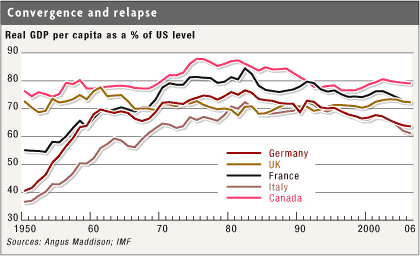
Graph of French Economic Decline Compared to UK and US


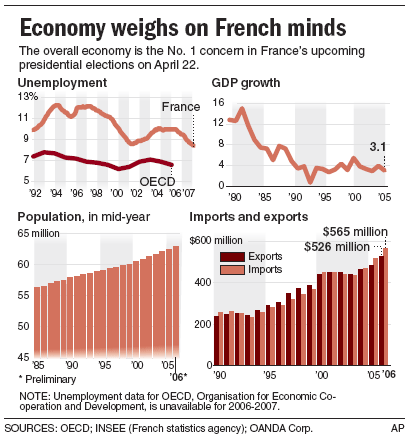
Unemployment. Furthermore, it is argued that the UK benefits from lower levels of unemployment compared to our European counterparts, especially France and Spain.
For example, in 2007, ILO unemployment in the UK is 5.4%, in France, 8% Source
Anecdotal evidence suggests upto 50% of young people are unemployed, contributing to the riots of 2005.

Source: French flee stagnant economy at MSNBC

Labour Market Inflexibilities. It is argued a weakness of the French economy is rigidities in the labour market. Critics (such as the Economist) regularly point to inflexibilities such as a maximum working week of 35 hours and the difficulty of hiring and firing workers. It is argued that these restrictions deter investment and productivity growth. Also trades unions in France are more powerful and arguably have created labour market unrest, preventing necessary reforms.

Problems of Being In Euro. Being in the Euro means that countries like France cannot devalue the exchange rate to boost exports. The rise of the Euro in recent months is making French exports relatively less competitive and this could weaken French growth. Also the common monetary policy means that interest rates may be unsuitable for the French economy. The UK has greater flexibility to cut rates if the economic situation requires it. Recently, the Pound has weakened against the Euro providing a boost to the exporting sector, helping to offset the fall in consumer spending.

However, it is argued that the French economy is not as sickly as it is made out to be.

Strengths of French Economy

  • Growth is picking up, although it is still struggling to reach 2% per year. Forecasts suggest growth will remain below trend for quite a few years to come.
  • Unemployment statistics suggest unemployment in France is higher, but labour market participation ratios of 87% are the same as in the US. This suggests that unemployment figures may be misleading and not as bad in France as some claim.
  • French labour laws provide security and protection for workers. In the UK and US it is argued there are more part time / temporary/ low paid jobs.
  • There is lower child poverty in France (see Le Monde article)
  • Le Monde makes a strong case for the French economy - see: english translation
The French and UK Housing Market.

Arguably, the UK's housing market has been a key factor in generating higher levels of consumer spending and economic growth. As house prices in the UK start to fall, it will have a powerful effect on reducing consumer spending and lowering levels of economic growth. Furthermore, it is argued UK house prices are overvalued and could fall by upto 25%. This means that the strong UK economic performance of the past few years may start to unravel as a slumping housing market causes lower growth.

In France, the housing market is less important to the economy. The ratio of homeownership is lower; it is about 50% rather than 77% in the UK. The French economy is not quite as unbalanced. The UK economy is susceptible to a fall in house prices and it could lead to a recession like the last time house prices fell in 1992. France will be less affected by the subprime crisis, even if French house prices are still overvalued by up to 20%

Overvalued housing markets in France and UK

References

Wednesday, April 16, 2008

Why Has A Higher Minimum Wage Increased Employment in the UK?

Readers Question: Why Does an Increase in the Minimum Wage not Cause Unemployment?

Classical Economic theory predicts that an increase in the Minimum wage should lead to unemployment. If the minimum wage(Wtu) is placed above the equilibrium We, demand for labour falls creating unemployment of Q2 - Q1

minwage

In a survey amongst economists by Dan Fuller (2003), he found 46% of Economists agreed with the statement that “minimum wages cause unemployment amongst unskilled workers” only 24% disagreed with this statement. [1]

However, the experience of the UK is that increasing the minimum wage has been compatible with falling unemployment and rising levels of employment.
  • The minimum wage was introduced in the UK in 1999 at £3.30.
  • As of October 2007 the minimum wage for adult workers is £5.52. (It will rise to £5.73 by end of 2008)
  • There is a development rate for workers 18-21 of £4.60
  • For people under 18 (not of compulsory school age) the rate is £3.40
  • Source: National Minimum wage HMRC - [2]
In 1999, UK unemployment was 1,822,000 between January and March.(ILO method)
by 2008, UK unemployment has fallen to 1.61 million or 5.25%. Employment rates have also increased to 74%. The claimant count method is even lower at only 793,000 UK Unemployment stats

The experience of the UK is that a 67% increase in the NMW has reduced unemployment and increased employment. The UK is not isolated, in the US, studies have also show a link between increasing the NMW wage and negligible effects on employment. E.g. David Card and Alan Krueger, in their 1997 book Myth and Measurement: The New Economics of the Minimum Wage

Reasons Why Higher Minimum Wage has Led to Increased Employment

1. Strong Economic Growth. In period of economic growth, firms employ more workers as there is more demand to produce goods. Economic growth in the UK has averaged 2.5% since 1999

2. Monoposony Power. Classical theory assumes labour markets are competitive, but, in practice workers often face employers with buying power. This means firms are able to pay workers less than the market wage. Therefore, when a government artificially raises wages, firms can actually afford to pay them. It is argued minimum wage legislation is similar to anti trust regulation. [see: Monopsony and Minimum wages]

3. Increased Productivity. A study by David Metcalf [3] found that firms responded to increased wages by increasing the productivity of workers, especially in the service sector. This is important because it suggests that higher wages can actually help increase productivity in the economy.

4. Lower hours. Rather than make workers redundant, firms have reduced the average hours worked. This is related to part 3, firms try to get higher productivity in a shorter time, so they can afford the minimum wage.

5. Pass on Cost increases. Because the minimum wage affects all firms, it is easier for the cost increases to be passed onto consumers. e.g. because all cleaning firms have higher wage costs, they can all increase their prices. If the wage increase just affected one firm, they would become uncompetitive. (note: the rise in prices has not led to significant inflation in the UK)

6. Avoidance of Minimum Wage. It is uncertain to ascertain the extent of this problem, but some firms have circumvented the minimum wage legislation by employing immigrant labour and paying them lower wages. It also makes it more attractive to employ young workers.

Related Essays

Wednesday, April 9, 2008

The Economics of Herding and Irrational Exuberance

Readers Question: Is there an economic term for the phenomenon of ignoring (or turning a blind eye to) future risk, assuming that the current situation will prevail? I refer to the situation we currently see of both borrowers and lenders who are being caught by interest rate rises, having seemingly assumed that interest rates would stay low.


An assumption of classical economics is that consumers and firms are rational. i.e. they take care to make the best choices given the information available.

In theory, people would seek to avoid situations where they buy overvalued assets. However, in the real world, we often have seen asset bubbles and behaviour which seems to be irrational. This is often termed irrational exuberance. It is studied in behavioural economics

Examples of Booms and Busts

Throughout history there have been many examples of speculative booms where investors jumped onto rising commodity prices, ignoring the economic fundamentals. Some examples of famous booms and busts include:
  • The price of tulips 17th Century immortalized by the book "Extraordinary Popular Delusions and the Madness of Crowds, "
  • The South Sea Company 1720
  • Florida Real Estate craze of 1926
  • The Wall Street boom of the 1920s and crash of 1929.
  • Dot Com bubble 2000-2002
  • House price boom in America 2001-2007
In all these cases, people ignore potential risk and get caught up in a wave of speculative buying. Assets tend to rise by much more than there underlying value. However, there comes a point when people realise the assets are overvalued and so start selling. This can cause an asset slump. The bubble can turn to a bust. After the bubble has burst, people start asking the question - why did so many people ignore the risk and get carried away?

Why People ignore Risk
  • The Madness of Crowds - This is the idea that the majority must be right. If other people are piling into a stock, it must be a good thing. Therefore, people feel safe because the so-called experts are recommending the stock. This is sometimes known as the herding effect.
  • New Paradigm. This applied particularly to the dot-com bubble in 2000-02. People were aware share prices were worth much more than earnings suggested they should be. However, the argument was that internet stocks were different to old stocks. The internet offered a chance for speculative growth, therefore, we shouldn't use old pricing formula.
  • People like the prospect of making a lot of Money. These asset bubbles generate stories of people making a lot of money. Maybe people think they can beat the market. i.e. they know there could be a crash, but, they believe they will be able to get out at the top.
Situation at the Moment.

In the post-2001 period, there was a period of easy and cheap credit. People felt that low-cost borrowing would continue for a long time. Therefore, many took out risky mortgages. Mortgage companies sold on their debt, thinking this acted as a kind of insurance. The problem was that the risk of lending was spread throughout the financial sector. People taking out mortgages felt secure because:
  • The mortgage companies who were very keen to lend.
  • Interest rates were very low (especially in the US)
  • Mortgage companies were keen to lend because they saw house prices rising (and felt they would always keep rising)
  • They sold on their loans in the form of CDOs to other finance companies.

However, the problem was that interest rates of 1.5% didn't last. They increased as consumer spending rose. Mortgage companies in the US were motivated to sell mortgages that were inappropriate.House prices didn't keep rising.

The effect was that mortgage defaults rose and house prices fell. This led to the credit crunch and shortage of funds causing interbank lending to become more difficult and expensive.

The problem here is that people were focused on a small aspect of the overall picture. There was certainly a strong sense of belief in rising house prices. Also, the last financial crisis led the Federal Reserve to aggressively cut rates to avoid problems.

However, it is of course, always easy to be wise after the event.

Related:

Friday, April 4, 2008

Hyperinflation - Causes, Costs and Examples

I recently wrote an article about Inflation in Zimbabwe, which has recently passed the 100,000% causing widespread hardship for the population.

Definition of Hyperinflation: A rapid and unchecked increase in the price level. Typically it may involve inflation rates of greater than 100% or greater than 1000% Hyperinflation is often reported per month, or even per day. Another distinguishing feature of hyperinflation is the idea that inflation is out of control. i.e. not only are prices rising rapidly, but the rate of increase is rising rapidly as well. With each cycle inflation gets worse.

Examples of Hyperinflation

— The most severe month of hyperinflation occurred in Hungary in July 1946 when prices increased by 4.19 quintillion per cent (4,190,000,000,000,000,000 %)

— In the same year the Hungarian National Bank issued a 10 quintillion pengo note (one followed by 19 zeros 10,000,000,000,000,000,000)

— During the hyperinflation episode in Germany from 1922 to 1923, the Weimar Republic printed postage stamps with a face value of one billion marks, as prices doubled every two days. At one point in 1923, the exchange rate equalled one trillion Marks to one dollar

— In Yugoslavia prices increased by 5 quadrillion per cent between October 1, 1993, and January 24, 1995

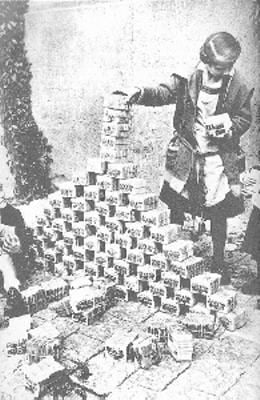
(German Kid playing with Bank Notes
(Other photos show people using bank notes to heat a stove)

What Causes Hyper Inflation

Usually, countries with hyper inflation have the following features

  • Large government debt, usually over 100% of GDP
  • Printing Money. To cope with meeting the debt, the government starts printing money. This decreases the value of existing money creating a multiplier effect where people lose confidence in money and keep demanding wage increases.
  • Reluctance / inability to deal with it. When Germany experienced hyperinflation in the 1920s it was not a phenomena they fully appreciated or understood. Their primary fear at the time was unemployment. They feared that unemployment could precipitate a Communist Revolution so they didn't want to do anything to reduce demand and possibly cause a recession.

Economic Costs of Hyper Inflation

1. Value of Savings falls. In a modern economy, interest rates are usually higher than the inflation rate. For example, if inflation is 5%. Interest rates may be 7%. Therefore, if you keep money in the bank or insurance fund, you maintain the real value of your money. However, when inflation becomes excessive, the rate of inflation is usually much higher than any potential interest rate. Therefore, people with savings see the real value of their wealth wiped out.

  • There is the story of people in Germany who began a saving scheme in 1903. For 20 years they put 10% of their wages into a pension scheme. When they cashed they pension scheme in 1923, it gave them enough money to buy a cup of coffee.

2. Menu Costs. These are the costs of dealing with rapidly rising inflation.

  • A consumer noted that the price of coffee was 5,000 Marks. He ordered one cup of coffee and when he finished drinking that coffee, he ordered another one. When the final bill came to 14,000 Marks he was told that the price of coffee and increased during the time he was drinking the first one.
  • When people got paid at 10am in the morning, they would have to spend it straight away, otherwise the wage would become worthless. There is the story that to pay teachers, the money had to be carried in a lorry. When the lorry came and distributed the wheelbarrows of money, the teachers gave it to relatives who would go off and buy goods straight away.
3. Lack of Confidence in the Finance Sector

The experience of inflation can become engraved on people's mind making them suspicious of financers, bankers and the general economic system. It is no coincidence the Nazi party were able to feed off these suspicions to introduce extremist policies.

4. Lack of Investment and Economic Growth

Ultimately hyperinflation causes people to have lower spending and firms lose confidence in investing. This can cause the economy to slow down and reduce living standards.

Tuesday, April 1, 2008

Why Economics Explains Almost Everything. - Book review.

Book Cover

The Economic Naturalist - Why Economics explains almost everything by Robert H. Frank

The Economic naturalist is another book in the genre of what might be called 'popular economics'. Although this formula of applied Economics has been used many times before, I feel this offers a useful addition to the growing genre of applied economics.

It is based on questions asked by first year students of Robert Frank's economic course.

The thing I like about the book is the quantity and diversity of questions and corresponding answers. There is little in the way of complex terminology, most answers rely on simple concepts such as opportunity cost and cost benefit principles. The answers are also quite short and to the point. On some occasions it leaves you thinking that there are many other possibilities as well. But, the important thing is that it generates a wealth of thought provoking ideas related to economics principles; the questions and answers would be just as interesting to non economists as economists.

Examples from the Economic Naturalist
  • Why Do Animal Rights activists Target fur-wearing women but leave leather clad bikers well alone?
Some answers suggested:
  1. The physical and evolutionary advantages of harassing old women versus burly bikers.
  2. The total number of animals it takes to make a fur coast versus a leather jacket. "Perhaps animal activists feel, in a finite world with limited time and resources, they should strategically target the activities that abuse the most animals."
  3. The cost benefit analysis of gaining converts to their cause as opposed to the cost of alienating people.
Some of the questions themselves are intriguing:
  1. If attractive people are more intelligent than others, and if blondes are considered more attractive, why are there so many jokes about dumb blondes?
  2. Why is there so much mathematical formulism in Economics? - Similar principle to raising your voice at a party. With stiff competition for jobs, positions in economic departments were often awarded to the most impressive use of mathematics. Thus, the bar was always been raised. To get noticed it is necessary to use more and complex mathematical equations. Thus the mathematics becomes a signal for an economist's competence rather than being intrinsically helpful to solve the problem in question (I'm sure many economists would dispute this)
  3. Why Does the Practise of Splitting the Bill cause people to spend more at Restaurants? - When the bill is split the marginal cost to you of buying an extra garlic bread is very low. When the bill is split between 10 people, you only pay 10% of the cost. Therefore a £2 side order only costs an extra 20p; therefore, it seems cheap. If you pay for your meal directly you have to face the full £2 charge.
  • Of course, it depends on the person; some people will be very sensitive to putting additional costs onto their friends. If the bill is to be split there is a significant social 'faux pas' of spending on the most expensive items. This is an example of one idea that can vary depending on who is involved with the meal.
You May also be interested in: